

Aditya Birla Capital: A Financial Conglomerate Finding Its Stride

There are financial companies that grow by adding businesses, and there are those that grow by making each business earn its keep. Aditya Birla Capital (ABCL) has spent the better part of the last five years doing both, assembling a broad financial services platform and gradually forcing the constituent parts to operate more efficiently. The results are beginning to show up in the numbers, though the picture requires some reading between the lines.
What the Company Actually Is
ABCL is the listed financial services arm of Grasim Industries, itself part of the Aditya Birla Group. It sits at the top of a structure that includes an NBFC (Aditya Birla Finance), a housing finance company (ABHFL), an asset management business (ABSL AMC), a life insurer (ABSLI), and a standalone health insurer (ABHI). There is also a broking arm and a stressed asset platform, though these are smaller contributors.
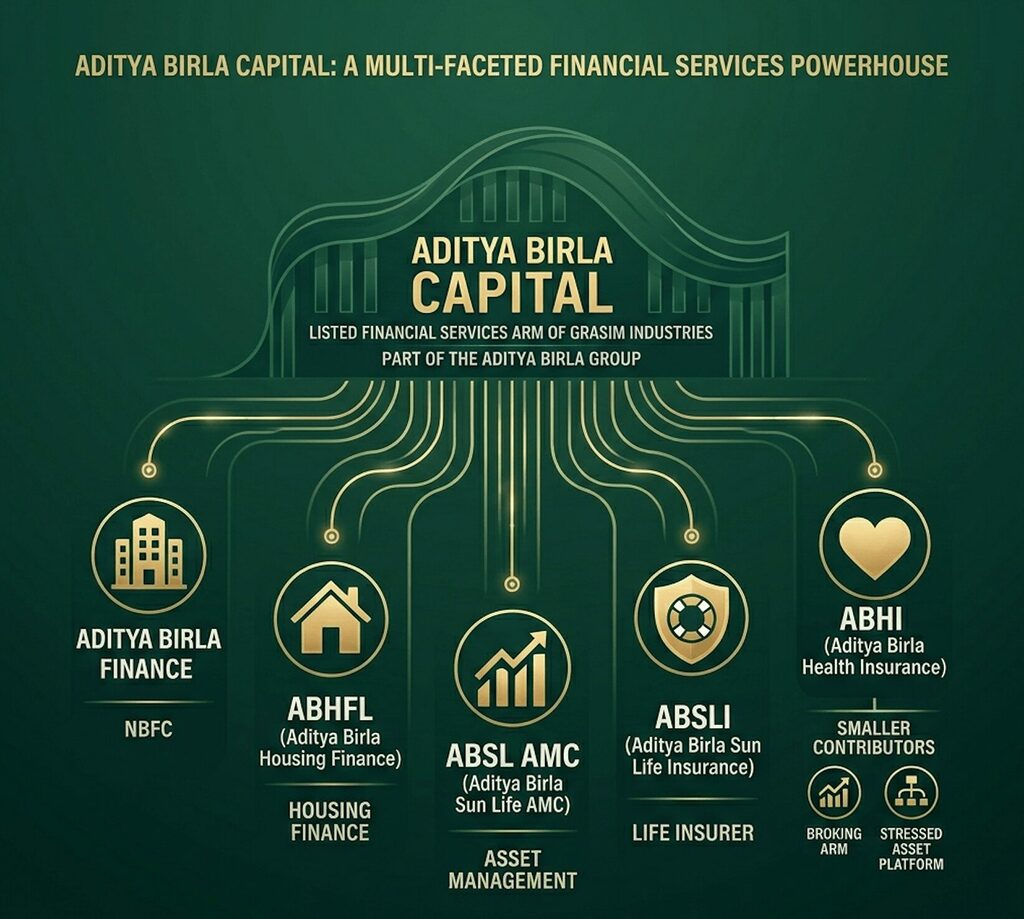
The breadth is intentional. The company’s “One ABC” strategy is built around cross-selling across a customer base of over 93 lakh, using proprietary platforms such as ABCD for direct-to-consumer, Udyog Plus for MSMEs, and Stellar for channel partners, to extract more wallet share from existing relationships. With over 1,742 branches and a digital infrastructure that now processes 100% of new life insurance business end-to-end, the distribution architecture has scale.
The Five-Year Financial Arc
Revenue compounded at roughly 16% annually between FY21 and FY25, from ₹19,088 crore to ₹40,184 crore. Operating income grew faster, at a 28% CAGR over the same period, from ₹5,007 crore to ₹13,580 crore. This is the cleaner signal. Operating margin expanded from 26% to nearly 34%, almost uninterrupted. That is the trend line that matters most: the core business is generating more operating profit per rupee of revenue as it scales.
Net income tells a more complicated story. FY23 shows a spike to ₹4,796 crore that can mislead if taken at face value. Non-operating income that year was ₹3,020 crore, against ₹867 crore in FY24, driven by elevated investment income and exceptional items rather than any step-change in operating performance. Strip those out, and the underlying trajectory is more modest but genuine: from ₹1,127 crore in FY21 to ₹3,332 crore in FY25.
Net margin has compressed from a peak of 17.6% in FY23 to 8.4% in FY25. The weight of interest costs, health insurance losses, and the absence of repeat one-off gains explains most of this. Return on equity followed a similar arc, rising to a peak of 26.8% in FY23 before settling at 11.6% in FY25. The industry median sits at 13.4%. The gap is almost entirely a function of health insurance drag and the cost of building out ABHFL and the life insurance franchise while they scale.
The standalone NBFC, by contrast, is generating 15.2% RoE as of Q3 FY26, a useful reference point for where intrinsic earnings power sits before consolidation effects pull the headline number down.
The Lending Engine
The NBFC remains the largest contributor, and Q3 FY26 showed it operating closer to its potential. AUM grew 24% year-on-year, led by unsecured business, personal, and consumer loans. The combined stress pool (Stage 2 and Stage 3) declined to 2.8%, an improvement of 150 basis points year-on-year, after a period during which management had deliberately pulled back from riskier segments to recalibrate underwriting. Return on assets came in at 2.25%, with management guiding toward 2.5% over the next four to five quarters.
Housing finance is the segment that has attracted external capital attention. ABHFL’s loan book has expanded at a 48% CAGR over three years, and in Q3 FY26 reported 58% AUM growth year-on-year alongside an RoA of 1.96%. In early 2025, Advent International invested ₹2,750 crore for a 14.3% stake. This serves as external validation of the franchise and, practically, a capital buffer that the company says provides growth headroom for the next two to two-and-a-half years. The cost-to-income ratio moderated to 45.4%, a sign that operating leverage is beginning to materialise in the newer business.
Insurance: One Segment Earning, One Still Building
Life insurance (ABSLI) reported individual Annual Premium Equivalent growth of 19% year-on-year in Q3 FY26, and the Value of New Business margin expanded to 19.4%. The product mix has shifted toward traditional savings and protection products, which now account for approximately 70% of the business. That shift matters for margin quality, as protection and participating products carry better long-term economics than ULIPs alone.
Health insurance (ABHI) is a different conversation. The business is growing fast. Gross Written Premium rose 55% year-on-year in Q3 FY26 and 39% for the nine months ending December 2025. Its market share among standalone health insurers has reached 14.2%. However, it continues to drag consolidated profitability. The combined ratio stood at approximately 111%, which means it is still paying out more in claims and expenses than it collects in premiums. The “Health First” model, which incentivises customers to maintain healthy behaviours and targets chronic condition management, is showing early unit economics improvement. Customers who participate in the model are exhibiting an 8% better loss ratio. The direction is right, but the segment is not yet at a self-sustaining profit level.
Asset Management: Steady but Not Spectacular
ABSL AMC is the most mature of the subsidiaries, and it shows in the results. Performance is solid rather than striking. Average AUM grew 20% year-on-year, PAT grew 14% quarter-on-quarter in Q3 FY26, and the distributor network now exceeds 93,000 mutual fund distributors. Revenue from operations grew 3.6% quarter-on-quarter, though core EBITDA growth was more modest at 1.5% as operating costs rose. The business is benefiting from steady SIP inflows and expanding retail participation in equity markets, and is building out its alternatives and passive products capabilities, including institutional mandates from ESIC and EPFO.
The Digital Layer
ABCL has operationalised over 22 live generative AI use cases across underwriting, sales, and service functions. The intent is productivity improvement and tighter risk management rather than headline innovation. The three proprietary platforms, ABCD, Udyog Plus, and Stellar, give the company owned channels that reduce dependence on third-party distribution and improve data capture across the customer lifecycle. Whether that translates into measurably lower customer acquisition costs and higher cross-sell rates over time is something the disclosure will need to surface more clearly.
What the Consolidated Picture Shows
ABCL reported a 41% year-on-year rise in consolidated PAT to ₹983 crore in Q3 FY26, on a 30% increase in revenue. The number looks strong but should be read in context. The base period included a more subdued NBFC and a health insurance segment absorbing heavier losses. The cleaner trend to watch is the NBFC’s RoA progression toward 2.5%, the housing finance segment’s ability to sustain growth as the Advent capital is deployed, and whether ABHI’s combined ratio moves meaningfully below 110% over the next few quarters.
The operating leverage story, a 34% operating margin in FY25 against 26% in FY21, is the most durable signal in the five-year data. It suggests that as health insurance losses narrow and the newer lending franchises season, the gap between operating profitability and reported net income should compress. That compression is what the market is likely pricing for.
We will keep tracking developments at Aditya Birla Capital as the lending, insurance, and asset management businesses evolve through FY26 and beyond.
Disclaimer: Investment in securities market are subject to market risks. Read all the related documents carefully before investing. Registration granted by SEBI, membership of a SEBI recognized supervisory body (if any) and certification from NISM in no way guarantee performance of the intermediary or provide any assurance of returns to investors.
The content in these posts/articles is for informational and educational purposes only and should not be construed as professional financial advice and nor to be construed as an offer to buy /sell or the solicitation of an offer to buy/sell any security or financial products.Users must make their own investment decisions based on their specific investment objective and financial position and using such independent advisors as they believe necessary.
Windmill Capital Team: Windmill Capital Private Limited is a SEBI registered research analyst (Regn. No. INH200007645) based in Bengaluru at No 51 Le Parc Richmonde, Richmond Road, Shanthala Nagar, Bangalore, Karnataka – 560025 creating Thematic & Quantamental curated stock/ETF portfolios. Data analysis is the heart and soul behind our portfolio construction & with 50+ offerings, we have something for everyone. CIN of the company is U74999KA2020PTC132398. For more information and disclosures, visit our disclosures page here.


You may want to read
 Logic Behind Our Rebalance Decisions – Mar 2024 Edition
 Strategic Analysis: The Persistent-Nagarro $2.9 Billion AI Consolidation
 HDFC Bank’s Governance Ripple: Understanding the Resignation, the Reaction, and the Path Forward