

From Labor to Capital: Investing in the Age of AI and Automation

Picture yourself in a supermarket where everything runs on its own. Robots restock the shelves, AI keeps track of inventory, and supply chains work smoothly without people. This store can make and sell products much more cheaply than before.
Now, think about what happens outside. The streets are empty because robots and AI have taken over jobs like driving, cashier work, logistics, software development, and office tasks.
This leads to a big question about full automation. If machines handle all the work and people lose their jobs, how will anyone have money to buy what these machines make?
If people earn less from work, they spend less, which hurts company profits. Even those who own the machines could face problems if not enough people can buy their products. To keep the economy running, value may need to move from paying people for their time to letting more people own a share of the machines.
The Core Idea
AI and robotics could shift the economy from earning through labour to earning through ownership. As automation makes capital – especially chips, power, grids, data centres and robotics – increasingly important, the economic surplus may increasingly flow to owners of these productive assets. Let us breakdown this shift and how specialised smallcases provide targeted exposure to different layers of the AI and automation stack.
The Production Equation: How AI Transforms the Economic Function
To see how value changes during technological revolutions, consider the classic Production Equation:
Q = f (L,K)
- Q (Total Output): This is the total amount of goods, services, or intelligence produced.
- L (Labor Input): This stands for human effort, work hours, or the number of people involved.
- K (Capital Input): This includes machinery, computers, energy, tools, and automated systems.
- f (Technology / Process Efficiency): This refers to how labor and capital are combined.
Why Historical Revolutions Didn’t Eliminate Labor
In the past, technology created new jobs and industries more quickly than it got rid of old ones. For example, when tractors reduced farm jobs, many workers found work in other areas:
Agriculture -> Factories -> Offices -> Retail -> Healthcare -> Tech & Services
Earlier advances in technology changed the kinds of work people did, but total output (Q) still depended a lot on human labor (L).
The Structural Break in the Equation
What sets advanced AI and general-purpose robotics apart is that, for the first time, technology is replacing human abilities in both thinking and physical tasks at the same time.
Traditional Production: Q=f(L,K)
Automated Production: Q=f(K)
Although the idea of a world with no human jobs has not been proven, it is clear that human labor is becoming less important compared to output. As technology takes over more costs, capital is gaining a larger share of the economic benefits.
From Wages to Ownership: The Shift to an Ownership Economy
In a labor-focused economy, people earn money by working and use their wages to pay for what they need. When the economy becomes more automated, wealth comes less from wages and more from owning things like machines or investments.
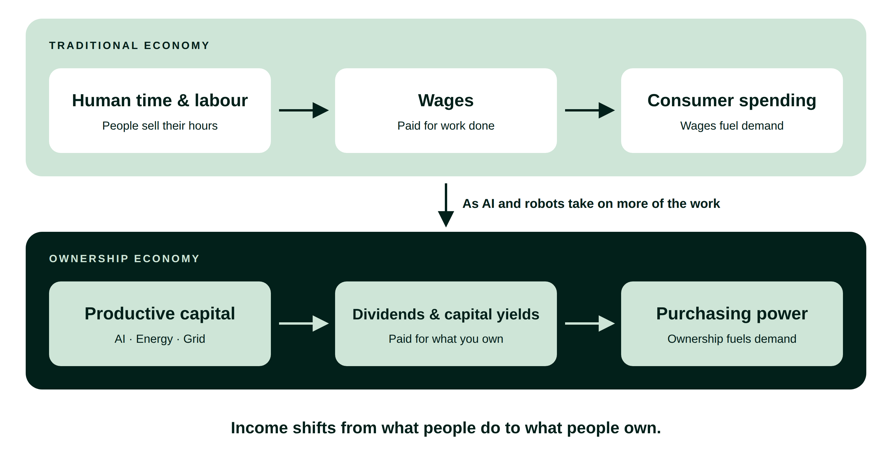
As companies spend less on workers and keep more profits, people who own machines, energy sources, or infrastructure gain more earning power.
The AI–Robotics Economic Stack
Economic surplus flows through a 6-tier pyramid:
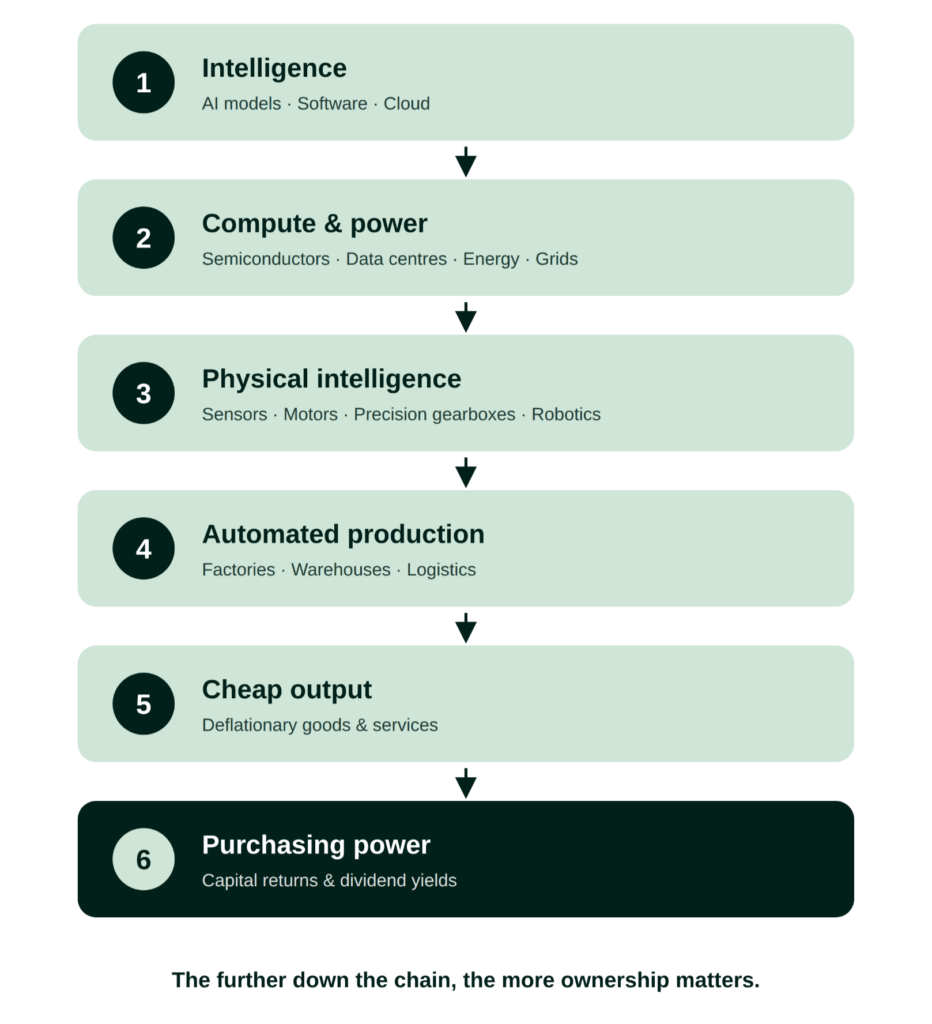
At first, most capital spending goes into Tier 1, which covers software and intelligence. Over time, though, software and intelligence become more common, so long-term capital returns shift toward scarce physical resources like semiconductors, raw electricity, electrical grids, data center space, and automated manufacturing.
How Specialized smallcases Offer Targeted Exposure
Investors looking to benefit from margin expansion as technology replaces labor can use a Capital Capture Framework. This approach centers on owning parts of the physical supply chain, such as hardware, energy, grids, and automated assets, which capture economic surplus as operating costs turn into capital returns.
Specialised smallcases help investors focus on different parts of the market stack. This approach avoids the risks of picking individual stocks or guessing which end-user apps will succeed.
| Smallcase Name | What the Smallcase Does | Stack Layer Covered | Economic Surplus Capture Mechanism |
| AI & Data Center Value Chain Theme | Invest in Indian-listed companies that build the physical infrastructure needed for AI computing. This includes data centre developers and operators, power and electrical systems, cooling and thermal management, and specialised compute hardware and racks. | Tier 2: Compute & Power | Benefit from India’s data centre expansion by owning the businesses that receive this spending. A growing share of it now goes to the equipment inside the building rather than the building itself. Electrical systems such as UPS, switchgear and busways, for example, make up 22–25% of facility budgets, up from 12%. |
| Global AI – Power & Data Centre Layer | Invest in select ETFs that focus on global companies supplying electricity to AI and supporting its computing needs. These include power generators and utilities, nuclear energy providers such as uranium miners and plant operators, grid and transmission equipment makers, and companies that own and run data centres. | Tier 2: Compute & Power | As demand for power from AI grows, it is quickly becoming the main factor limiting how fast data centres can be built. When electricity is in short supply, companies that can provide it reliably are in a better position. This group includes generators that can secure long-term contracts, grid equipment makers with strong order books, and data centre owners who rent out capacity that takes years to develop. |
| Global AI – Chip & Hardware Layer | Invest in the global supply chain behind AI hardware by choosing certain ETFs. These funds include companies that design chips, run foundries, make chipmaking equipment, produce high-bandwidth memory, and mine copper and rare earths. | Tier 2: Compute & Power | AI infrastructure spending often goes to a small group of suppliers. Only a few foundries make the most advanced chips, using machines built by just a handful of companies. High-bandwidth memory also comes from a limited number of producers. Because there are so few suppliers, these businesses are well positioned no matter which AI product becomes most popular. |
| Global AI – Frontier Models Layer | Invest in select ETFs that focus on companies developing advanced AI models in the US and China. In the US, these are major tech firms that either create their own models or support AI labs. In China, the top companies operate in a separate ecosystem with their own models, cloud services, and chips. | Tier 1: Intelligence | Benefit from AI by investing in companies that are most likely to profit from it. Since building advanced AI models costs billions of dollars, only a few companies can compete. These companies already own the cloud platforms, apps, and customer networks that connect AI to users, so they can make money from AI through their existing businesses, even as model costs go down. |
The Bottom Line
The shift to automation is more than just a technical change. It marks a move from selling human labor to owning productive assets.
When investors focus their strategies on the physical parts of the AI stack, such as energy, power grids, semiconductors, and specialized data centers, they can benefit from the economic gains that come as capital takes the place of labor worldwide.
Disclaimer: Investment in securities market are subject to market risks. Read all the related documents carefully before investing. Registration granted by SEBI, membership of a SEBI recognized supervisory body (if any) and certification from NISM in no way guarantee performance of the intermediary or provide any assurance of returns to investors.
The content in these posts/articles is for informational and educational purposes only and should not be construed as professional financial advice and nor to be construed as an offer to buy /sell or the solicitation of an offer to buy/sell any security or financial products.Users must make their own investment decisions based on their specific investment objective and financial position and using such independent advisors as they believe necessary.
Windmill Capital Team: Windmill Capital Private Limited is a SEBI registered research analyst (Regn. No. INH200007645) based in Bengaluru at No 51 Le Parc Richmonde, Richmond Road, Shanthala Nagar, Bangalore, Karnataka – 560025 creating Thematic & Quantamental curated stock/ETF portfolios. Data analysis is the heart and soul behind our portfolio construction & with 50+ offerings, we have something for everyone. CIN of the company is U74999KA2020PTC132398. For more information and disclosures, visit our disclosures page here.


You may want to read
 Do you fancy timing the markets?
 US Tariffs Rattle Global Markets, Strain Economies
 Why We Created the AI & Data Center Value Chain Portfolio