Anthropic Is Going Public. Here’s What’s Behind the $2 Trillion Price Tag

Anthropic, the company that created the Claude AI models, plans to offer its shares to the public for the first time. The company hopes to list on the Nasdaq stock exchange in mid-November 2026. If this happens, it might become the largest IPO ever.
This deal values a young company very highly. Anthropic started in 2021, increased its revenue about 12 times in 2025, but still lost billions of dollars that year. Here is a straightforward look at the size of the IPO, how Anthropic earns money, what it spends on, and the risks investors are considering.
Most of the numbers in this article come from a draft of Anthropic’s IPO prospectus. This document gives detailed information that a company must share before selling its shares. In the US, it is part of an S-1 filing with the SEC, the market regulator. This is similar to the DRHP that Indian companies file with SEBI before an IPO. Anthropic filed its draft privately, and Reuters, IFR, and other news outlets reported on copies they reviewed in late September and early October 2026. The final version could be different.
TL;DR
Anthropic is reportedly targeting a $1.8–$2 trillion valuation for a potential November 2026 IPO, despite billions in losses. Revenue grew nearly 12 times to $4.6 billion in 2025, but the company faces huge computing costs, $518 billion in supplier commitments, and dependence on a handful of customers and Big Tech partners. The key question for investors is whether its rapid growth can justify the valuation and long-term financial risks.
How big is the IPO?
Anthropic is aiming to raise up to $100 billion, with a valuation between $1.8 trillion and $2 trillion. If successful, this would be the biggest stock market listing ever.
The timing isn’t set yet. Investor marketing could begin as soon as the week of November 9, with trading planned before the US Thanksgiving holiday on November 26. Bankers waited until after the US mid-term elections, and the company wanted to share its third-quarter results with investors first.
One simple way to judge the price is to compare it with sales. The draft prospectus shows about $20 billion of cash and short-term investments at the end of 2025. Take that away from a $2 trillion valuation, and investors would be paying about 49.5 times the roughly $40 billion of revenue expected in 2026. At $1.8 trillion, the figure is about 44.5 times. Reuters Breakingviews put it at about 47 times, using a separate estimate of about $120 billion of net cash reported by The Information. For comparison, SpaceX, which listed in June 2026, is valued at about 42 times its expected 2026 sales.
Anthropic is also arranging other funding. It’s negotiating a $15 billion revolving credit facility with banks, a pre-approved line of credit it can draw on and repay as needed. The company may also raise money by selling bonds after it goes public.
The backdroThe environment is uncertain. OpenAI, a competitor, has said it won’t go public until 2027 and is reportedly raising $30 billion privately instead. Meanwhile, smart-ring maker Oura recently cancelled its planned Nasdaq IPO after investors objected to its price.
How Anthropic makes money
Anthropic makes money by selling access to Claude. Most customers are charged based on how much they use, rather than paying a fixed monthly fee. There are four main ways to buy Claude:
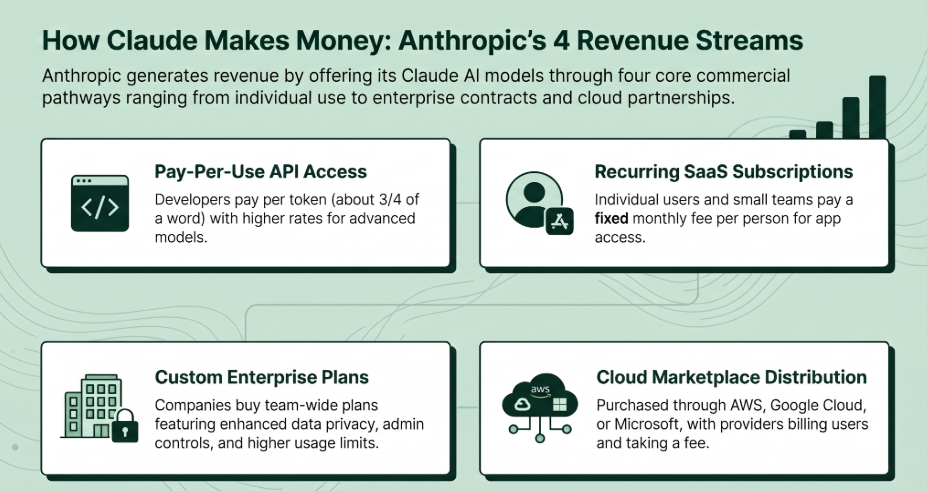
In Anthropic’s financial reports, revenue is divided by payment method. In 2025, the company earned $4.6 billion, with about $3.8 billion (83%) from pay-per-use and $789 million (17%) from subscriptions. The previous year, pay-per-use made up 75% of revenue.
Anthropic expects pay-per-use to stay as its main source of revenue. This helps sales grow quickly, but these customers are not tied to long-term contracts. They can reduce usage if budgets get tight or a cheaper model becomes available.
By region, the US accounted for almost two-thirds of Anthropic’s 2025 revenue, while the rest of the world made up about one-third.
The risk of relying on a few big customers
In 2025, about a quarter of Anthropic’s revenue came from two customers, each making up 12%. The prospectus does not name them, but bankers believe they are probably Cursor and GitHub. Both are AI coding tools, and GitHub is owned by Microsoft.
This is how it works: when a developer uses Cursor or GitHub’s coding assistant and asks for help, the tool sends the request to Claude. Anthropic bills the tool, not the developer, for each token used.
Coding uses many more tokens than a regular chat. These tools send large chunks of code with each request and often go through several rounds of automatic code writing, testing, and fixing.
This leads to two main risks:
- A major risk if one leaves: If either platform switches to another AI model or creates its own, Anthropic could lose up to 12% of its revenue, based on 2025 numbers.
- The developer might not notice: The coding tool manages the relationship with the developer and can change the AI model behind its product without the developer needing to do anything.
Anthropic also notes that many of its biggest customers do not have long-term contracts and could reduce or stop spending. Its own coding product, Claude Code, lets Anthropic reach developers directly instead of relying on these platforms.
Claude Code lets developers write, test, and fix code with Claude in their own projects. Developers pay Anthropic directly, either through a subscription or on a pay-per-use basis, without another platform involved. Reuters Breakingviews says it started the “vibe coding” trend, where people describe what they want and let AI write the code, and points out that the 2025 numbers do not reflect much of this growth yet.
This benefits Anthropic in three ways:
- Anthropic owns the customer: Developers work directly with Anthropic, so no platform can quietly move them to a different AI model.
- No middleman involved: Anthropic earns directly from developers and does not have to rely on another company’s pricing or product choices.
- Less dependence on two accounts: Each developer who uses Claude Code directly makes Anthropic less reliant on Cursor and GitHub.
There is a catch: Claude Code competes with Cursor and GitHub, which are also two of Anthropic’s biggest customers. The reports do not mention how much revenue Claude Code currently generates.
Margins and losses
Anthropic now makes money on each sale, but it still lost about $8 billion running the business in 2025, and $42 billion in total. Here is how the key numbers compare across 2024 and 2025:
| Measure | What it means | 2024 | 2025 | What changed |
| Revenue | Money earned from customers | About $386 million | About $4.6 billion | Up nearly 12 times |
| Gross margin | Share of each sale left after the direct cost of serving customers, mostly computing power | -95% | About 40% | In 2024, each $1 of sales cost almost $2 to serve. In 2025, about 40 cents of each dollar was left over. |
| Computing spend per $1 of revenue | Total computing spend, for both training and serving customers, divided by revenue | $6.53 | $1.60 | In 2025, Anthropic spent $7.33 billion on computing against $4.59 billion of revenue. Sales grew much faster than the computing bill. Much of this spend is likely training, which is counted outside gross margin; the reports don’t give the split. |
| Operating loss | Loss after all running costs, including research, training new models, staff and sales | About $2.98 billion | About $8.06 billion | Nearly tripled. But the loss per $1 of revenue fell from about $7.72 in 2024 to about $1.76 in 2025. |
| Net loss | Loss after everything, including financing costs | Not reported | About $42 billion | About $34 billion of this is a paper charge linked to convertible notes, not cash spent (explained below). |
Most of the net loss is due to accounting rules. Around $34 billion of the $42 billion is tied to convertible notes that Anthropic sold to companies like Amazon and Alphabet. A convertible note is a loan that can later be exchanged for shares at a set price. As Anthropic’s value increased, the debt used to swap these notes became more valuable, so the company was required to record it as a cost. This is just an accounting cost, not $34 billion in cash leaving the company.
This accounting charge is still important for new investors. Amazon has already bought $8 billion of these notes, plans to buy $15 billion more, and has about $92 billion in paper gains from them. If these notes are converted into shares, the total number of shares will increase. That means each existing share would represent a smaller part of the company, which is known as dilution.
Where the money goes
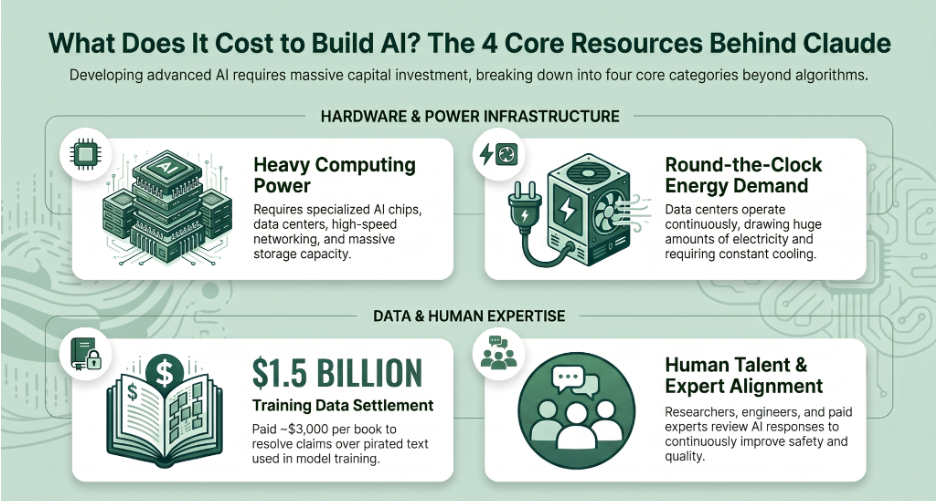
Anthropic’s largest expense is computing power. In 2025, the company spent more than $7 billion on computing infrastructure. Here are the main costs for an AI company like Anthropic:
Bills it has already signed up for
Anthropic has agreed to supplier contracts totalling at least $518 billion over the next ten years. About 80% of this amount must be paid even if the company does not use all the services. It’s similar to a long office lease, where rent is due every month, even if some rooms are unused.
Anthropic’s contracts are with six suppliers: Alphabet (Google’s parent), Amazon, Microsoft, Broadcom, SpaceX, and AMD. These agreements cover the chips, data centres, and power the company says it needs. The deals with Alphabet and Amazon are each worth $100 billion. The SpaceX contract is more flexible, but according to Reuters Breakingviews, this flexibility was expensive.
Anthropic’s commitments increased rapidly as the company sought to secure sufficient capacity before any potential shortages.
- By the end of 2025, Anthropic had $54.6 billion in non-cancellable commitments.
- By early 2026, total commitments exceeded $417 billion, covering 3.5 gigawatts of dedicated computing capacity.
- According to the draft prospectus, the total is at least $518 billion.
The scale is unusual. If 80% of $518 billion cannot be cancelled, that is roughly $414 billion of fixed bills. When SpaceX listed in June 2026, it disclosed $25.5 billion of such commitments.
This matters because if demand continues to grow, Anthropic will use the capacity it has paid for. But if demand slows, the company still has to pay for most of it, which could increase losses. Analysts say Anthropic’s revenue would need to grow several times the expected 2026 level to break even after accounting for operating and financing costs.
In the short term, Anthropic expects to pay these bills using funds from the IPO, a $15 billion credit facility, and possible bond sales.
Partners, suppliers and rivals at the same time
Amazon and Google are Anthropic’s investors, lenders, suppliers, sales channels and customers, and they also build rival AI models. Anthropic’s other big partners play more than one role too:
| Partner | What it does for Anthropic | Where it competes |
| Amazon | Investor; holds convertible notes; sells its computing power ($100 billion deal); sells Claude through Amazon Web Services; also a customer | Builds its own AI models |
| Google (Alphabet) | Investor; holds convertible notes; sells it computing power ($100 billion deal); sells Claude through Google Cloud; also a customer | Builds its own AI models |
| Microsoft | Sells it computing power (deal signed November 2025); sells Claude through its cloud; owns GitHub, likely one of the two biggest customers | Major backer of rival OpenAI |
| SpaceX | Supplies computing infrastructure | Owns xAI, a rival AI company |
| Broadcom and AMD | Supply chips and infrastructure | – |
Money circulates between these companies. Amazon and Google invest in Anthropic, which then spends heavily on computing power. Anthropic also sells Claude to the cloud customers of these partners and keeps a portion of the sales.
This sales channel has grown quickly. In 2023, sales through Amazon and Google accounted for 11% of Anthropic’s revenue, rising to 32% in 2024 and 47% in 2025, totalling about $2.16 billion. According to Reuters, Anthropic paid about $351 million in fees to these partners, or about 16 cents per dollar sold through them.
The partners also handle a large share of Anthropic’s cash collections. By the end of 2025, they were responsible for collecting 60% of the $909 million that customers owed Anthropic, up from 42% the previous year. Anthropic cautions that any disputes or delays could impact its cash flow.
Anthropic says this arrangement gives it a reach that would be hard for one company to achieve alone. However, it also acknowledges that this setup creates conflicts of interest. Cloud partners can see Anthropic’s pricing and deal terms, which may influence how much computing power they provide or how actively they promote Claude. They could also decide to promote their own AI models instead.
There is also some debate about how this revenue should be counted. Anthropic records the total amount customers pay through these marketplaces as revenue and lists the platforms’ fees as a cost. OpenAI argues that this approach makes Anthropic’s revenue appear larger than it actually is. If only the amount Anthropic keeps is counted, 2025 revenue would be about $4.25 billion instead of $4.6 billion. Anthropic maintains that it follows established accounting rules.
Weighing it up
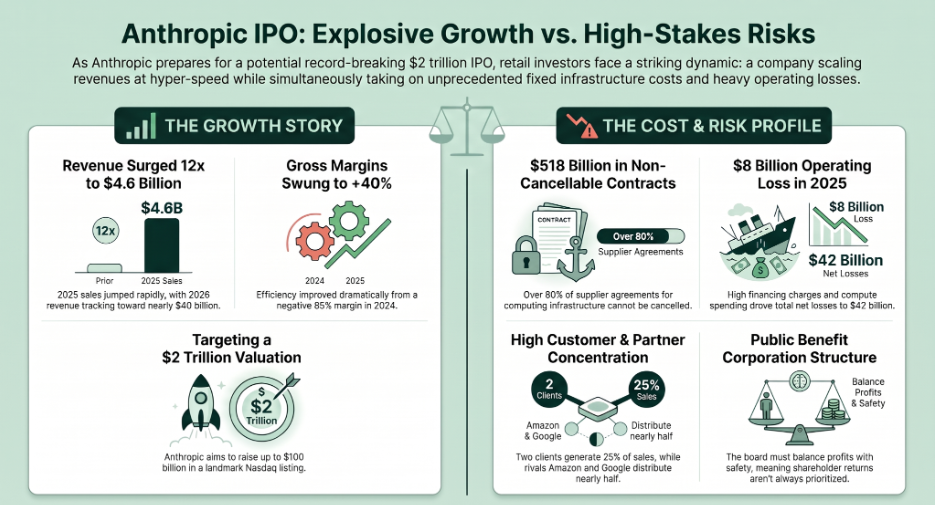
Anthropic’s IPO challenges investors to consider its rapid growth alongside the significant losses and costs it has already taken on.
The company’s growth stands out. Revenue jumped about 12 times to $4.6 billion in 2025. In the first half of 2026, revenue reached $16 billion, and Reuters Breakingviews estimates the full year could be just under $40 billion if sales stay steady. Gross margin improved from-95% to about 40%, and the cost of computing per dollar of sales has dropped significantly.
On the other side, the costs and risks are just as large. Anthropic lost about $8 billion on operations and $42 billion in total in 2025. It has at least $518 billion of supplier contracts, most of which cannot be cancelled. Two customers made up a quarter of revenue, and nearly half of sales went through partners that are also rivals. An outside data firm, TickerTrends, estimates that Anthropic’s recurring revenue has recently stopped growing, though this is not company data.
There are two more things shareholders should know. Anthropic is a public benefit corporation, which means its board must balance profit with its mission and may not always put shareholders first. The company also faced action from the US government earlier in 2026, including a federal order to stop using its models, but government contracts make up less than 1% of its revenue.
Opinions among market watchers differ. Morningstar’s chief equity strategist said the losses are a concern but probably won’t stop investors, since big spending on AI is common. A partner at Steward Partners, a wealth manager, said it’s hard to justify a value above $2 trillion for companies that lose billions.
Before the listing, investors should watch for the final prospectus, third-quarter results, the final share price and date, and the number of new shares that could be issued from convertible notes. These will help show if growth can keep up with the costs.
Sources
- IFR (Gareth Gore), “Anthropic reveals huge supplier liabilities just weeks ahead of potential IPO”, 1 October 2026
- Reuters (Echo Wang and Milana Vinn), “Anthropic warns government attitudes may hurt customer ties, IPO prospectus shows”, 2 October 2026
- Reuters Breakingviews (Karen Kwok), “Anthropic’s $2 tn goal is AI’s biggest moonshot”, 29 September 2026
- Reuters (Echo Wang and Krystal Hu), “Anthropic IPO prospectus lays bare deep dependence on Big Tech partners”, 29 September 2026
- Reuters (Tom Hals), “What is a public benefit corporation, the Anthropic legal structure?”, 29 September 2026
- Tekedia Capital via Public Technologies, citing Bloomberg, “Anthropic Eyes Mid-November IPO in Potential $2 Trillion AI Market Debut”, 2 October 2026
- Associated Press, coverage of the Bartz v. Anthropic authors’ settlement, September 2025
Figures are from news reports on a draft IPO prospectus, published between 29 September and 3 October 2026; the final prospectus may differ.
Disclaimer: Investment in securities market are subject to market risks. Read all the related documents carefully before investing. Registration granted by SEBI, membership of a SEBI recognized supervisory body (if any) and certification from NISM in no way guarantee performance of the intermediary or provide any assurance of returns to investors.
The content in these posts/articles is for informational and educational purposes only and should not be construed as professional financial advice and nor to be construed as an offer to buy /sell or the solicitation of an offer to buy/sell any security or financial products.Users must make their own investment decisions based on their specific investment objective and financial position and using such independent advisors as they believe necessary.
Windmill Capital Team: Windmill Capital Private Limited is a SEBI registered research analyst (Regn. No. INH200007645) based in Bengaluru at No 51 Le Parc Richmonde, Richmond Road, Shanthala Nagar, Bangalore, Karnataka – 560025 creating Thematic & Quantamental curated stock/ETF portfolios. Data analysis is the heart and soul behind our portfolio construction & with 50+ offerings, we have something for everyone. CIN of the company is U74999KA2020PTC132398. For more information and disclosures, visit our disclosures page here.


You may want to read
 US Tariffs Rattle Global Markets, Strain Economies
 Inside HNI Prime Growth at a Fair Price Asset Allocation smallcase
 Building a Robust Small-Cap Portfolio with 3 Factors