

Beyond the Platform: What India’s Defense Boom Is Actually Built On?

Ask most people what India’s defense build-out looks like and they’ll picture a factory — tanks rolling off a line, ships going up on a slipway, an assembly hall full of components stamped “Made in India.” That picture isn’t wrong, but it’s a decade out of date. The conversation inside the industry has moved on. At a recent Defense Conference, held in June’ 2026, which brought together company leadership, former defense-industry executives and sector experts, the recurring theme wasn’t capacity. It was ownership — of the intellectual property, the software, and the handful of critical sub-components that actually decide who wins a modern defense contract.
A note on the numbers that follow: most of what’s below — market sizes, procurement forecasts, timelines — comes from what management teams, industry veterans and sector specialists said on stage or in meetings at this conference. These are their estimates and projections, not independently verified market data, and they’re presented here as such.
From assembler to owner
For most of India’s post-independence history, defense manufacturing meant licensed production: buy the design, build it under supervision, hand back the margin on IP to whoever sold it to you. That model is being dismantled in real time. Company after company now describes itself not as a manufacturer but as a “design-led systems integrator” — the difference being that a manufacturer executes someone else’s blueprint, while a systems integrator owns the blueprint and decides what gets upgraded, when, and how.
The figure that anchors this shift is procurement policy: 75% of India’s defense capital procurement budget is reserved for domestic sourcing. But the more interesting shift is where, within that 75%, the money is moving. India has made considerably more progress on platform-level localisation — the tank hull, the ship frame, the basic airframe — than it has on the critical subsystems inside those platforms, according to the picture painted across multiple company presentations. And that’s where the real opportunity is said to sit now: semiconductors, processors, seekers, sensors, mission software, and the electronic warfare stack that makes a platform useful rather than just present on a battlefield. Electronics are increasingly described by industry executives as the “brain” of modern defense systems — spanning radar, communications, missile guidance and command-and-control — and that brain is where companies say they’re choosing to compete now, not on how many units they can bolt together.
This has a direct implication for how the sector should be read going forward: platform contracts are becoming table stakes. Long-term competitive advantage, in the view of the executives who spoke on this, is expected to accrue to whoever owns the proprietary IP sitting inside the platform — not to whoever has the biggest shed to build it in.
Drones: the sector’s fastest-moving segment
If there’s one segment where this shift from “make more” to “own the IP” is playing out fastest, it’s drones — at least according to the numbers industry speakers put forward. India’s domestic drone market was projected at the conference to reach roughly US$11.1 billion by 2030. One speaker estimated procurement could jump 3–4x in the next cycle, from roughly INR13,000 crore currently to around INR30,000 crore, with tactical UAV demand alone said to be on track to rise from INR3,000–3,500 crore in the last cycle to INR12,000–14,000 crore in the next, plus a separately estimated ~INR30,000 crore strategic-drone opportunity on top. These are forward-looking industry projections, not confirmed procurement budgets, so they’re best read as a sense of scale and direction rather than a locked-in number.
What’s driving the urgency, by the industry’s own account, isn’t a five-year plan — it’s a live combat validation. Operation Sindoor was repeatedly cited by conference speakers as the moment that compressed years of cautious procurement planning into an accelerated adoption cycle for indigenous drones, counter-drone systems, anti-jamming technology and autonomous platforms. Industry sources at the conference said four Indian companies have already demonstrated indigenous anti-jamming capability in recent trials — a category that, by their account, barely existed as a serious domestic offering a few years ago. That claim comes from industry participants describing their own sector, not from an independent audit of trial results.
Here’s how conference speakers characterised the shifting structure of this market — again, their read on it, not a settled consensus:
| What speakers said is changing | What they said it means |
| Deployment cycles have compressed to 6–18 months, versus 5–10 years for traditional platforms | Companies that can iterate fast win; slow-moving legacy suppliers lose relevance quickly |
| Hardware is becoming commoditised | Payload technology, sensing, and EW survivability — not the airframe — now decide competitiveness |
| ~50 current participants are expected to consolidate to 7–10 meaningful players | Full-stack engineering capability and balance-sheet strength (working capital, bank guarantees) matter more than being first to market |
| Counter-drone could become as large as, or larger than, offensive drone demand | Detection, jamming, interceptor drones and directed-energy weapons are the next procurement wave, not an afterthought |
If that consolidation estimate holds, it implies that a large share of today’s ~50 drone companies are unlikely to remain independent players. Scale, IP depth, and the ability to carry the working capital that large defense contracts demand would do the sorting.
Lasers, space and the next frontier
Beyond drones, several companies described building capability in categories that were largely absent from India’s defense industry a decade ago. Multiple management teams said they’re developing indigenous high-power laser weapon systems — modular units scaling from roughly 1kW up to 5kW, with a single high-power system framed by one company as a meaningful revenue opportunity per unit. Directed energy, autonomous underwater vehicles, hypersonics and counter-drone lasers were all described by speakers as “next frontier” categories rather than distant research projects.
Space was framed, explicitly and repeatedly, as the next major defense domain — not an adjacent industry. One industry veteran estimated that the government’s current plan for 51 military satellites represents less than 20% of India’s actual long-term requirement, with real satellite-constellation coverage needing considerably more by his account. What lends that claim some weight is a figure cited at the conference on private-sector entry: the number of private space companies in India is said to have grown from roughly 7 to over 300 since the sector opened up in 2020. That’s a substantial shift in who’s allowed to build what, if the figure holds up.
Exports: from selling products to selling partnerships
Conference speakers noted that India entered the ranks of the top 25 global arms exporters in 2022, with the private sector said to account for roughly two-thirds of total defense exports — offered as a marker of export-led capability building rather than government-to-government deals alone. In select categories, speakers said Indian platforms already reach around 60% of global markets, and cited interest from developed-market buyers (artillery systems drawing interest from France, for instance) as validation that Indian defense products can compete on merit, not just on price. These are the industry’s own characterisations of its export standing, best treated as directional rather than independently benchmarked figures.
What’s changing in how exports are conducted is arguably more important than the headline numbers. By multiple accounts at the conference, the conversation has shifted from “can we sell someone a finished product” to “can we build a technology partnership, local manufacturing tie-up, or co-development arrangement.” That’s a more durable form of export growth — it builds relationships and repeat revenue rather than one-off sales — but it’s also a slower, more demanding one, requiring the kind of sustained R&D and quality consistency that, by the industry’s own admission, only a handful of Indian companies have fully proven out so far.
Shipbuilding: the multi-decade story hiding in plain sight
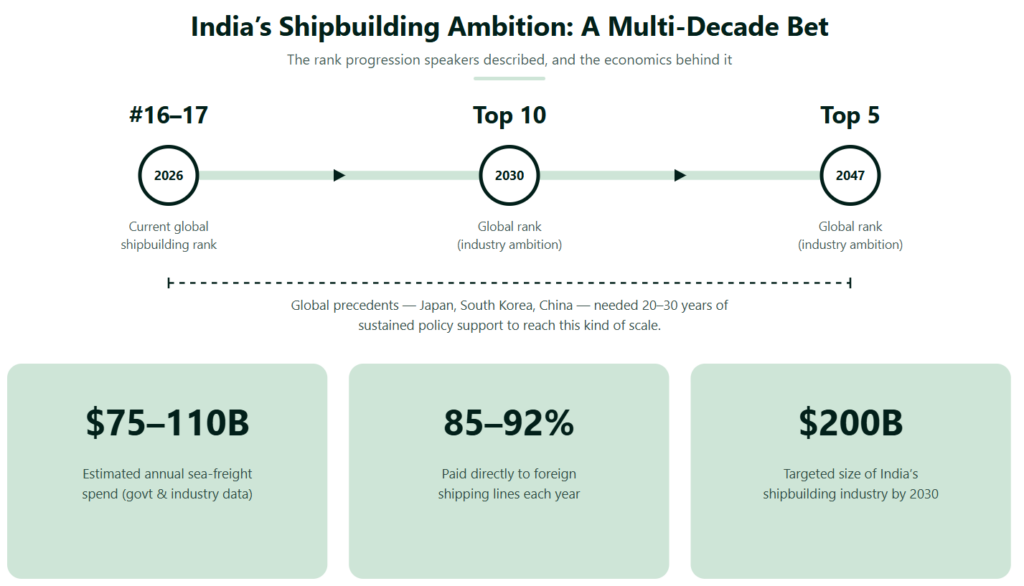
If drones are the near-term catalyst, shipbuilding is the long-duration compounding story — and it came up independently across nearly every industry veteran at the conference, which is itself notable. The framing offered was almost entirely about economics, not defense: speakers put India’s annual freight costs at somewhere in the range of US$85–100 billion, with roughly 85% of that estimated to accrue to foreign shipping companies. That’s broadly in line with government data and other industry statements, which place India’s annual outbound and inbound sea freight expenditure at roughly US$75–110 billion, with 85–92% of it paid directly to foreign shipping lines such as Maersk, MSC and COSCO. That’s the “leakage” that a domestic shipbuilding and shipping industry is meant to plug, according to both the conference speakers and these broader estimates.
The ambition attached to fixing this, as described at the conference, is substantial — speakers talked about India moving from its current rank of roughly 16th–17th globally to the top 10 by 2030, and into the top 5 by 2047, with the domestic industry scaling toward something like US$200 billion by 2030 on one estimate. Government support is being built out in parallel, per the discussion: a four-pillar maritime strategy, roughly INR70,000 crore in shipbuilding incentives, and new financing infrastructure (Sagarmala Development Company gaining NBFC status) aimed at a problem shipbuilders flagged repeatedly — the near-total absence of a dedicated shipping finance ecosystem, even from large domestic banks.
Global capital interest was also raised, with one speaker citing reports that Hyundai is evaluating a roughly US$4 billion investment into Indian shipbuilding capacity. A newer entrant described rebuilding an idle shipyard into an operational facility within about two and a half years, with more than US$500 million in firm orders booked and technical partnerships alongside established players like Samsung Heavy Industries and Mazagon Dock — figures from that company’s own account of its progress.
But nearly every veteran who spoke on this topic attached the same caveat, almost verbatim: shipbuilding success stories globally — Japan, South Korea, China — took 20 to 30 years of sustained, uninterrupted state support to reach scale, by their account. Execution discipline across 30–42-month build cycles, working capital management, and bidding prudence were repeatedly flagged as the single biggest risk to India’s ability to convert this ambition into results. However, these specific figures are hedged; the underlying point speakers kept returning to was consistent: this is not a sector where a good five-year plan is sufficient; it’s one where policy needs to survive several changes of government and several commodity cycles to actually compound.
Private industry is bigger, but it’s still not the majority
Speakers put private-sector participation in defense production at roughly 3% two decades ago, rising to about 25% today, with policy ambition to cross 30%. That’s genuine progress if the figures are right — and the government opening up complex, sensitive programs like the AMCA fighter to private co-design and co-development is a real structural signal, not a symbolic gesture. But it’s worth sitting with the implied number: on this account, three-quarters of defense production still runs through the older, DPSU-led model. The private sector’s rise looks real, but by the industry’s own numbers it is not yet the dominant force — it’s a growing minority stake in a system still anchored by public-sector players, some of whom continue to carry meaningful execution challenges and order backlogs of their own.
The part of the story that doesn’t make it into the headlines
Here’s where the sector’s forward momentum needs a closer look: the gaps described at the conference are structural, not cosmetic, and they show up in almost every company’s own account of its business — these are the industry’s admissions about itself, not outside criticism.
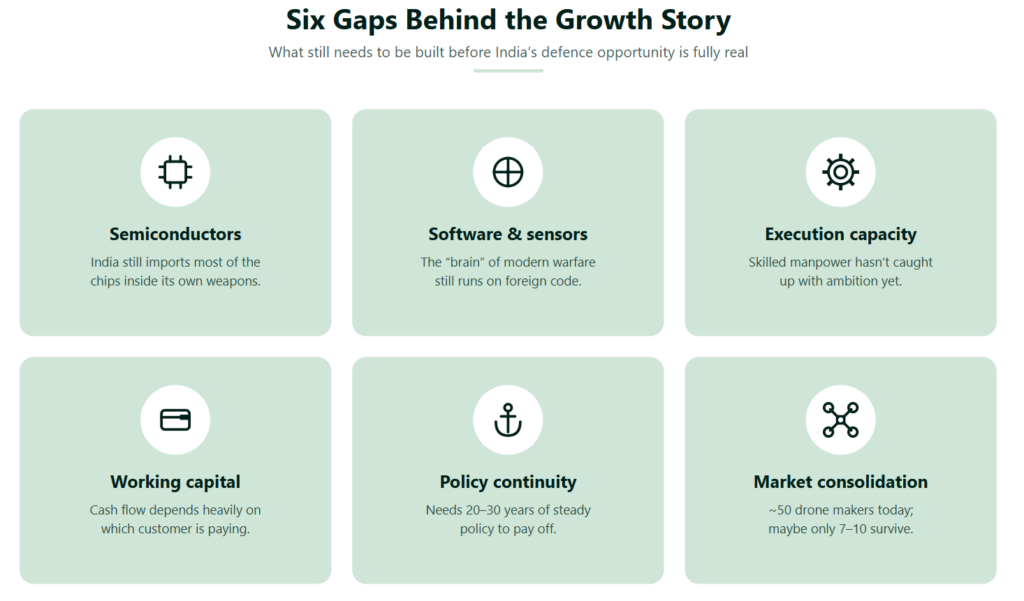
Semiconductors remain the most significant unresolved dependency. Across multiple companies — including the most advanced electronics players in the country — semiconductor imports were said to still account for the overwhelming majority of the remaining imported content, even in products where indigenous design ownership is otherwise nearly complete. This isn’t a company-specific weakness; by the industry’s own telling, it’s a national one. India can design and own the IP for a missile guidance system, a radar, or a command-and-control network, and still be dependent on foreign fabrication for the chip that makes it work. One executive estimated localisation here could take 10–15 years, not a couple of procurement cycles — and until it happens, “indigenous” defense electronics carry an asterisk.
Mission software, sensors, and underwater systems remain foreign-IP-dependent. These aren’t peripheral categories — they’re the categories the industry itself identifies as the actual differentiators in modern warfare. Having a domestically built hull or airframe with imported sensing, mission software and seeker technology inside it is a materially weaker position than the “atmanirbhar” framing suggests, and it constrains full strategic autonomy in exactly the systems that matter most in a live conflict.
Execution capacity is a genuine constraint. Skill shortages and limited execution bandwidth were raised candidly, not defensively, by industry veterans at the conference. The timelines cited elsewhere in these same discussions — shipbuilding’s 30–42 month cycles, drone programs’ compressed 6–18 month deployment windows, and defense electronics with 15–35 year operational lifecycles — all demand a depth of skilled manpower and program-management maturity that speakers themselves acknowledged the industry is still building, not one it already has in reserve.
Working capital dynamics are uneven across customer segments. Naval programs were described as tending to be cash-positive because of milestone-based payments, while Army and Air Force programs are said to be more exposed to dispatch-and-acceptance cycle variability — meaning cash flow timing risk isn’t evenly distributed across the industry, and a company’s order book size can overstate how comfortable its actual cash position is.
The shipbuilding ambition is contingent on something India has not yet proven it can sustain. Every global precedent cited at the conference — Japan, South Korea, China — required an estimated 20 to 30 years of uninterrupted policy continuity to reach scale. Whether India can hold that kind of course across successive governments and budget cycles is an open question that the speakers themselves flagged, not one they claimed to have answered. The ambition to reach the global top 5 by 2047 is credible as a direction; on the industry’s own telling, it is not yet proven as an outcome, and the gap between the two is measured in decades of discipline, not quarters of good news.
Consolidation implies a meaningful share of today’s players won’t remain independent. If the drone market really does shrink from an estimated ~50 players to 7–10, as speakers projected, that’s a real business risk, not a neutral statistic — a number of companies currently raising money, signing contracts, and generating headlines in this space may not survive as independent entities. Investors and partners treating every drone-sector announcement as equally durable are underpricing that risk.
None of this undercuts the broader direction of travel — the shift toward IP ownership, the drone sector’s growth, the broadening of exports, and the shipbuilding ambition are all real themes that came through consistently among independent speakers at this conference. But a sector story built entirely on growth numbers, without sitting with where the industry itself says the dependencies still lie, is incomplete.
The sharper implication is that the next phase of India’s defense opportunity may reward companies differently from the last one. Order-book growth and manufacturing capacity remain important, but the more durable competitive advantage is increasingly likely to sit with companies that own critical IP, can localise high-value subsystems, execute compressed development cycles, and finance increasingly complex programs. Put differently: the gaps this piece has walked through — semiconductors, mission software and sensors, execution capacity, working capital, and the multi-decade policy consistency shipbuilding will require — aren’t a footnote to the growth story. They’re the filter. How well a company clears them, more than how large its order book looks today, is what’s likely to separate the businesses that compound through this cycle from the ones that simply ride it.
Disclaimer: Investment in securities market are subject to market risks. Read all the related documents carefully before investing. Registration granted by SEBI, membership of a SEBI recognized supervisory body (if any) and certification from NISM in no way guarantee performance of the intermediary or provide any assurance of returns to investors.
The content in these posts/articles is for informational and educational purposes only and should not be construed as professional financial advice and nor to be construed as an offer to buy /sell or the solicitation of an offer to buy/sell any security or financial products.Users must make their own investment decisions based on their specific investment objective and financial position and using such independent advisors as they believe necessary.
Windmill Capital Team: Windmill Capital Private Limited is a SEBI registered research analyst (Regn. No. INH200007645) based in Bengaluru at No 51 Le Parc Richmonde, Richmond Road, Shanthala Nagar, Bangalore, Karnataka – 560025 creating Thematic & Quantamental curated stock/ETF portfolios. Data analysis is the heart and soul behind our portfolio construction & with 50+ offerings, we have something for everyone. CIN of the company is U74999KA2020PTC132398. For more information and disclosures, visit our disclosures page here.


You may want to read
 What Happens After a Pharma Company Gets an FDA Warning Letter?
 BEL: Executing on a Policy Tailwind
 Understanding ratios on smallcase factsheets [includes examples]