
Emcure’s Bet: Skip the US, Own Europe and Canada Instead
Pharmaceutical companies rarely make headlines the way tech startups do, but some of the most interesting business stories in India are quietly playing out in this sector. Emcure Pharmaceuticals is one of them, a company that started as a domestic branded generics player in 1981 and has spent the last decade turning itself into a genuinely international pharma business. Here’s a closer look at the company, how it operates, how it has performed financially, and where it’s headed.
The Company
Emcure was founded by Satish Mehta and has grown into a diversified pharmaceutical company with manufacturing, R&D, and commercial operations spanning India, Europe, Canada, and several emerging markets. It develops and sells everything from oral tablets to complex injectables, biosimilars, and biotherapeutics.
The business today is roughly split between its home market and the rest of the world: about 44% of revenue comes from India, and 56% comes from international markets, with Europe, Canada, and other emerging markets (grouped as “Rest of World”) each contributing meaningfully. The company runs 13 manufacturing facilities and five R&D centres across India, with accreditations from major global regulators including the USFDA, UK MHRA, Health Canada, and EDQM in Europe.
Business Model
Emcure’s approach to making money rests on a mix of strategies rather than a single formula:
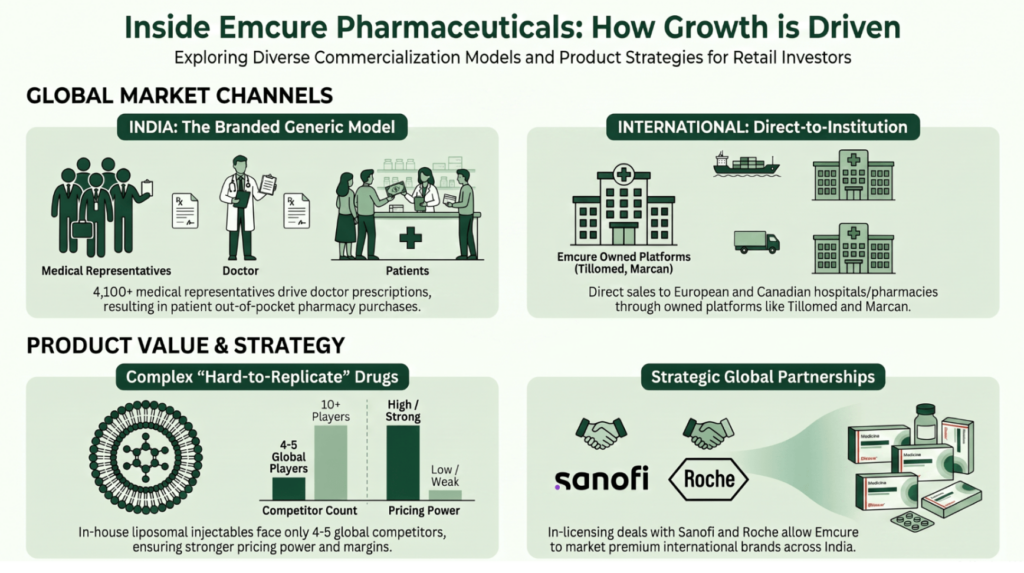
- Branded generics in India: Patients pay out-of-pocket at the pharmacy, with Emcure’s ~4,100 medical representatives driving doctor prescriptions that pull patients toward its branded products.
- Regulated-market generics abroad (Europe and Canada): Buyers here are hospitals and pharmacy chains rather than individual patients, with a large share, especially hospital injectables in Europe, sold through centralised government/health-system tenders. Emcure sells directly into these channels through its own owned platforms (Tillomed in Europe, Marcan/Mantra in Canada) rather than third-party distributors.
- Complex, hard-to-replicate products (liposomal injectables, biosimilars, iron and chiral-molecule drugs): These are Emcure’s own generic or biosimilar versions, developed and manufactured in-house once the originator’s patent expires, not licensed from another company. Because these molecules are technically hard to replicate, only a handful of competitors manage to bring a version to market, which supports better margins. In its liposomal Amphotericin B franchise, for instance, Emcure counts just 4-5 global competitors with strong pricing power, versus 10+ players and weak pricing in the older, conventional version of the same drug.
- In-licensing partnerships with Sanofi, Novo Nordisk, and Roche: Emcure pays these companies for the right to market their drugs in India, then sells them through its own doctor and pharmacy network, keeping a share of revenue for distribution. It’s an asset-light way to grow since Emcure isn’t funding the underlying R&D, though it’s worth noting these in-licensed brands (currently ~6-7% of domestic sales) have actually run at lower gross margins than Emcure’s own portfolio, diluting the blended domestic margin somewhat.
Emcure is making an early-stage foray into the direct-to-consumer OTC space with brands like Arth (offering 28+ SKUs for sleep, PCOS, and weight management) and Galact (focused on lactation support). Sold non-prescription through retail, pharmacy, and online channels, this nascent segment currently contributes minimally to overall earnings.
Taken together, blended gross margin across the business runs at roughly 60-61%, while EBITDA margin stood at 19.4% in FY26 and is expected to improve toward 21.7% by FY28, with the complex/specialty products and international scale-up doing most of the work in pushing margins higher over time.
Notably, Emcure has very limited exposure to the US market, only around 2-3% of revenue, which shields it from the pricing pressure and tariff-related volatility that affect many Indian pharma exporters focused on the US generics business.
Fundamental Performance
Looking at the recent financial trajectory gives a sense of where the business stands:
- Revenue grew from about ₹5,986 crore in FY23 to roughly ₹9,204 crore in FY26, a three-year compound annual growth rate (CAGR) of about 15%, with international markets outpacing the domestic business.
- EBITDA margin averaged around 18.8% over the past three years (FY24-FY26), settling at 19.4% in the latest year (FY26), helped by growing operating leverage as the international business scaled up.
- Profit after tax stood at roughly ₹892 crore in FY26, having grown at a three-year CAGR of about 22% (FY23-26). PAT margin averaged about 8.6% over FY24-FY26, recovering to 9.7% in the latest year after dipping in FY24 due to higher interest costs and depreciation tied to capacity expansion.
- Return on equity averaged about 18.6% over the past three years, coming in at 19% in FY26, a level that stands out, since only a handful of companies in India’s listed healthcare space consistently deliver returns near that mark.
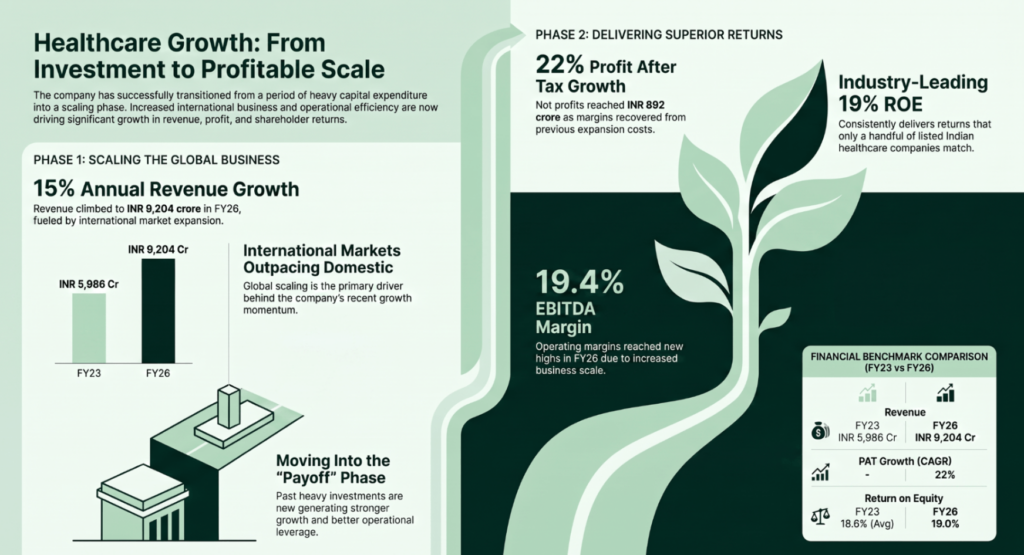
Put simply, the last few years have shown a business moving from a phase of heavy investment (which weighed on margins and profits) into a phase where that investment is beginning to pay off in the form of stronger growth and better returns.
Mergers, Acquisitions, and Partnerships
A large part of Emcure’s international expansion has come through acquisitions rather than organic buildout, a deliberate strategy to buy market access rather than build it slowly from the ground up:
- Tillomed (2014) gave Emcure a front-end distribution platform in Europe, bought specifically because Emcure needed a way to market its own generics directly in regulated markets like the UK and Germany, rather than relying on third parties. It has since grown into a 150+ product platform across the UK, Germany, Spain, and Italy. Marcan Pharma (2015) served the same purpose for Canada, giving Emcure its first regulatory and commercial foothold there; Mantra Pharma (2023) was added specifically to gain access to Quebec, Canada’s French-speaking market, which most Indian generic companies skip due to its distinct language and regulatory requirements; together, the two created a genuine pan-Canada presence. Manx Healthcare’s UK portfolio (2025) was bought to add over 100 marketing authorizations (regulatory approvals that let a drug be sold in a given country), roughly half still awaiting commercialization, expanding Emcure’s European product pipeline. Cutimed (2026) was a more recent, smaller move to enter Canada’s dermatology and personal care segment, extending beyond prescription drugs.
- On the partnership side, Emcure has struck in-licensing deals with Sanofi (cardiovascular and diabetes brands), Novo Nordisk (an exclusive tie-up for semaglutide, the GLP-1 drug behind the global obesity/diabetes treatment boom), and Roche (nephrology and transplant medicines), each designed to deepen doctor access in India without Emcure having to develop these molecules itself.
Together, these deals paint a picture of a company that has been quite intentional about which markets to enter and has generally chosen to buy an existing platform rather than build a new one from zero.
Growth Drivers
Several themes look set to shape Emcure’s next phase of growth:
- Complex generics and biosimilars scaling internationally: products like liposomal Amphotericin B are being rolled out across more European countries, and biosimilars such as Tenecteplase and Bevacizumab are gaining traction in emerging markets.
- The GLP-1 opportunity: through its Novo Nordisk partnership, Emcure has an early foothold in one of the fastest-growing drug categories globally, spanning diabetes, obesity, and cardiometabolic conditions.
- Long-acting HIV therapies: regulatory filings for products like Lenacapavir could open access to a next-generation of HIV treatment and prevention options in emerging markets.
- Nutraceutical and wellness market: India’s market is projected to grow substantially over the next several years, giving the Arth brand room to expand.
- Biologics manufacturing capability: Emcure has built integrated production platforms across mammalian, microbial, and mRNA technologies, laying the groundwork for future specialty and biosimilar launches.
- Deepening presence in ophthalmology: Anchored by a lower-cost biosimilar alternative for a common eye condition, aimed at expanding treatment access, particularly outside major metro areas.
Key Challenges
No pharmaceutical business scales without friction, and Emcure has had its share recently:
- Organizational restructuring: Its innovation-focused domestic subsidiary, Zuventus, led to a spike in staff attrition and a temporary slowdown in domestic sales growth in the latter part of FY26.
- Patent expiry pressure: the loss of exclusivity on a major iron-supplementation product in FY24 created a period of competitive drag that took time to work through.
- Regulatory complexity across jurisdictions: operating in multiple regulated markets means facility inspections and approval delays in any single market can create ripple effects.
- Global supply chain: Dependence on the supply chain is a common risk across the pharmaceutical manufacturing industry, particularly given geopolitical uncertainty.
- Rising debt levels post-IPO: After using listing proceeds to reduce debt, subsequent acquisition payouts (including the Mantra earnout and a Zuventus stake buyout) have pushed leverage back up, with management guiding toward a longer deleveraging timeline than originally planned.
- Intense domestic competition: India’s branded generics market remains crowded, with many well-funded companies competing for the same prescribers.
Conclusion
Emcure’s journey from a domestic branded generics company to a business with owned commercial platforms in Canada and Europe, a growing complex-generics and biosimilars pipeline, and a network of partnerships with some of the world’s largest pharmaceutical companies, is a story worth watching regardless of where it goes next. It reflects a broader shift happening across Indian pharma, companies moving away from pure-volume, price-competitive generics toward more specialized, higher-barrier products, while also building genuine international commercial capability rather than relying solely on manufacturing scale.
Where this story goes from here will likely depend on how well the company executes on its recent investments, integrating acquisitions, scaling new product launches, and steadying its domestic subsidiary after a period of restructuring. It’s a business in transition, with several moving parts unfolding simultaneously across geographies and therapy areas, and that, more than any single number, is what makes it an interesting one to follow.
Disclaimer: Investment in securities market are subject to market risks. Read all the related documents carefully before investing. Registration granted by SEBI, membership of a SEBI recognized supervisory body (if any) and certification from NISM in no way guarantee performance of the intermediary or provide any assurance of returns to investors.
The content in these posts/articles is for informational and educational purposes only and should not be construed as professional financial advice and nor to be construed as an offer to buy /sell or the solicitation of an offer to buy/sell any security or financial products.Users must make their own investment decisions based on their specific investment objective and financial position and using such independent advisors as they believe necessary.
Windmill Capital Team: Windmill Capital Private Limited is a SEBI registered research analyst (Regn. No. INH200007645) based in Bengaluru at No 51 Le Parc Richmonde, Richmond Road, Shanthala Nagar, Bangalore, Karnataka – 560025 creating Thematic & Quantamental curated stock/ETF portfolios. Data analysis is the heart and soul behind our portfolio construction & with 50+ offerings, we have something for everyone. CIN of the company is U74999KA2020PTC132398. For more information and disclosures, visit our disclosures page here.


You may want to read
 Strategic Analysis: The Persistent-Nagarro $2.9 Billion AI Consolidation
 Monsoons, Markets & Money: What’s Shaping 2025?
 Part IV: Gold Tax Implications – Best Way to Buy Gold After the 2024 Budget