Hidden Engine Behind Jewellery Stores – Understanding Gold Metal Loans

When you step into a bright jewellery showroom to buy a gold necklace or ring, a simple question rarely crosses your mind: How does the jeweller afford to keep tens of crores of rupees worth of gold sitting on display shelves?
You might assume the retailer simply takes out a standard business loan to buy the gold. However, in the organised jewellery industry, buying gold with standard cash loans can be dangerous. Instead, many top jewellers rely on a specialized financial tool called a Gold Metal Loan (GML).
TL;DR
Gold Metal Loans (GMLs) help Indian jewellers borrow physical gold instead of cash, reducing borrowing costs and limiting exposure to gold price fluctuations. This article explains how GMLs work, the role of banks and bullion suppliers, the gold supply chain, regulatory requirements, and the risks investors should monitor, including hidden debt, liquidity pressure and incomplete hedging.
How General Working Capital Loans Work
In most industries, businesses use working capital loans to keep daily operations running. A bank lends the business cash, and the company uses that cash to buy raw materials, manufacture products, sell them, and repay the loan with interest.
In the industry, a traditional cash loan works like this:
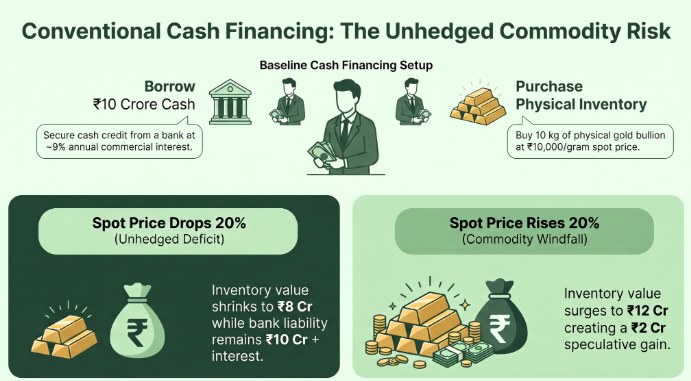
A jeweller borrows ₹10 crore in cash from a bank at a standard commercial interest rate of about 9% per year.
The jeweller uses that cash to purchase 10 kilograms of raw gold bars at ₹10,000 per gram on the open market.
The Major Downside: Involuntary Speculation
Gold prices change every single day. If global gold prices drop by 20% while the gold is sitting in the workshop or showroom, the physical inventory value drops to ₹8 crore. However, the loan owed to the bank remains fixed at ₹10 crore plus interest. The jeweller takes an immediate, direct ₹2 crore loss out of its own pocket.
Conversely, if gold prices surge 20%, the inventory value jumps to ₹12 crore, creating a sudden profit.
By relying on cash credit, the retailer inadvertently transforms into an involuntary commodity speculator, exposing its operating profit margins directly to international gold price volatility.
Mechanism & Concrete Operational Lifecycle
A Gold Metal Loan restructures this transaction by replacing cash disbursements with the delivery of physical metal. The lending bank delivers 10 kilograms of physical gold bullion (typically in standard 1 kg or 100 gram bars) directly to the jeweller over a contractual borrowing tenor-typically standardized at 270 days.
The operational lifecycle of a GML differs fundamentally from a traditional Rupee loan across two distinct paths:
- Track 1 (Rupee Working Capital Loan): The jeweller borrows cash in Rupees, uses those funds to purchase physical gold bars, holds the inventory during manufacturing, sells the finished jewellery, and ultimately repays the bank’s cash principal plus interest.
- Track 2 (Gold Metal Loan): The bank provides physical gold directly under a 270-day tenor facility. The jeweller manufactures jewellery directly from the borrowed metal, sells the finished pieces to retail customers, fixes and settles the gold price with the bank as sales occur, and repays the metal obligation alongside gold-denominated interest.
The Natural Hedge & Earnings Isolation
The primary structural benefit of a GML facility is the creation of an automatic balance sheet hedge. When physical gold is received, the jeweller records the metal on its books as both an inventory asset and a short-term liability (initially equal at the spot market value, e.g., ₹10 crore).
Because the liability is defined in terms of physical weight (10 kg) rather than a fixed Rupee amount, the value of the asset and the liability fluctuate in direct tandem across the 270-day tenor:
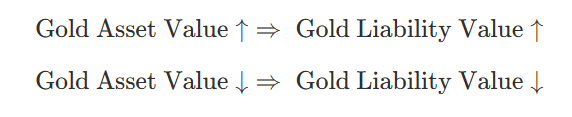
If market gold prices surge to ₹12,000 per gram, inventory asset value rises to ₹12 crore, while the physical loan liability similarly increases to ₹12 crore. If gold prices drop to ₹8,000 per gram, both the inventory asset and loan liability decline to ₹8 crore. Selling finished items at prevailing market rates cancels out the risk of higher repayment liabilities to banks.
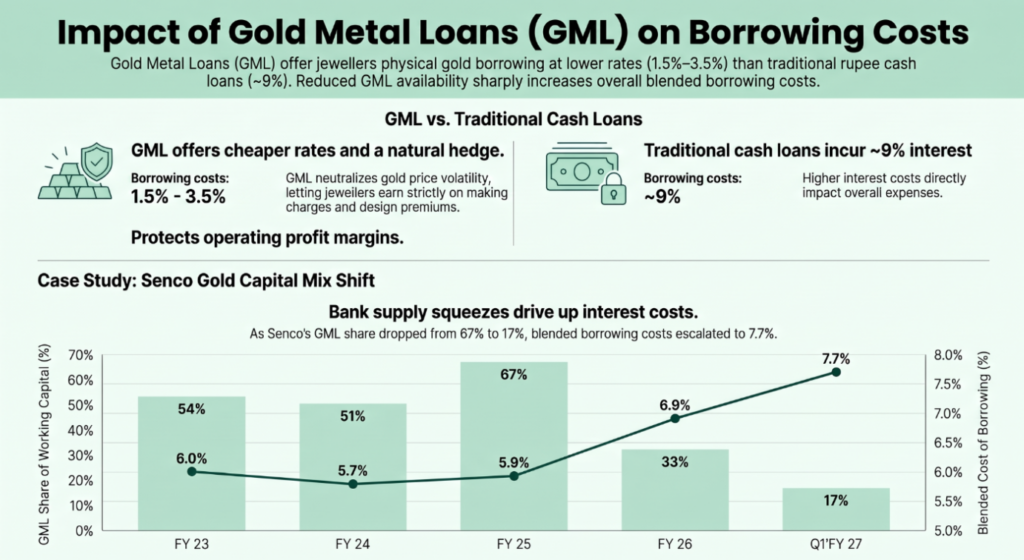
The interest rates offered by the Indian banks on GML represent the sum of prevalent GLR in the London market, country risk premium, entity-specific risk premium and the banks’ margins. It typically ranges between 1.5% to 3.5% per annum against the benchmark gold value.
The operational value of this structure is evident in Senco Gold’s FY24 financial disclosures: maintaining 61% of its total borrowings as GMLs at an average interest rate of 3.1% per annum successfully reduced its overall blended borrowing cost from 6.0% to 5.7%.
By neutralising directional price movements, GML structures insulate operating earnings. Jewellers eliminate commodity exposure and isolate profitability, ensuring margins are derived strictly from making charges, design premiums, and retail markups.
The End-to-End Value Chain & Regulatory Framework
Upstream Operations (Refining & Vaulting)
The physical value chain originates at accredited international and domestic refiners (such as MMTC-PAMP or LBMA-certified international entities). Raw gold doré or 12.5 kg London Good Delivery bars are refined to 99.9% (24-karat) purity and cast into standardised 1 kg or 100 gram minted bars.
Following refining, the physical gold is transported under high-security transit insurance to customs-bonded vaults located at major Indian international airports (primarily Mumbai and Delhi). At this juncture, the metal remains under international consignment arrangements, with legal ownership retained by international bullion banks. The bullion is not purchased outright upon arrival; instead, it is held in secure custody pending formal release authorisation from an authorised domestic bank.
Midstream Operations (Banking Infrastructure & Artisan Distribution)
Physical release from customs-bonded vaults requires intervention by an authorised domestic financial institution. RBI-approved Nominated Domestic Banks (such as State Bank of India, ICICI Bank, and HDFC Bank) grant GML credit lines to qualified retail jewellers.
When a jeweller draws down on its approved line, the nominated bank issues a formal release authorisation to the vault custodian. Upon clearance, physical 1 kg or 100 g bullion bars are delivered directly to the jeweller’s primary manufacturing plants or directly to empanelled artisans (karigars). These skilled artisans melt, alloy, and craft the raw bullion into plain, studded, or ornate retail inventory.
Downstream Operations (Quality Certification, Sale & Settlement)
Once manufacturing is complete, finished ornaments are submitted to Bureau of Indian Standards (BIS)-certified hallmarking centres for metal purity verification. Upon certification, items are distributed across regional showroom networks for retail sale.
The final leg of the operational lifecycle involves the interplay between consumer purchasing, price fixation, and tax assessment:
- Retail Purchase & Price Fixation: When a jeweller initially takes gold bars from a bank, they do not buy the gold at a fixed cash price-they simply hold the physical metal. When a customer enters the showroom and purchases an ornament, the jeweller immediately contacts the bank to “lock in” (fix) the current Rupee spot price for that exact weight of gold. This ensures the retail sale price charged to the customer matches the exact repayment value owed to the bank.
- Customs Duty Mechanics & Cash Outflow Timing: When gold arrives in India and lands up at the customs-bonded vaults, the domestic bank pays 15% import duty (10% Basic Customs Duty + 5% Agriculture Infrastructure and Development Cess) to the customs officer for a domestic GML. This duty is collected by the bank from the jeweller on delivery of the gold. The jeweller then manufactures jewellery and sells the finished jewellery to a consumer. What it receives from the consumer includes the spot price of gold, making charges, import duties paid, other fees and taxes.
- Financial Closure & Title Transfer: Once the retail customer pays cash for the finished ornament, the jeweller uses that revenue to pay the bank the fixed gold value plus the bank’s borrowing interest fee.
Upon full cash settlement, official legal title and ownership of the gold pass from the international bullion bank to the end consumer, completing the loan cycle.
Financial Accounting & Investor Analysis
When a company takes a GML, it records the physical gold as both an inventory asset and a short-term financial liability on its balance sheet. At the end of every financial reporting period, both numbers are updated (marked-to-market) to match current gold prices.
The Analytical Pitfall for Investors
Investors who look only at headline “conventional bank loans” can be easily misled:
Company A has ₹5,000 crore in traditional bank loans.
Company B has ₹2,000 crore in traditional bank loans plus ₹5,000 crore in GML loans under current liabilities.
A surface-level screening tool might assume Company B is safer because its headline conventional debt is lower (₹2,000 crore vs ₹5,000 crore). However, Company B still owes ₹5,000 crore worth of physical gold.
Because of this, credit rating agencies like CRISIL explicitly classify gold-on-loan (GML) obligations as short-term debt when evaluating a company’s financial health
Operational Risks & Constraints
Despite their structural advantages, GML facilities are dynamic financial instruments that demand active management. Flaws in execution, systemic supply disruptions, or extreme commodity price rallies can expose a retailer to operational liquidity stress.
Partial Hedging Gaps
A Gold Metal Loan creates a natural balance sheet hedge only when the physical weight of inventory matches the physical weight of borrowed gold. If a jeweller maintains 10 kg of total physical gold inventory but funds only 8 kg via GML facilities, the remaining 2 kg remains unhedged and exposed to spot price movements.
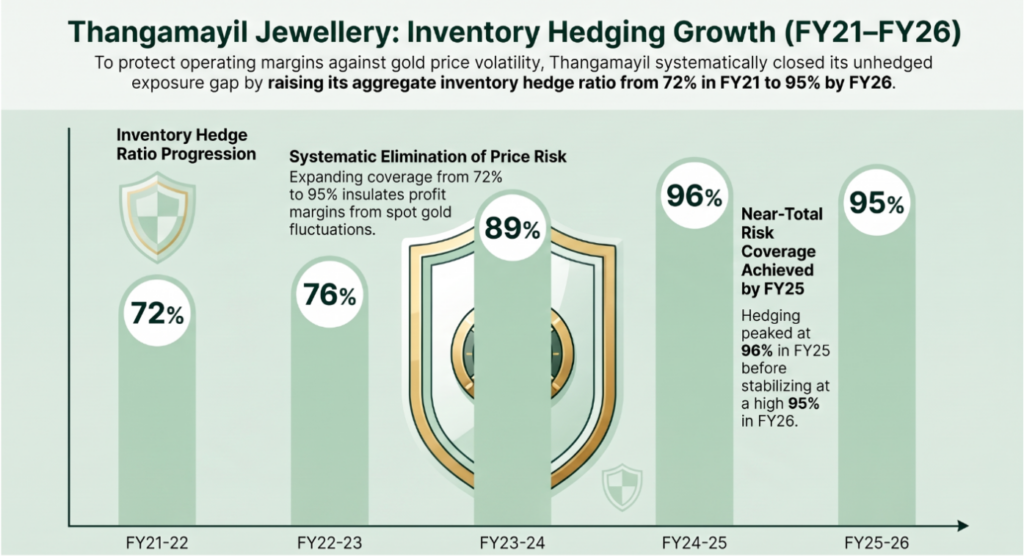
Recognizing this operational vulnerability, regional jeweller Thangamayil implemented a deliberate risk-mitigation strategy to close its unhedged inventory gap, systematically expanding its aggregate inventory hedge ratio from 72% in FY21 to 95% by FY26.
Cash Flow Strain & Bank Margin Calls
Although GML facilities neutralize long-term inventory price risk on paper, rapid market rallies can create short-term cash flow pressures. As global gold prices surge, the Rupee-denominated value of the physical metal liability increases proportionally.
To manage this expanding credit exposure, commercial banks issue margin calls, requiring jewellers to post immediate additional cash or collateral. Consequently, while a jeweller remains fully hedged against net inventory losses on an accounting basis, abrupt price spikes can strain short-term liquidity to satisfy bank collateral demands.
Bank Credit Limits & Supply Squeeze Dynamics
Jewellers cannot expand GML lines at will. Borrowing capacities are constrained by commercial bank credit allocations and strict regulatory guidelines mandated by the Reserve Bank of India (RBI). RBI regulations require nominated banks to actively track end-use, perform physical stock inspections, verify insurance coverage, and maintain oversight over inventory sales and loan settlements.
If banking supply squeezes restrict access to GML facilities, jewellers are forced to transition to higher-cost conventional credit lines, impacting financial performance.
Senco Gold’s recent disclosures demonstrate the financial impact of GML supply contractions.
Price Fixation Timing & Execution
Managing a GML facility is an active, multi-step process rather than a static borrowing arrangement. As highlighted in Thangamayil’s corporate disclosures, jewellers frequently draw physical gold from nominated banks on an unfixed price basis.
Under the standard 270-day loan tenor, management must actively time the final rate fixation or utilize forward derivative contracts to bridge fixation gaps as retail sales occur. If retail sales lag behind or if fixation windows are mismanaged, the retailer is exposed to short-term market volatility before the final price is locked, risking margin erosion.
Comparing the real-world performance of companies using hedged GML strategies against those relying on unhedged conventional financing provides empirical context.
To sum it up,
Gold Metal Loans are the financial engine that keeps India’s retail jewellery industry running smoothly. By borrowing physical weight rather than cash, jewellers protect themselves from wild commodity market swings, lower their interest expenses, and focus strictly on what they do best: crafting and selling fine jewellery.
Disclaimer: Investment in securities market are subject to market risks. Read all the related documents carefully before investing. Registration granted by SEBI, membership of a SEBI recognized supervisory body (if any) and certification from NISM in no way guarantee performance of the intermediary or provide any assurance of returns to investors.
The content in these posts/articles is for informational and educational purposes only and should not be construed as professional financial advice and nor to be construed as an offer to buy /sell or the solicitation of an offer to buy/sell any security or financial products.Users must make their own investment decisions based on their specific investment objective and financial position and using such independent advisors as they believe necessary.
Windmill Capital Team: Windmill Capital Private Limited is a SEBI registered research analyst (Regn. No. INH200007645) based in Bengaluru at No 51 Le Parc Richmonde, Richmond Road, Shanthala Nagar, Bangalore, Karnataka – 560025 creating Thematic & Quantamental curated stock/ETF portfolios. Data analysis is the heart and soul behind our portfolio construction & with 50+ offerings, we have something for everyone. CIN of the company is U74999KA2020PTC132398. For more information and disclosures, visit our disclosures page here.


You may want to read
 Blame Evolution: The Brain’s Role in Your Investing Decisions
 The ₹1 of Premium Everyone Wants a Piece Of: IRDAI’s Commission Reset, Explained
 How Phoenix Mills Built a ₹16,500 Crore Mall Business by Letting the Rent Lag Behind the Sales