

HCLTech Is Down 36% This Year, Here’s What It’s Betting On Next
As HCL Group celebrates its 50th anniversary, the milestone represents more than a victory lap for one of India’s most enduring tech titans. According to CEO C. Vijayakumar, the industry is currently weathering its “biggest inflection point yet,” a shift so profound that the next half-century of innovation essentially begins today. However, this new frontier is opening against a backdrop of intense market volatility. Despite HCLTech’s recent recognition on Fortune’s “World’s Most Admired Companies 2026” list, the company—and the broader IT sector—is under fire. Investor anxiety is palpable; HCLTech’s shares have weathered a 36% drop since the start of the year, punctuated by a 17% slide in mid-February following reports that AI major Anthropic could automate the modernisation of ATM software. This “turning point” isn’t just a corporate strategy—it is a high-stakes response to a market questioning the very relevance of traditional IT services.
Why the Move to AI Feels “Painful”
Technology evolves in milliseconds, but human organisations move much slower. This is why Vijayakumar describes the current era as a “painful, people-led transition.” The “pain” refers to the friction inherent in re-skilling hundreds of thousands of employees and re-engineering legacy business processes that have remained unchanged for decades. Chairperson Roshni Nadar-Malhotra uses a “Lego” analogy to demystify the tech: AI tools are essentially sophisticated blocks. While powerful on their own, they are inert without human architects to determine what to build and how to integrate them into a complex enterprise. The difficulty lies not in the “blocks,” but in the human effort required to assemble them into meaningful value.
“It’s going to be painful because it really involves people.” — C. Vijayakumar, CEO of HCLTech
The Three Worlds of the New IT Industry
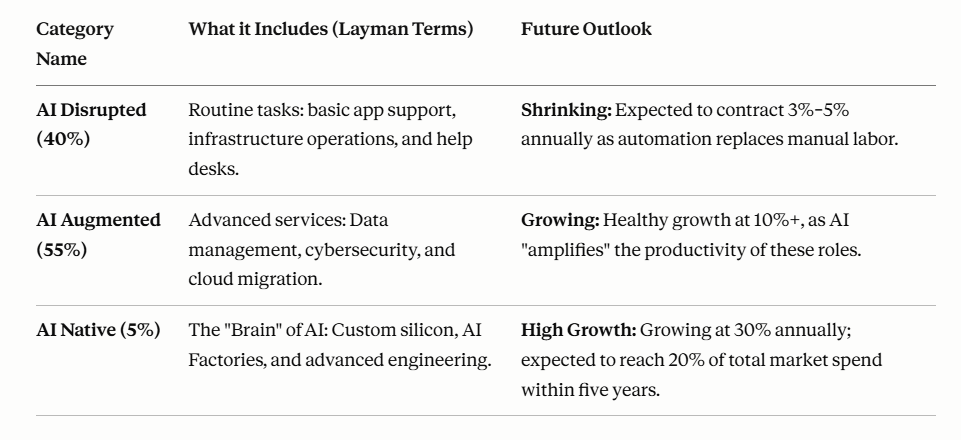
To navigate this volatility, HCLTech has mapped the IT landscape into three distinct categories. This “Three Worlds” framework explains why some parts of the business are contracting while others represent a massive growth opportunity.
From Software to Silicon: The Hardware Revolution
In a strategic “return to its roots,” HCL is moving aggressively into the physical hardware that powers AI. This is anchored by a joint venture with Foxconn to establish India Chip Pvt Ltd. The value in the AI era is shifting disproportionately toward semiconductor companies and tech OEMs because chips are the “brain” of the operation. By investing in this space, HCL is directly targeting the “AI Native” world—specifically the Custom Silicon Engineering mentioned in the table above. By controlling the hardware, HCL ensures it isn’t just servicing AI but building the foundation it runs on.
Sovereign AI: Building for India’s Scale
Perhaps HCL’s most ambitious play for the “AI Native” world is its involvement in Sarvam, India’s full-stack sovereign AI company. HCLTech acted as the lead strategic investor in a recent funding round that saw a $234 million first close .”Sovereign AI” is the practice of building AI models locally, using local data and languages, to ensure the technology is both culturally relevant and cost-effective. For a country like India, this isn’t just a luxury—it’s a necessity for population-scale impact. Sarvam’s real-world footprint already includes:
- Agriculture: Multilingual voice agents collecting high-quality data from 17 million farmers for the Ministry of Agriculture.
- Insurance: A low-cost, nationwide voice campaign supporting renewals for 45 million policyholders.
- Frontier Models: The Sarvam 105B model, which matches global reasoning standards while being optimised for India’s unique data landscape.
Innovation Zones and Global Partnerships
HCLTech is using its AI Innovation Zones to help companies stop just “testing” AI and start using it to run their businesses. These zones are dedicated spaces where clients can build and launch advanced AI tools that handle complex, real-world tasks.
Here is a simplified look at HCLTech’s major AI collaborations:
- Google Cloud: Building “Smart” and “Active” Systems
Located in Santa Clara, California, this zone uses Google’s Gemini Enterprise to create two specific types of AI:
- Agentic AI: Systems that act like autonomous employees, capable of completing multi-step business tasks independently.
- Kinetic AI: AI designed to interact with physical movement and robotics.
- NVIDIA: Teaching AI to “See” and “Act”
HCLTech is a rare global partner using NVIDIA’s Cosmos platform. This collaboration focuses on Physical AI and video analytics, enabling AI to process visual information and interact with and understand the physical world in real time.
- AWS & OpenAI: Making AI a Core Tool
Rather than using AI as a simple chatbot, HCLTech has dedicated engineering teams working with OpenAI’s enterprise systems. They help businesses weave AI directly into their primary “operating systems,” turning it into a fundamental tool that runs core company operations.
The goal of these partnerships is to turn AI from a laboratory experiment into a production-ready tool that delivers clear, measurable results for a business.
What Does This Mean for the Workforce?
Despite the “AI Disrupted” category’s projected shrinkage, the industry’s outlook for talent is not as dire as the headlines suggest. While routine roles are under threat, the CEO maintains that “core software engineering” is more relevant than ever. The industry is responding to this disruption with massive re-skilling. HCLTech has already trained 135,000 employees in Generative AI, including 11,800 “AI Builders.” The goal is a workforce that can thrive in the “AI Augmented” world, where specialised skills in data, cloud security, and AI-led transformation are in high demand.
Conclusion: A Slower, Steadier Future
The “painful transition” HCL describes is the sound of an industry retooling itself for a new century. While stock market fluctuations reflect a “lag” between technological potential and enterprise deployment, the long-term trajectory is one of steady evolution rather than overnight destruction. As the next 50 years of the HCL Group begin, the focus remains on ensuring that AI serves “people, planet, and progress”—turning technical “Lego blocks” into measurable, real-world value.
Disclaimer: Investment in securities market are subject to market risks. Read all the related documents carefully before investing. Registration granted by SEBI, membership of a SEBI recognized supervisory body (if any) and certification from NISM in no way guarantee performance of the intermediary or provide any assurance of returns to investors.
The content in these posts/articles is for informational and educational purposes only and should not be construed as professional financial advice and nor to be construed as an offer to buy /sell or the solicitation of an offer to buy/sell any security or financial products.Users must make their own investment decisions based on their specific investment objective and financial position and using such independent advisors as they believe necessary.
Windmill Capital Team: Windmill Capital Private Limited is a SEBI registered research analyst (Regn. No. INH200007645) based in Bengaluru at No 51 Le Parc Richmonde, Richmond Road, Shanthala Nagar, Bangalore, Karnataka – 560025 creating Thematic & Quantamental curated stock/ETF portfolios. Data analysis is the heart and soul behind our portfolio construction & with 50+ offerings, we have something for everyone. CIN of the company is U74999KA2020PTC132398. For more information and disclosures, visit our disclosures page here.


You may want to read
 Rebalancing a Windmill Capital smallcase: Everything You Need to Know
 Windmill Capital Investor Letter – June 2026 Edition
 From Universe to Portfolio: The Art of Stock Selection