

Macro Matters: How India’s Economy Shapes its Sectoral Trends

Ever wondered why IT stocks rally after a US Federal Reserve rate cut announcement, or why autos slow down when inflation rises? It’s all in the macro game. The big economic forces like growth, inflation, and policy decisions ripple through every stock portfolio. Understanding these macro factors isn’t just for economists; it’s essential for long-term investors.
So, let’s break down how the moving parts of India’s economy shape sectoral fortunes and what that means for your investments.
GDP Growth: The Engine of Broad Market Returns
Gross Domestic Product (GDP) growth is essentially the economy’s “engine speed,” and a revving engine fuels certain sectors more than others. In boom times, say when GDP growth hits ~7-8%, cyclical industries linked to consumption and infrastructure tend to outperform.
For instance, currently, India’s GDP growth is among the fastest globally, growing at an annual rate of 6-7% against major economies like China and the US. As a result, indices of capital goods, banking, and auto stocks see a boost. Conversely, when GDP growth slows down significantly, the economy’s “speed breaker” benefits the defensive sectors. FMCG (staples) and pharma stocks, which sell essential items people need regardless of the economy, tend to hold up or even take the lead during sluggish growth phases.
According to a report by JP Morgan, consumption will be a key driver for India’s growth going forward.
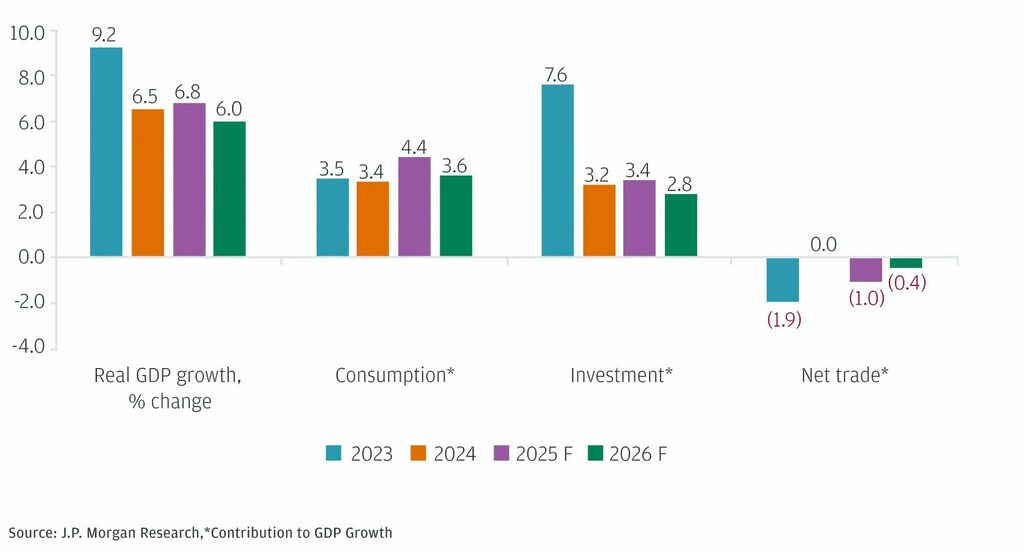
To circle back to GDP effects on your portfolio, in high-growth periods, rising incomes and confidence boost discretionary spending (think new cars, houses, new projects), directly lifting sectors like autos, realty, and banking. In slowdowns, consumers tighten their belts, and companies cut capex, making staple goods and medicines relatively more attractive investments (their demand is steady).
Inflation: The Good & the Bad
Inflation is that silent force gnawing at your purchasing power. When inflation rises, input costs for businesses also climb, squeezing profit margins.
However, inflation doesn’t hurt every sector equally. The impact varies based on pricing power, i.e., the ability to pass on cost increases to consumers. For example, several FMCG companies hiked prices by around 3.5% to 5% in late FY25 to offset inflationary pressures from commodities like palm oil, honey, and coffee, with expectations of continued price adjustments into FY26. Despite some volume pressures due to weaker urban demand, these hikes helped sustain margins amid rising costs.
In contrast, rate-sensitive and discretionary sectors feel the heat the most when inflation spikes. Consider automobiles and real estate. Higher prices (and the higher interest rates that often follow inflation) make cars and homes less affordable, cooling demand. Banks can also get hit indirectly; while they might enjoy higher lending rates initially, persistent inflation can slow loan growth and increase defaults, hurting the banking sector in the long run.
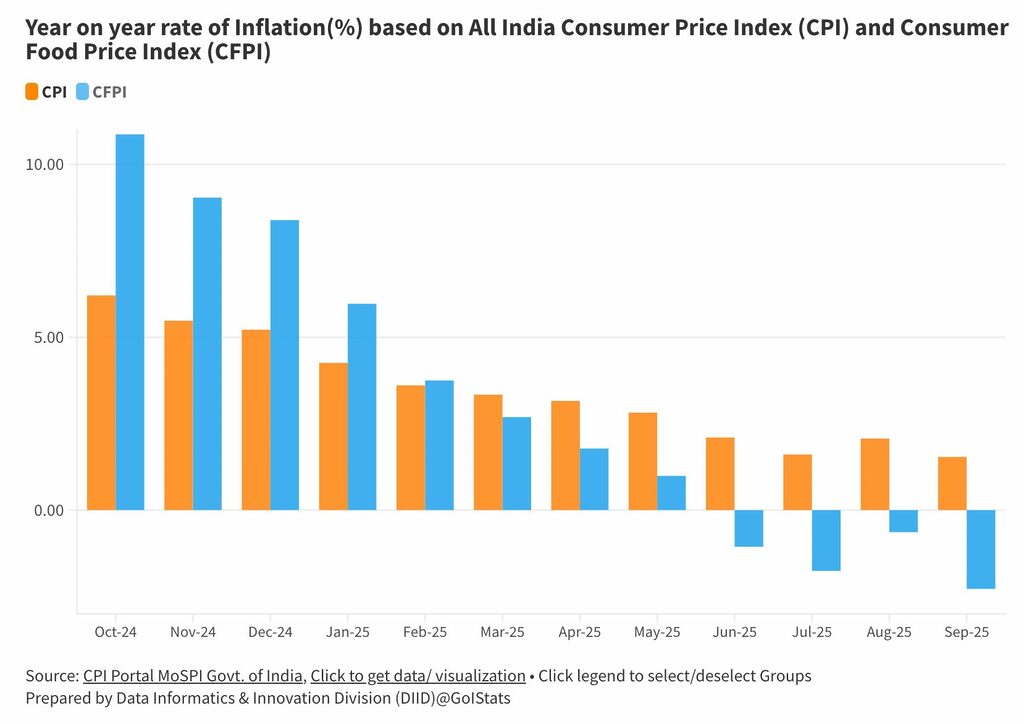
But is high inflation always a bad sign for the economy?
High inflation is not always a bad sign for the economy; it can have both positive and negative effects depending on the context and magnitude.
In the Indian economy, moderate inflation (around 2-6%) can encourage spending and investment because consumers and businesses anticipate rising prices and prefer to buy or invest sooner rather than later. This can stimulate economic growth and production.
In recent years, the Reserve Bank of India has worked to control inflation while supporting growth, showing that managing inflation at moderate levels is key. Overall, moderate inflation can be a sign of a growing economy, while high inflation is generally harmful if uncontrolled and persistent.
Interest Rates & MPC Decisions: The Market’s Mood Ring
If GDP is the engine, interest rates are the fuel. The RBI’s Monetary Policy Committee (MPC) sets those rates, and their stance works like a market mood ring. When the RBI cuts rates (a dovish move), it injects liquidity and optimism.
Lower rates mean cheaper loans and higher spending. Real estate stocks often lead the charge. Mortgage costs drop, home sales jump (no wonder the Nifty Realty index was the top sectoral gainer on RBI’s steep rate cuts so far this fiscal. Banking stocks also benefit from rising credit demand, while IT and growth sectors gain from a weaker rupee and global liquidity.
When rates rise, though, the brakes come on. Costlier loans hit autos and realty hardest, and banks see slower growth. In 2022’s inflation-led hikes, these sectors softened visibly. Investors often pre-empt such moves; bank and auto stocks dip ahead of expected hikes, while defensive sectors like IT or pharmaceuticals become safe havens.
In short, RBI policy is the liquidity lever: easing fuels rallies, tightening cools them. Even the MPC’s tone (“accommodative” vs “withdrawal of accommodation”) can swing indices. A surprise cut sparks rate-sensitive stocks (such as real estate or banks), while a hike nudges investors to defensive sectors (IT, pharma). With the repo rate steady at 5.50% after 100 bps of cuts in 2025, the RBI’s pause has kept financials and mid-caps buoyant.
Government Policies – The Invisible Hand Steering Sectors
Government policy is the economy’s invisible hand, steering sectors through fiscal measures, incentives, and reforms. From PLI schemes to Make in India and Atmanirbhar Bharat, recent pushes have reshaped industries.
Consider the transformation in India’s defence sector. For decades, defence was an underdog. Then policy reforms kicked in: the government mandated higher domestic sourcing (priority to “Buy Indian (IDDM)” in procurements) and pumped up the defence budget. The result? In FY2024-25, 65% of India’s defence equipment was made domestically, a dramatic shift from the days when ~70% was imported.
Renewables tell a similar story. India’s 500 GW non-fossil target and solar/EV incentives have made it the world’s fourth-largest renewable energy producer, powering multi-fold growth for solar, battery, and green energy firms. Electronics and EV PLIs are driving the next wave of exports. In fact, reports indicate that electronics could soon surpass petroleum as India’s second-largest export.
On the other hand, policy can also impact sectors: a sudden tax or regulatory change can harm (consider windfall taxes on oil or a telecom AGR dues surprise in the past). But more often, policy opens up opportunities. The government’s push on infrastructure (roads, rail, logistics) has meant steady business for construction and capital goods firms. A recent example is the GST 2.0 overhaul in 2025, which simplified tax slabs and reduced prices on many goods, giving a demand boost to autos and durables.
For investors, reading policy signals is key to identifying the next multi-year sector trends. The structural themes like defence manufacturing, renewable energy, digital infrastructure, and Make-in-India manufacturing are multi-year transformations. Aligning part of your portfolio with these themes can be a way to ride the long-term wave.
Global Cues: The Domino Effect
India’s markets move to a global beat. Commodity swings, Fed policy, and geopolitics all ripple through domestic sectors.
A prime example is oil prices. With 85% of crude imported, falling prices cool inflation and boost margins for oil-sensitive sectors like aviation (where fuel is ~40% of costs).
When the US Fed raises rates, global capital often retreats from emerging markets; when the Fed turns dovish, liquidity returns.
Geopolitical moves can jolt sectors too. Trump’s 2025 tariff shock, the 100% duties on select Indian pharma exports, hit a $20 billion industry and forced government negotiations. Conversely, the India-UK FTA in the same year removed duties on 99% of Indian exports, benefiting textiles, jewellery, and auto components.
And when global tensions rise, gold shines. In 2025, prices crossed $4,000/oz (about ₹1.22 lakh per 10 grams), boosting gold finance firms and miners even as jewellery demand dipped.
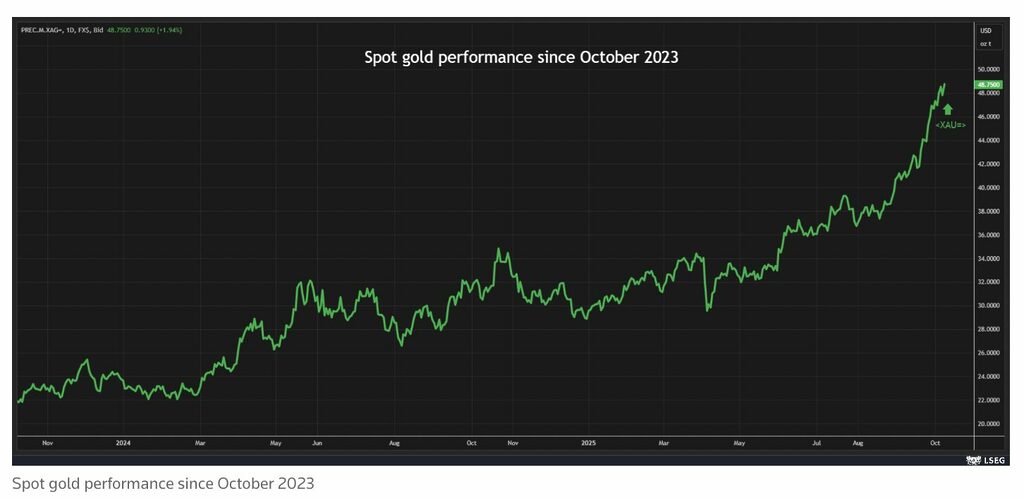
The key point: Keep one eye on the global dominoes. A well-diversified portfolio or a thematic basket aligned with global trends (such as an export-oriented smallcase or a commodities-driven one) can help navigate these twists. If the US sneezes or oil sneezes, know which part of your portfolio might catch a cold – and which part might actually thrive.
To Wrap Up
The big picture behind market moves is the economy itself. By reading the signs, you start seeing the why behind market gyrations.
ADDITIONALLY…
You can’t predict the economy with certainty, but you can prepare your portfolio to move with it. How? Through diversification and by aligning part of your investments with macro-resilient themes.
Also, think long-term structural trends: India’s drive toward self-reliance, renewable energy, and digital transformation, which will play out over the years.
This is where model portfolios can help. Instead of picking individual stocks, you can invest in curated baskets aligned with these macro themes, like Green Energy, Defence, or Consumer Spending. Platforms like smallcase offer expert-curated portfolios to help you diversify across companies and sectors and help you ride out volatility.
Check out model portfolios on smallcase suited for your investment style here.
Disclaimer: This analysis is for educational purposes and does not constitute investment advice. Market conditions can change, and past performance is not indicative of future results. Investors should conduct their own research and/or consult a certified financial advisor before making investment decisions.


You may want to read
 Not All That Glitters: What Gold & Silver’s Rally Reveals About the Economy
 The Consumption Catalyst: Reading GST 2.0 Through Investors’ Lens
 India’s Q1 GDP Data: What Led to a 5-quarter Growth?