

India’s Great Ethanol Shift: What it Means for Your Portfolio
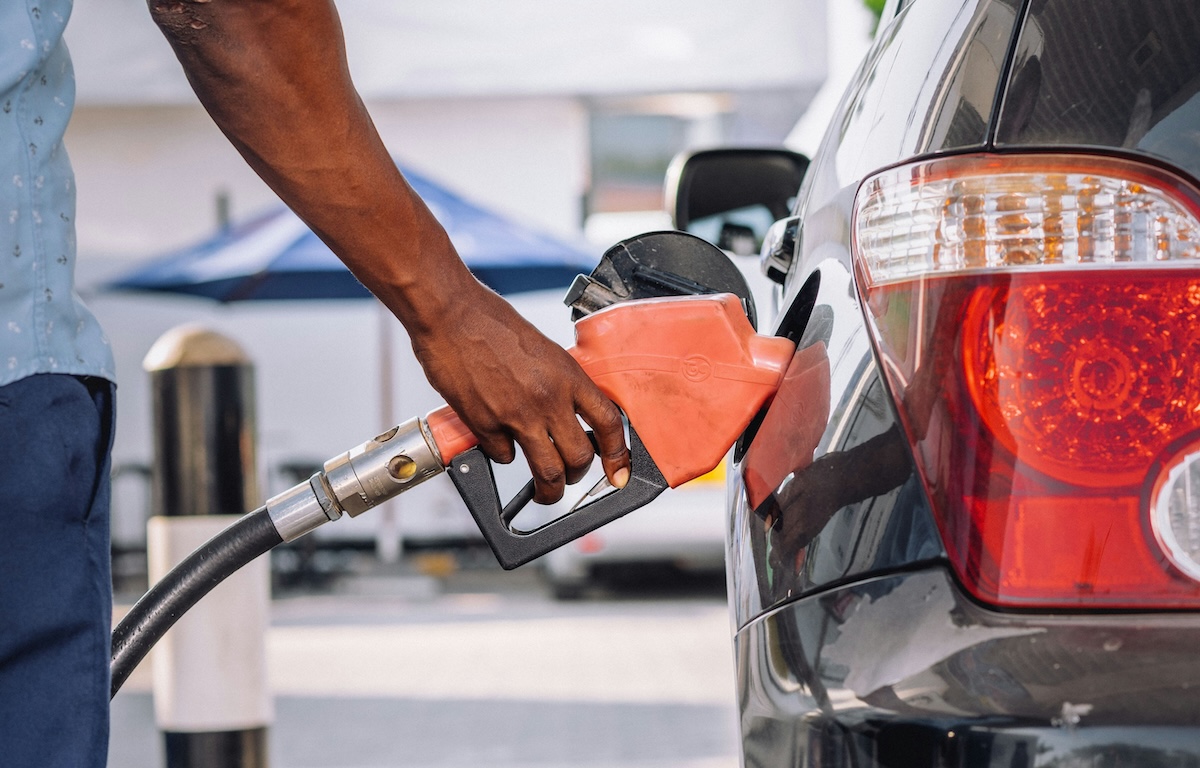
As of April 2026, every litre of petrol sold across India contains 20% ethanol: a biofuel made from sugarcane, maize, and surplus food grains. India met its E20 blending target five years ahead of the original 2030 deadline.
But E20 may only be the beginning at the pumps. E85 fuel is already available at select outlets, and in June, Union Minister Nitin Gadkari signed off on the regulatory framework for 100% ethanol fuel — a move significant enough that India’s auto industry is estimated to spend about ₹50,000 crore preparing for it.
This pivot can reshape which companies benefit, which sectors get rewired, and where investors betting on the auto sector might want to pay attention.
Let’s unpack what this means.
First, What Are E20, E85, and E100?
The number refers to the proportion of ethanol in the fuel blend. India’s nationwide E20 rollout is complete, meaning petrol now contains 20% ethanol. E85 raises that share to as much as 85%, while E100 is almost pure ethanol. Here’s a quick breakdown:
| Fuel Grade | Ethanol Share | What it Means for Your Vehicle |
| E20 | 20% Ethanol, 80% Petrol | The new standard petrol. Most recent cars and bikes run on this perfectly. |
| E85 | Up to 85% Ethanol | Requires “Flex-Fuel” engines built to handle higher bio-fuel mixes seamlessly. |
| E100 | Near-pure Ethanol | Pure bio-fuel; currently being rolled out in dedicated pilot projects. |
What is the Govt Doing?
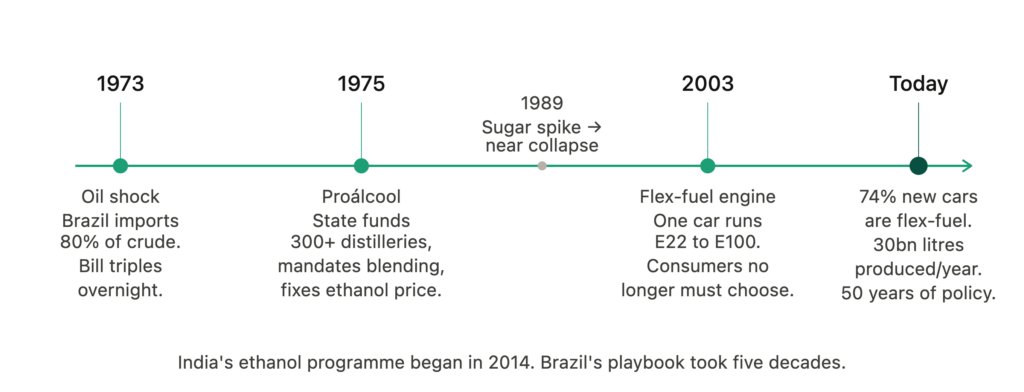
The government is not moving linearly from lower to higher blends. Instead, it is pursuing a dual-track strategy, scaling both E20 and higher-ethanol blends in parallel, similar to Brazil’s long-term ethanol programme.
Brazil offers a useful reference point for how such a transition evolves over time.
Brazil’s Move to Ethanol – A Timeline
Why this Push, and Why Now?
India imports nearly 89% of its crude oil requirements, resulting in an annual import bill exceeding ₹22 lakh crore. Global oil price spikes and geopolitical disruptions directly impact India’s economy and currency.
Ethanol offers a domestic alternative. It can be produced within India, reducing reliance on imported fuel while lowering emissions. E20 blending alone is estimated to have reduced CO₂ emissions significantly.
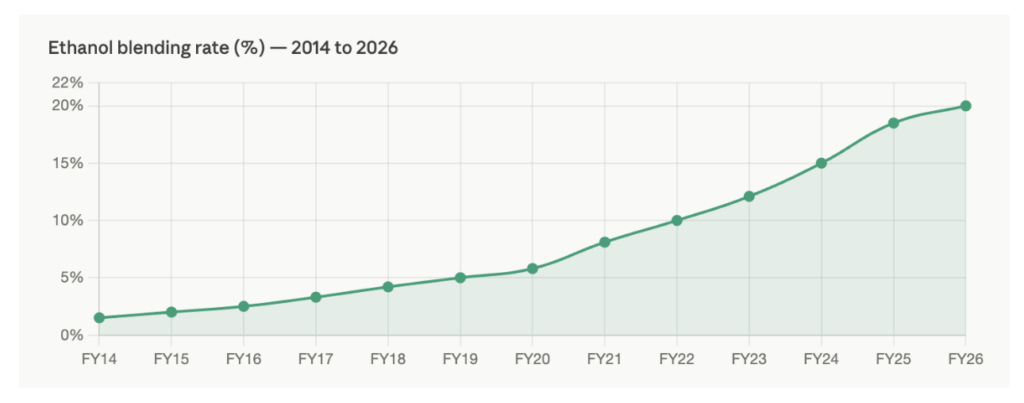
Source: Ministry of Petroleum and Natural Gas / PIB
The policy also supports rural incomes. Between 2014 and 2025, ethanol procurement transferred roughly ₹1.18 lakh crore to farmers by creating demand for sugarcane and grain-based feedstocks.
The logic is straightforward:
Domestic ethanol production → Lower petrol demand → Reduced crude imports → Lower external vulnerability |
But, There’s a Catch
Ethanol blending comes with its own problems.
Ethanol is more corrosive than petrol and burns differently, requiring specialised fuel systems, compatible engine components, and software that can automatically adjust combustion.
Enter flex-fuel vehicles
And just as Brazil did, flex-fuel vehicles (FFVs) are the answer to this issue. FFVs are designed to run on a wide range of ethanol-petrol blends, from E20 to E100.
Indian automakers have already started preparing. Maruti Suzuki has launched the WagonR Flex Fuel, while Hero MotoCorp has introduced flex-fuel versions of the Splendor+ and HF Deluxe.
The shift is being driven not just by fuel policy but also by regulation. Under the upcoming CAFE 3 (Corporate Average Fuel Efficiency) norms, expected from April 2027, flex-fuel vehicles are likely to receive regulatory treatment similar to EVs when calculating fleet emissions. That creates a strong incentive for automakers to expand their flex-fuel offerings.
Auto Sector: Preparing for a Fuel Future
This is where policy begins to translate into market positioning.
Maruti Suzuki’s WagonR Flex Fuel and Hero MotoCorp’s flex-fuel motorcycles are notable not for being technologically groundbreaking, but for targeting mass-market consumers.
In fact, Maruti Suzuki has in its 2030 product plan said 25% of its vehicles will be compatible with ethanol-blended fuel E20, while another 25% will be hybrid electric vehicles (HEV).
TL;DR: Manufacturers are preparing for scale.
Mahindra & Mahindra, Hyundai and MG are also expected to introduce ethanol-compatible models. Meanwhile, suppliers of engine control units, fuel systems and sensors could benefit as flex-fuel production expands.
That said, the ecosystem is still at an early stage. Hero’s flex-fuel motorcycles are initially launching only in select states, while broader E85 and E100 fuelling infrastructure is expected to emerge gradually through 2026 and beyond.
Oil Companies: The Infrastructure Backbone
India’s oil marketing companies also sit at the centre of the transition.
They are the largest buyers of ethanol and will also be responsible for building the fuelling infrastructure needed for E85 and E100 adoption.
The current roadmap targets scaling up to 500 retail outlets by December 2026, followed by a major expansion to 5,000 dispensing stations nationwide by the end of 2027.
This is more complex than a simple pump upgrade. Ethanol requires dedicated storage, separate handling systems and tighter quality controls. The investment burden will largely sit with OMCs.
How these companies price higher ethanol blends relative to petrol may ultimately determine how quickly consumers adopt them.
EVs: A Different Story
Will ethanol disrupt India’s EV market? Not necessarily.
India’s energy transition strategy is increasingly becoming a multi-fuel strategy. Ethanol, EVs and green hydrogen are being developed in parallel because they serve different use cases.
Flex-fuel vehicles may be particularly relevant in rural and semi-urban markets where charging infrastructure remains limited. EVs, meanwhile, continue to gain traction.
India’s EV market has already crossed 2.5 million annual sales, with passenger EVs nearly doubling year-on-year. Two- and three-wheelers remain the primary volume drivers.
Key reasons behind this:
- Higher fuel costs: Global supply shocks and geopolitical tensions have kept conventional fuel prices elevated, improving the cost appeal of EVs for both consumers and fleet operators.
- Policy push: Incentives such as the PM E-Drive Scheme are supporting near-term adoption.
- Local manufacturing scale-up: Global OEMs like Toyota and Suzuki are committing over $11 billion to India, while domestic players such as TVS, Bajaj, and Ather continue to lead the two- and three-wheeler EV market.
Ethanol Transition: The Risks
Brazil took decades to build its flex-fuel ecosystem. India is still in the early stages and may face challenges like:
- Infrastructure challenge: Success depends on vehicle availability, fuelling infrastructure, and competitive pricing scaling up together.
- Vehicle compatibility: Higher ethanol blends require compatible engines and fuel systems. Adoption could be slower if the availability of flex-fuel vehicles remains limited.
- Lower fuel efficiency: Ethanol contains less energy than petrol, which can lead to lower mileage and affect consumer acceptance of higher blends.
- Food vs fuel debate: Greater use of sugarcane and food grains for ethanol production could put pressure on food supplies and agricultural prices.
- Commercial uncertainty: Despite the scale of investment, analysts expect flex-fuel vehicles to account for a low single-digit share of the market by 2030.
In short, the capacity has already been built, but demand may take time to catch up.
What this Means for Your Portfolio
The ethanol story is not a short-term trade. It is a multi-year policy theme with implications across several sectors.
- Sugar and distillery companies: Higher ethanol blends could drive additional demand for ethanol producers and feedstock suppliers.
- Auto manufacturers: Automakers are investing in flex-fuel vehicles to prepare for a future with higher ethanol adoption.
- Oil marketing companies (OMCs): They will play a key role in building the fuelling infrastructure needed for E85 and E100.
- EVs remain part of the story: Ethanol and EVs are expected to grow alongside each other rather than compete directly.
The ethanol story touches multiple sectors at once — sugar and distilleries, auto, OMCs, and clean mobility. For investors, tracking these structural themes together may offer more clarity than looking at any single company.
If these themes are on your radar, you can browse smallcase collections across electric mobility, the auto sector, renewable energy, and more to see what fits your view.
Explore smallcase now!
Disclaimer: Investments in the securities market are subject to market risks. Read all the related documents carefully before investing. Past performance is not indicative of future results.
This analysis is for educational purposes and does not constitute investment advice. Market conditions can change, and past performance is not indicative of future results. Investors should conduct their own research and/or consult a certified financial advisor before making investment decisions.


You may want to read
 Is India’s Deep Sea Oil Exploration Move an Economic Gamechanger?
 Strategic Analysis: The Persistent-Nagarro $2.9 Billion AI Consolidation
 Why India’s Retail Investors Are Embracing Quant Investing