

Is India’s Deep Sea Oil Exploration Move an Economic Gamechanger?

₹84,084 crore mission. 60 deepwater wells. And a govt willing to bear 50% of the costs.
India is turning its attention to what’s beneath the ocean floor. Samudra Manthan, a deep-sea exploration scheme, aims to find more oil and gas under Indian waters, so the country depends a little less on expensive and risky imports.
But there is more than just oil exploration. It marks a change in how India sees its oceans now, not just a shipping route, but also as an economic zone that can support entire industries: drilling, engineering, shipbuilding, subsea equipment.
For long-term investors, that’s the more interesting part. Energy security and domestic production are being treated as an industrial project, not just a policy target.
What Exactly Is “Samudra Manthan”?
The name comes from the mythological tale where gods and demons churned the ocean to bring out its hidden treasures. The modern version is more technical, but the idea is similar: India wants to “churn” its seas to find oil and gas reserves that can support a fast-growing economy.
Today, India imports around 88-89% of its crude oil and roughly half its natural gas. This means every global shock — wars, shipping disruptions, sanctions — hits our fuel bill first, and then inflation and growth.
In his Independence Day speech in 2025, Prime Minister Narendra Modi flagged a “National Deep Water Exploration Mission” as a modern Samudra Manthan to reduce exactly this vulnerability. The Cabinet approved the scheme on 31 July 2026, to run through FY 2030-31.
Source: PIB
How The Money Is Being Used
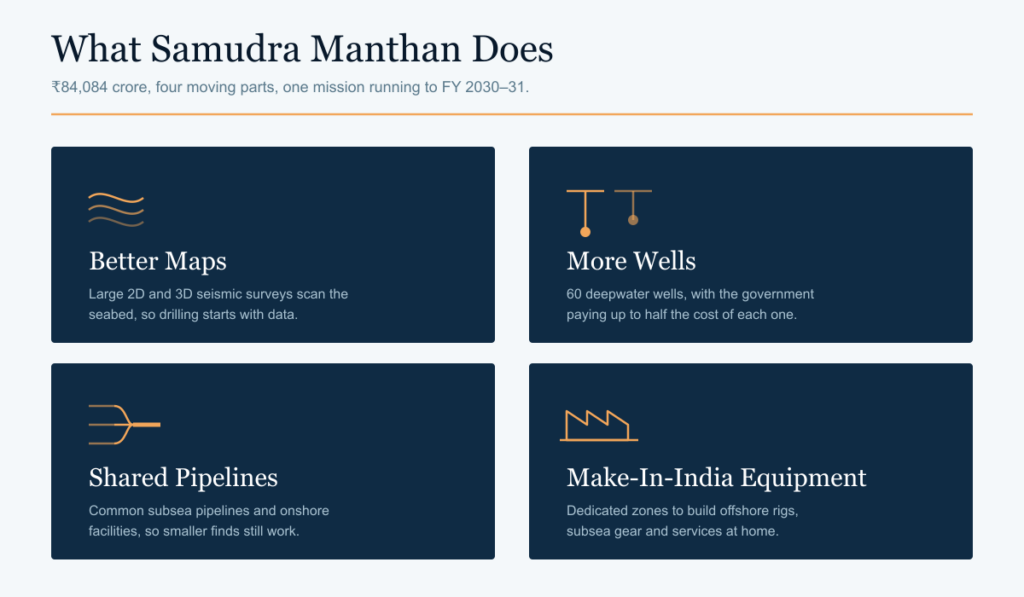
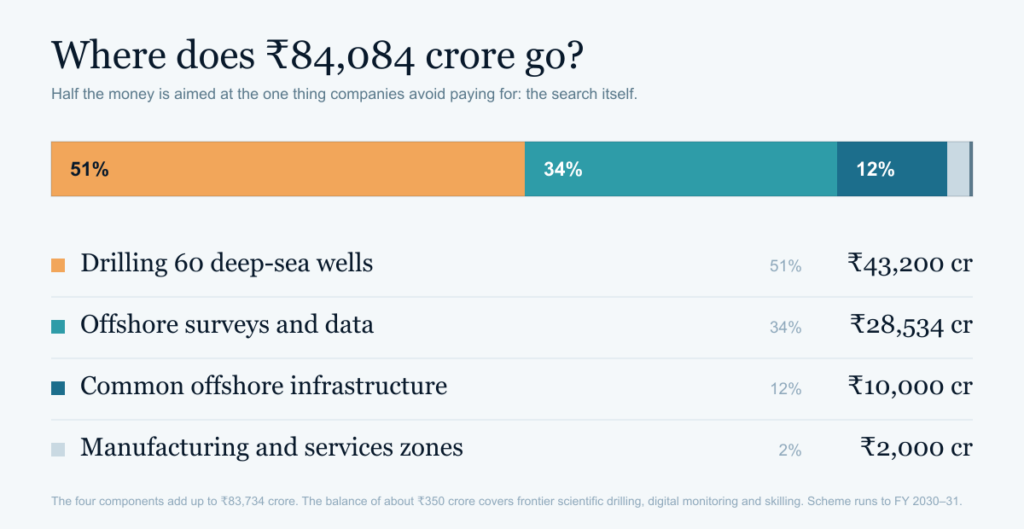
The ₹84,084 crore outlay splits across four buckets.
- Drilling 60 deep-sea wells: The government pays up to 50% of each exploration well, capped at about ₹675 crore per well.
- Offshore surveys and data: Before drilling, the scheme funds large 2D and 3D seismic surveys—basically “scans” of the seabed. This data reduces the chance of drilling in the wrong place.
- Common offshore infrastructure: Build shared subsea pipelines and onshore facilities so multiple discoveries can use common evacuation and processing infrastructure instead of each project building its own.
- Manufacturing and services zones: This part aims to create dedicated zones to make offshore equipment and provide services in India, cutting dependence on imported gear.
Source: PIB
The Targets: What Does Success Look Like?
The government and independent explainers point to a few clear numbers:
| Target | What’s Expected |
| Reserves | Add more than 600 MMTOE (million metric tonnes of oil equivalent) to India’s oil and gas reserves over time |
| Annual Production | 10-15 MMTOE a year, with peak potential around 20 MMTOE if discoveries pan out |
| Import Independence | Roughly 3-5% lower oil and gas imports once production ramps up |
| Timeline | Phase I runs to FY 2030-31 |
On paper, this will not turn India into a Saudi Arabia. But shaving off even a few percentage points of import dependence can ease pressure on the current account, the currency and inflation during global shocks.
Why This Is Being Called A “Game-Changer”
1. The government is taking on the biggest risk
Deep-sea exploration is expensive, and success isn’t guaranteed. That’s why companies have historically focused more on developing known reserves than searching for new ones.
With Samudra Manthan, the government is funding high-risk exploration itself—making it easier for companies to explore areas they might otherwise have avoided.
2. It’s building an entire offshore ecosystem
This isn’t just about drilling more wells. The mission also supports seismic surveys, pipelines, processing infrastructure, and domestic manufacturing.
3. It’s about more than oil
India imports the majority of its crude oil, leaving it vulnerable to supply disruptions and volatile global prices.
By boosting domestic exploration, Samudra Manthan is as much an energy security initiative as it is an industrial one, aimed at reducing long-term import dependence.
What’s Beyond Just Oil?
Here’s the part that usually gets left out of the conversation, but it is equally important.
India has a coastline of about 11,098 km, including its islands. Beyond that sits an Exclusive Economic Zone of over 2 million sq km — the world’s 18th largest. Under the UN Convention on the Law of the Sea, that zone extends 200 nautical miles from the coast, and inside it India has exclusive rights to explore and use whatever resources there are – oil, gas, minerals, fish.
That’s a very large piece of economic territory.
Also, look at what else is sitting in that zone. Around 70 GW of offshore wind potential off Gujarat and Tamil Nadu alone. Polymetallic nodules in the Central Indian Ocean Basin — an estimated 380 million tonnes of them, containing nickel, copper, cobalt and manganese, which is why the Deep Ocean Mission exists. Fisheries that support crores of livelihoods.
India doesn’t really have that industry at scale yet. You can’t build it without sustained offshore activity to feed it. Sixty funded wells over five years is the first credible order book that the ecosystem has ever been offered.
The Realistic View of Oil Exploration
Although very promising, the initiative has some caveats that are worth watching:
Not every well will hit oil or gas. Deepwater exploration is inherently uncertain, and some of the 60 wells will inevitably come up dry or prove commercially marginal. That’s not a failure of the scheme — it’s how frontier exploration works.
Timelines are long. Even after a discovery, moving from “find” to “production” takes years of approvals, engineering and construction. This is not a quick fix for pump prices.
Environment and ESG concerns are real. Deep-sea drilling carries spill and ecosystem risks, and global capital increasingly views fossil-fuel projects through an ESG lens. India will need strong safeguards and a clear explanation of how offshore output fits into its larger clean-energy journey.
The Bottom Line
Will Samudra Manthan be a game-changer for the economy? Early signs look promising.
The bigger opportunity lies in the ecosystem it could create. If the mission succeeds, it won’t just add oil and gas reserves; it could strengthen offshore engineering, shipbuilding, marine logistics, subsea infrastructure, and domestic manufacturing over the next decade.
If you’d like to explore this space further, you can browse smallcase’s Oil & Energy collection, which brings together portfolios focused on India’s evolving energy landscape.
This article is for information purposes only and should not be construed as investment advice. Investments in securities markets are subject to market risks. Read all related documents carefully before investing.
Disclaimer: This analysis is for educational purposes and does not constitute investment advice. Market conditions can change, and past performance is not indicative of future results. Investors should conduct their own research and/or consult a certified financial advisor before making investment decisions.


You may want to read
 Tips Music Is Turning Yesterday’s Hits Into Today’s Profits
 How Phoenix Mills Built a ₹16,500 Crore Mall Business by Letting the Rent Lag Behind the Sales
 How Aadhar Housing Finance Turned “No Payslip? No Problem” Into a ₹31,000 Crore Business