
Who Runs the House of Tata? Trusts, Sons, Mistrys and the Fight Over Chandra’s Third Term

India’s most respected business group is facing its second major boardroom dispute in ten years. On 17 September 2026, the Tata Sons board voted 4 to 1 to give N. Chandrasekaran a third five-year term as chairman and to start working towards meeting the RBI’s listing requirement. Just hours later, Tata Trusts, which owns about two-thirds of Tata Sons, called the reappointment “illegal” and a “legal nullity.” The only director who voted against it was Noel Tata, chairman of the Trusts.
To understand why a vote at the holding company has unsettled a group with ₹16.24 lakh crore in revenue for FY26, as reported by Tata Sons, you need to look at the two families, two institutions, and a unique ownership detail at the heart of the issue.
TL;DR:
Tata Sons is at the centre of its second major boardroom battle in a decade. N. Chandrasekaran has been reappointed for a third term and the company is now expected to comply with the RBI’s listing requirement, but Tata Trusts – its 66% shareholder – has called the decision illegal. At the heart of the dispute are the Tata Trusts’ control rights, the SP Group’s 18.4% stake and need for an exit, and a long-running disagreement over whether Tata Sons should remain private or go public. What began as a leadership question has now become a larger test of who ultimately controls the Tata Group.
The Two Families
The Tatas: Jamsetji Nusserwanji Tata started a trading firm in 1868 and later planned India’s first integrated steel plant, its first hydroelectric power projects, and the Taj Mahal Palace hotel. His sons, Sir Dorabji Tata and Sir Ratan Tata, expanded on these plans. Unlike most Indian business families, both sons left their fortunes and shares to charitable trusts, so control of the business shifted to philanthropy rather than to heirs.
The Tata family had an unexpected link to Muhammad Ali Jinnah. In 1918, Jinnah married 18-year-old Rattanbai “Ruttie” Petit, the daughter of his friend, the wealthy Parsi industrialist Sir Dinshaw Petit. One well-known story says that Jinnah first asked Dinshaw what he thought about inter-community marriages. Dinshaw said they could help national integration, and then Jinnah revealed he wanted to marry Dinshaw’s own daughter. Dinshaw was strongly against the idea, but Ruttie married Jinnah anyway. The Petit family was also connected to the Tatas, as Ruttie’s brother later married Sylla Tata, who was J.R.D. Tata’s sister.
Later generations included J.R.D. Tata, a descendant of Jamsetji’s cousin R.D. Tata, and Ratan Naval Tata, Sir Ratan Tata’s adopted grandson. Noel Tata, Ratan Tata’s half-brother from Naval Tata’s second marriage to Simone Tata, now leads the Trusts.
The Mistrys (Shapoorji Pallonji Group): The SP Group, founded in 1865, is one of India’s most prominent construction and engineering companies, known for projects such as the Chenab Railway Bridge and Bharat Mandapam. The Mistry family’s stake in Tata Sons goes back several generations, built up through buying shares from earlier owners, and now stands at about 18.4%, making it the largest block not owned by the Trusts. Pallonji Mistry, who passed away in 2022, was such a quiet figure on the Tata Sons board that he was nicknamed “the Phantom of Bombay House.” His sons are Shapoor Mistry, who now leads the SP Group, and the late Cyrus Mistry.
How the families are connected: The relationship is more than just business. Noel Tata is married to Aloo Mistry, who is Pallonji’s daughter and the sister of Shapoor and Cyrus. So, the person challenging the SP Group’s exit terms is actually negotiating with his own brothers-in-law.
Tata Sons and Tata Trusts: Who Owns What
Tata Sons is the unlisted holding company that leads the group. It owns the “Tata” brand and holds controlling or significant stakes in most of the group’s listed companies.
Tata Sons’ direct stakes in major listed group companies, based on FY26/year-end and subsequent shareholding disclosures :
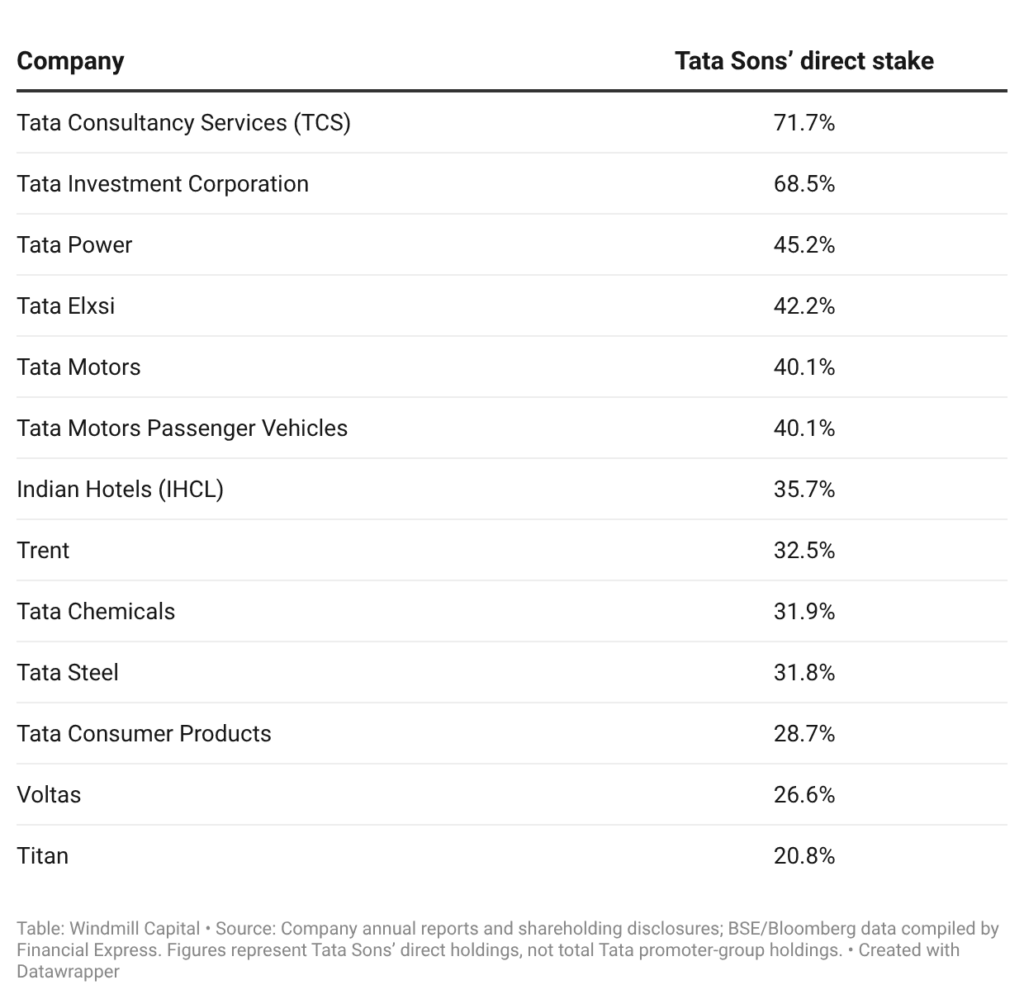
According to Tickertape’s tracker, these holdings were valued at over ₹12 lakh crore in March 2026. The TCS stake alone, worth about ₹6.2 lakh crore, makes up nearly half of that total and is also a key source of dividend income for Tata Sons.
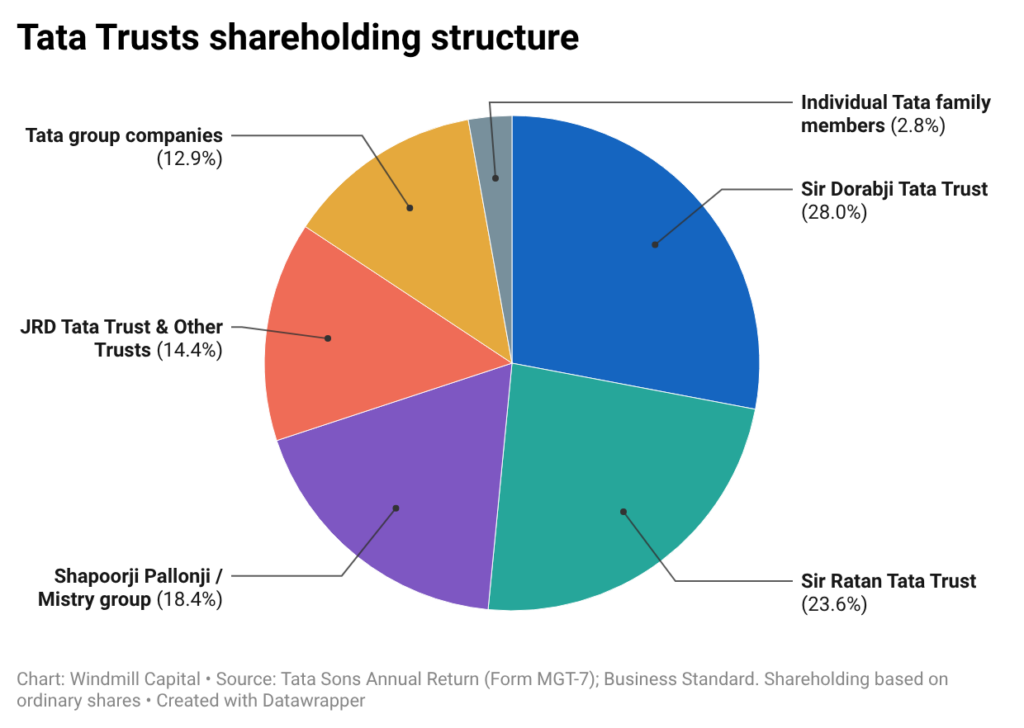
Tata Trusts are above Tata Sons in the ownership structure. The Sir Ratan Tata Trust (founded in 1919) and the Sir Dorabji Tata Trust (founded in 1932) are the largest, and together with related trusts, they own about 66% of Tata Sons. The Trusts nominate one-third of the Tata Sons board. According to Article 121 of Tata Sons’ Articles of Association, major decisions, including appointing the chairman, require a majority of the full board and approval from the majority of Trust-nominated directors. This rule gives Trust nominees significant blocking power and is central to the current legal dispute.
The Trusts’ holdings in Tata Sons also benefit from a unique historical tax situation. Indian tax law usually limits how charitable trusts can invest to maintain their tax exemption, but shares held as part of a trust’s assets before 1 June 1973 are grandfathered. This rule has been key in tax disputes over Tata Trusts’ long-term holdings in Tata Sons. According to Moneylife’s Sucheta Dalal, this gives Tata Trusts an advantage that newer philanthropic foundations lack, though the exact tax treatment has been debated in court.
Leaders of the Tata Group, from Jamsetji to today: The chairman of Tata Sons is effectively the head of the entire Tata group. Tata Sons controls the Tata brand, holds the group’s largest shareholdings, and decides how capital is allocated. The chairman usually also leads the biggest operating companies. Currently, Chandrasekaran chairs the boards of TCS, Tata Steel, Tata Motors, Tata Motors Passenger Vehicles, Tata Power, Air India, Tata Consumer Products, and Indian Hotels. This is why every dispute over the chairman’s role, from 2016 to now, is really about who controls the group. Excluding interim periods, only seven people have held this position:
- Jamsetji Tata (1868–1904): founder of the enterprise that became the Tata Group.
- Sir Dorabji Tata (1904–1932): built Tata Steel and Tata Power and set up the first major trust.
- Nowroji Saklatwala (1932–1938): Jamsetji’s nephew and the first chairman outside the direct line.
- J.R.D. Tata (1938–1991): led for 53 years and launched Tata Airlines (later Air India), TCS and Titan.
- Ratan Tata (1991–2012): consolidated Tata Sons’ hold on its operating companies and bought Tetley, Corus and JLR.
- Cyrus Mistry (2012–2016): the first chairman from the SP family.
- N. Chandrasekaran (2017–present): the first non-Parsi chairman and the first professional manager to get the job.
Ratan Tata also returned as interim chairman between October 2016 and February 2017.
Chairmen of Tata Trusts: Ratan Tata led both Tata Sons and the Tata Trusts for much of his tenure, but that arrangement is no longer permitted. He chaired the Trusts from the early 1990s until his death on 9 October 2024. Noel Tata became chairman of the Trusts two days later. However, in 2022, Tata Sons changed its rules to prevent anyone who chairs the Sir Dorabji Tata Trust or the Sir Ratan Tata Trust from also serving as chair of Tata Sons. This means Noel can influence who leads Tata Sons, but he cannot take the role himself.
Cyrus Mistry: Appointed in 2012, Removed in 2016
The appointment. As Ratan Tata approached the retirement age of 75 that the group had set for non-executive directors, a selection panel spent more than a year looking for a successor. Cyrus Mistry, who had joined the Tata Sons board in 2006 to represent the SP stake, was initially a member of that panel. The panel ended up choosing him. He was named deputy chairman in November 2011 and took over as chairman in December 2012.
The friction: Mistry took over several costly projects from Ratan Tata’s time, such as the loss-making European steel business from Corus, the Tata Nano, and a dispute with NTT Docomo. His efforts to reduce losses conflicted with the Trusts. Ratan Tata, still chairman of the Trusts, and other trustees felt excluded from key decisions and believed the group’s founding values were being overlooked.
The removal. On 24 October 2016, Trust-nominated directors asked Mistry to resign at a routine board meeting at Bombay House. He refused, and the board removed him within the hour. Several directors who voted against him had joined the board only recently. Ratan Tata came back as interim chairman. Directors who objected to the manner in which Mistry was removed, including Nusli Wadia, were later removed from the boards of group companies.
The aftermath: In 2017, Tata Sons changed from a deemed public company to a private company. Although Tata Sons was never listed, its size and shareholding structure meant company law treated it like a public company, making its shares easier to sell. Becoming a private company made it much harder for the SP Group to sell its 18.4% stake without the Tatas’ approval, which is why the exit issue remains unresolved. The Mistry family took both matters to court. In December 2016, two SP Group investment firms filed a case with the National Company Law Tribunal (NCLT), accusing Tata Sons of oppressing minority shareholders and mismanagement. The case challenged Mistry’s removal, and the conversion to a private company was later added as a claim. The NCLT dismissed the case in July 2018. On appeal, the NCLAT ruled in the Mistrys’ favour in December 2019, reinstating Cyrus Mistry as chairman and declaring the conversion to a private company illegal. In March 2021, the Supreme Court overturned the NCLAT on both points, upholding his removal and the private-company status. Cyrus Mistry died in a car accident in September 2022.
Chandra Takes Over (January 2017)
The board set up a selection committee soon after Mistry’s removal. Natarajan Chandrasekaran had joined TCS in 1987 and been its CEO since 2009, turning it into the group’s main source of profit. The committee chose him quickly. His appointment was announced on 12 January 2017, and he took charge on 21 February 2017.
He was the first non-Parsi chairman and the first career Tata manager to lead Tata Sons. His appointment brought stability back to Bombay House, and he maintained a good relationship with Ratan Tata. During his tenure, the group expanded, Tata Sons reduced its debt, and there was a push into digital and electronics businesses, though some ventures, such as Air India and newer projects, incurred significant losses. The board reappointed him in February 2022 for a second five-year term, ending on 20 February 2027.
RBI, the Listing Rule, and Why Chandra Said No, Then Yes
Enter the RBI: To understand the next steps, it’s important to consider the Reserve Bank of India. Since Tata Sons mainly holds shares in other companies, the RBI regulates it as a non-banking finance company (NBFC), specifically as a core investment company (CIC), a category for holding companies that invest primarily in their own group.
Why the listing rule exists. In September 2018, Infrastructure Leasing & Financial Services (IL&FS) defaulted. It was a large, unlisted, closely held group with more than 340 companies under its umbrella and over ₹90,000 crore in debt, and its problems had remained hidden until it was too late. The IL&FS crisis exposed the risks posed by large, complex and lightly scrutinised non-bank financial groups. RBI subsequently introduced its scale-based regulation framework for NBFCs in October 2021. It sorts NBFCs into layers by size and risk. The biggest and most interconnected go into the upper layer, and one of the rules for that layer is that they must list on the stock exchange within three years, so that outside investors, analysts and disclosure rules put them under more scrutiny.
Tata Sons gets included: On 30 September 2022, the RBI named Tata Sons as one of 16 upper-layer NBFCs, giving it until 30 September 2025 to list. Listing would bring in outside shareholders and regular scrutiny, which could weaken the Trusts’ strong control. As a result, Tata Sons began looking for alternatives.
What Tata Sons did (2022–24): Tata Sons tried to stop being classified as a finance company. It argued that, after paying off all its borrowings, it should be allowed to relinquish its CIC registration. In FY24, Tata Sons repaid ₹21,813 crore in debt and became debt-free, then applied to the RBI to surrender its CIC registration. If the RBI agreed, Tata Sons would no longer be in the upper layer, and the listing requirement would disappear. At the September 2024 AGM, the SP Group, which wanted a listing to sell its stake at a fair price, asked Tata Sons to consider an IPO, but Tata Sons refused.
RBI waits: The RBI neither accepted nor rejected the application. In January 2025, it kept Tata Sons on the upper-layer list and said it was still reviewing the deregistration request. In July 2025, Tata Trusts passed a resolution against listing. The 30 September 2025 deadline passed with Tata Sons still unlisted and its application unresolved. Other upper-layer NBFCs, including Tata Capital, went ahead with their IPOs. This stalemate lasted nearly a year and sets the stage for what follows.
Who’s Who in the 2025–26 Fight
The dispute following Ratan Tata’s death involves more people than the one in 2016. Here are the key individuals and institutions:
- Noel Tata is at the centre of the dispute, holding four important roles that sometimes conflict. He became chairman of Tata Trusts, which owns 66% of Tata Sons, after his half-brother Ratan Tata died in October 2024. As a Trust-nominated director on the Tata Sons board, he has a vote in accordance with the Articles. However, a rule from 2022 prevents him from chairing Tata Sons directly, so he can only influence the group through the board and the Trusts’ veto. His marriage to Aloo Mistry, Shapoor Mistry’s sister, also makes the SP Group’s stake and exit price a family issue. Noel also chairs Trent and Tata Investment Corporation.
- N. Chandrasekaran, known as “Chandra,” has been chairman of Tata Sons since 2017. His second term will end on 20 February 2027.
- Venu Srinivasan is chairman emeritus of the TVS Group, vice-chairman of Tata Trusts, and the other Trust nominee on the Tata Sons board. He supported Noel until 2025, but changed sides in 2026. This shift will determine the outcome of the vote in September.
- Mehli Mistry was a close confidant of Ratan Tata and serves as an executor of his estate. He leads M Pallonji & Co and is related to the Mistry family of the SP Group. In 2025, he led the trustees who opposed Noel’s group.
- Vijay Singh is a former defence secretary and a Tata trustee. Until 2025, he was also a Trust nominee on the Tata Sons board.
- Darius Khambata, a former Advocate General of Maharashtra, is a trustee who supported Mehli Mistry.
- Shapoor Mistry and the SP Group: owners of the 18.4% stake, with ₹55,000–60,000 crore of debt, who need
- The RBI is the regulator, and its listing rule now influences all other decisions.
How It Unfolded: July 2025 to September 2026
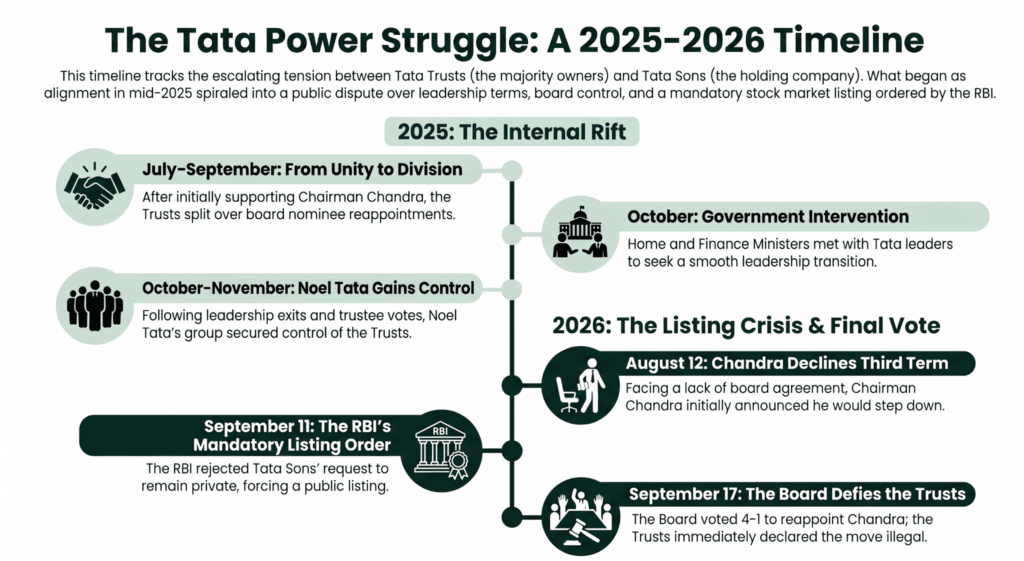
In July 2025, both main trusts supported Chandra for a third term and agreed that Tata Sons should remain a private company. At this stage, the Trusts and Chandra were aligned.
In September 2025, after Ratan Tata’s departure, the Trusts split into two groups. Vijay Singh, who was 77, needed to be reappointed as a Trust nominee on the Tata Sons board due to a new rule requiring annual reviews for nominees over 75. On 11 September, four trustees – Mehli Mistry, Darius Khambata, Pramit Jhaveri, and Jehangir HC Jehangir – voted against his reappointment. They then tried to nominate Mehli Mistry instead, but Noel Tata and Venu Srinivasan blocked this move. Singh resigned from the Tata Sons board, leaving only Noel Tata and Venu Srinivasan as Trust nominees. This detail becomes important a year later.
By early October 2025, the split was now public, and Tata Sons was still in a standoff with the RBI over the listing. The group matters too much to the economy for the government to watch its owners fight in public. Noel Tata, Venu Srinivasan, Darius Khambata and Chandra met Home Minister Amit Shah at his residence in New Delhi, and Finance Minister Nirmala Sitharaman joined them later. According to reports citing people familiar with the meeting, the talks focused on a smooth leadership transition and clarity over governance at the Trusts. Neither side has disclosed what was said or whether anything was agreed.
Between 28 October and 4 November 2025, Mehli Mistry’s term as trustee came up for renewal. Noel, Srinivasan, and Vijay Singh voted against his renewal, while Khambata and Jhaveri supported him. On 4 November, Mistry announced he was leaving Tata Trusts and resigning from his seats on the Sir Ratan Tata Trust, the Sir Dorabji Tata Trust, and the Bai Hirabai J.N. Tata Navsari Charitable Institution Trust. He did not contest the decision and said he was stepping down to prevent further conflict. With this, Noel’s group gained control of the Trusts.
In February 2026, with control of the Trusts, Noel shifted his focus to Tata Sons. At the board meeting, he suggested delaying the decision on Chandra’s third term and asked Chandra about his position on listing. The board could not reach an agreement. Reports also indicate that Noel questioned the group’s planned $120 billion five-year capital spending, preferring smaller, quicker-return projects, and called for reviews of Air India, semiconductors, and the consumer technology business.
On 12 August 2026, Chandra informed the directors that he would not seek a third term, pointing to the lack of agreement in February. The Trusts accepted his decision, and the Sir Dorabji Tata Trust started looking for his replacement.
On 11 September 2026, the RBI rejected Tata Sons’ request to relinquish its CIC registration and told the company to comply with the upper-layer rules, which require listing. Moneylife reports that Tata Sons is the only company in this category that has not complied. The RBI also filed a caveat in the Bombay High Court to ensure it would be heard before any court could pause its order.
According to Moneylife, the SP Group raised concerns before sending a formal letter. The SP Group, which has ₹55,000–60,000 crore in debt at 19–20% interest and has pledged its entire Tata Sons stake, complained to the PMO, Finance Ministry, and RBI. They said the Tata side, led by Noel Tata and the Trusts, was pressuring them to sell their 18.4% stake at an arbitrary, low price without a formal valuation. Moneylife reports that tensions increased during talks about selling part of the stake, and that Noel had earlier shared his proposed valuation with Shapoor Mistry through Deepak Parekh, former HDFC chairman. Some Tata trustees had also written to the government in support of listing.
On 17 September 2026, the RBI order changed the calculation. Tata Sons now had to list, and the other directors argued that the group and future IPO investors needed a steady chairman to see it through. They asked Chandra to reconsider, and he agreed.
At the board meeting, Noel opposed both reappointing Chandra and moving forward with the listing. Instead, he suggested approaching senior RBI officials, considering legal options, and requesting three more years – until September 2029 – to meet the listing requirement. He also proposed an SP Group plan to raise about ₹25,000 crore by selling a stake in its Tata Sons shares, which would help reduce SP’s debt without a listing. Reports vary on the amount and structure: some say it involved about 7% of SP’s holding, while others mention a sale of 2–3 percentage points of Tata Sons. The valuation was still undecided.
The board voted 4–1 to reappoint Chandra for five years, starting on 21 February 2027, and approved steps to meet the RBI’s listing requirement. Venu Srinivasan, Saurabh Agrawal (the group CFO), and independent directors Harish Manwani and Anita George voted in favour. Noel Tata voted against. Notably, Srinivasan, who had been Noel’s ally during the 2025 trustee disputes, supported the board this time.
17th September 2026 onwards: After Noel left Bombay House, Tata Trusts issued statements calling the reappointment “illegal” and “legally void and without any basis”. Their argument is based on Articles 118 and 121, as well as the outcome from September 2025. With only two Trust nominees on the board – Noel and Srinivasan – the nominees were split. The Trusts believe that, with two nominees, both must agree to form a majority, and that the chairman’s casting vote applies only when the entire board is tied, not just the nominees. They referenced a legal opinion from former Chief Justice D.Y. Chandrachud, which the board did not accept. On 20 September, the Trusts repeated that the resolution was “void ab initio”. They also argued that listing would not improve governance, since Tata Sons already has independent directors and board committees.
Why it matters?
The dispute comes down to one question: who controls the Tata group? A listing of Tata Sons would bring in outside shareholders, market valuation, and additional disclosure requirements, while potentially giving the SP Group a clearer route to monetise its holding and Tata Sons another avenue to raise capital. Tata Trusts argues that listing would alter the distinctive ownership model under which philanthropic trusts retain majority control of the group’s holding company.
Ratan Tata led both Tata Sons and the Trusts for much of his time, but Noel Tata cannot do this because the Articles now require the two roles to be separate. This dispute is a test of how much influence the Trusts can use through their majority shareholding, board nominees, and special rights under Tata Sons’ Articles, and how independently the Tata Sons board can act.
Disclaimer: Investment in securities market are subject to market risks. Read all the related documents carefully before investing. Registration granted by SEBI, membership of a SEBI recognized supervisory body (if any) and certification from NISM in no way guarantee performance of the intermediary or provide any assurance of returns to investors.
The content in these posts/articles is for informational and educational purposes only and should not be construed as professional financial advice and nor to be construed as an offer to buy /sell or the solicitation of an offer to buy/sell any security or financial products.Users must make their own investment decisions based on their specific investment objective and financial position and using such independent advisors as they believe necessary.
Windmill Capital Team: Windmill Capital Private Limited is a SEBI registered research analyst (Regn. No. INH200007645) based in Bengaluru at No 51 Le Parc Richmonde, Richmond Road, Shanthala Nagar, Bangalore, Karnataka – 560025 creating Thematic & Quantamental curated stock/ETF portfolios. Data analysis is the heart and soul behind our portfolio construction & with 50+ offerings, we have something for everyone. CIN of the company is U74999KA2020PTC132398. For more information and disclosures, visit our disclosures page here.


You may want to read
 Union Budget: 2024-25 ft. Windmill Capital
 How Kirloskar Oil Engines Went From Boring to Upper Circuit
 Windmill Capital Investor Letter – June 2026 Edition