The 2026 US Midterms and AI Stocks: What Happened and What’s Next
What are US midterm elections?
US midterm elections happen in the middle of a president’s four-year term. The president isn’t up for election then. Instead, Americans choose members of Congress, which makes the country’s laws and manages federal spending.
Congress is made up of two parts. Every two years, all 435 seats in the House of Representatives are up for election, and about a third of the 100 Senate seats are too. In 2026, there were 35 Senate races and governor elections in 36 states.
Midterms are important because the party in charge of Congress decides which laws get a vote. These elections often go against the party in power. In 20 of the last 22 midterms, the president’s party lost House seats.
The 2026 midterms took place on November 3, during President Donald Trump’s second term. Democrats took control of both the House and Senate from the Republicans and won important governor races in Texas, Ohio, and Georgia.
Artificial intelligence and the data centers behind it became a surprise issue in this election. Two days after the vote, AI stocks had one of their worst days of the year. This blog explains what happened, step by step.
AI before the election: what the two parties argued about
AI became a major campaign issue in 2026, mostly because of data centres—large buildings filled with computer chips that power AI tools. Campaigns spent over $380 million on TV ads about data centres, according to AdImpact. Democrats spent more than three times as much as Republicans on this topic.
Why voters cared
Data centres use huge amounts of electricity and, depending on their design, water. As more were built, many residents worried that the extra demand was pushing up their own power bills.
There is some evidence to support this. On PJM, the largest US power grid serving 13 states, the auction price for future power supply rose from $28.92 to $269.92 per megawatt-day in just one year. PJM reports that data centres are responsible for most of this new demand. Researchers at the Federal Reserve Bank of Dallas estimate that existing data centres have increased wholesale electricity prices by 2% to 6% on average across the US.
Where the parties stood
| Issue | Most Democrats | Most Republicans |
| New data centres | Tighter rules; some backed a moratorium (a temporary ban on new approvals) | Rapid expansion, with faster federal approvals for new power projects |
| Who pays for the power | Binding rules making data centres pay their own grid costs; ending their tax breaks | A voluntary pledge by tech companies to cover their own power costs |
| AI safety rules | Federal safety testing and oversight before powerful AI models are released | Lighter rules, and one national standard that would override state AI laws |
The Republican pledge came from President Trump. In March 2026, Google, Microsoft, Meta, Oracle, xAI, OpenAI and Amazon signed his “Ratepayer Protection Pledge”, promising to build or buy their own power and pay for grid upgrades. Critics pointed out that it was voluntary and had no way to be enforced.
The lines were not always clear
- Some Republicans disagreed with the White House. In July 2025, the Senate voted 99 to 1 to drop a plan that would have blocked state AI laws. Republican Senators Marsha Blackburn and Josh Hawley led the opposition, and Florida Governor Ron DeSantis also spoke out against it.
- Texas shifted its position. Governor Greg Abbott, who had promoted Texas as the centre of US AI growth, decided to restrict data centres late in the campaign.
- Not all Democrats supported bans. In March 2026, Senator Mark Warner of Virginia called a data centre moratorium “idiocy” and argued it would give China an advantage.
- Both parties used the issue in attack ads. In Wisconsin, the Republican candidate accused his Democratic opponent of being too friendly to data centres.
The results: Democrats won both chambers
Democrats won control of both the Senate and the House, taking them from the Republicans. Many news outlets called this a broad rejection of the Trump administration.
Senate: Democrats won seven seats from Republicans in Texas, Kansas, South Carolina, Ohio, Iowa, Maine, and North Carolina, giving them at least 54 out of 100 seats. As of November 10, votes were still being counted in Alaska and Mississippi, with Democrats slightly ahead in both. In Ohio, Sherrod Brown won after ads described his opponent as “the face of data centres in Ohio.”
House: Democrats won 255 of 435 seats, their biggest majority since 2008, and are expected to make Hakeem Jeffries Speaker.
Governors: Gina Hinojosa in Texas, Amy Acton in Ohio, and Keisha Lance Bottoms in Georgia all won after focusing their campaigns on slowing the growth of data centres.
Local votes: Many towns and counties voted directly on rules for data centres, and most supported putting limits in place. An AP poll found that in both Republican and Democrat-leaning states, most voters did not want a new data centre nearby.
How much did AI matter? Polls vary. An NBC exit poll found that 56% of voters said AI and data centres were a crucial or major factor in their vote. In contrast, an AP poll found about a quarter of voters called data centres “crucial,” which ranked well behind concerns like the cost of living and government corruption.
When it takes effect: The new Congress begins on January 3, 2027. Until then, Republicans will continue to control both chambers. Senate Majority Leader John Thune said Senate Republicans will push back against any efforts to reverse what they have passed.
What happened to AI stocks after the results
One easy way to track AI stocks is to look at them as a group. The Global X Artificial Intelligence & Technology ETF (AIQ) includes about 90 global AI companies, ranging from software and cloud businesses to chipmakers. This gives a good picture of how the sector has performed overall.
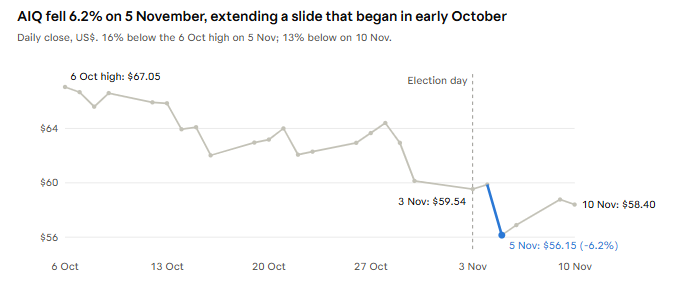
AIQ rose 0.55% the day after the election, but then dropped about 6.2% on 5 November. Investors were concerned that delays in building new data centres might slow down orders for AI chips and equipment. However, the decline had started before the vote, as some investors wondered if the large investments in AI would be worth it.
By the end of election day, AIQ was already about 11% below its high from 6 October, and about 16% below after 5 November. Since then, it has regained some value, but on 10 November it was still about 13% below that earlier peak.
What Democrats have said about AI since winning
Democrats have promised closer scrutiny of AI companies and tighter rules on data centres. But they do not all agree on how far to go.
In Congress
The mood in Congress has turned tougher on Big Tech. Democrats want the heads of AI companies to testify under oath, and the senator likely to lead the committee that oversees tech has proposed independent safety audits before powerful AI models are released. On data centres, some want a national pause while others prefer minimum federal standards.
In the states
The new Democratic governors of Texas, Ohio and Georgia have all promised to slow data centre growth, from a full pause on approvals in Texas to strict conditions in Ohio, such as making data centres pay their own power costs. They take office in January, and any pause will depend on their state legislatures and regulators.
What Democrats can and cannot do
From 3 January 2027, Democrats can hold hearings and call tech executives to testify without anyone else’s approval. New laws are harder. Any bill still needs President Trump’s signature, or a two-thirds vote in both chambers to override his veto.
In September, Trump rejected calls for more federal AI regulation, arguing it could hurt US competitiveness. This is why many analysts expect state governments, not Congress, to have the bigger say over data centres.
What analysts are saying
Most major banks think the election will slow some parts of the AI buildout starting in 2028, but it won’t stop it.
Delays are likely, but not a full stop. The biggest risk is for projects set for 2028, since most of the 2027 capacity is already under construction (Nomura). About 30% of the expected 2028 US capacity could face pauses (UBS), and states that may add restrictions account for 45% of planned capacity (Goldman Sachs). Goldman thinks any state pauses will be brief, since data centres were not a top concern for most voters.
States matter more than Congress. Broad federal limits would face hurdles in Congress and from the President, so state and local rules will decide where and how fast data centres get built (UBS). UBS sees regulation “redistributing and extending the investment cycle rather than derailing it”, and still expects global AI spending to grow from about $1.0 trillion in 2026 to $1.5 trillion in 2028, though much of that reflects higher memory chip prices.
Big cloud companies look better placed than newer players. Limited supply has made existing computing capacity “significantly more valuable”, and borrowing costs have gone up faster for neoclouds, which are newer companies that rent out AI computing power. Neoclouds account for only about 8% of AI spending, compared to 80% for the biggest cloud companies
Valuations have already reset. The data centre sector’s valuation multiple is now about half of what it was in June, which could allow for positive surprises. Healthcare is expected to be the next big area for AI (Goldman Sachs). UBS’s CEO expects some short-term ups and downs but sees AI as a strong long-term growth driver.
Things we are watching
The election has added a new layer of uncertainty for AI stocks, but the bigger picture is still forming. Over the coming months, we will watch how new rules on data centres take shape, how AI companies adjust their spending plans, and whether demand for AI keeps growing.
We will continue to watch this space closely and make changes when necessary.
Sources
Election results and politics
- CBS News: Senate results, Variety, California Today results guide
- Mississippi Today: races still uncalled, 10 November
- AP: Mike Johnson won’t seek Republican leader post
- Roll Call: midterm history
- Scripps News: governor races and data centres
- TIME: how AI backlash shaped the midterms
- AP: data centres took a beating in the midterms, Wisconsin coverage
- MS NOW: election live updates
AI policy before and after the vote
- AP: Trump’s Ratepayer Protection Pledge
- Data centres and electricity costs, PJM demand outlook
- Republican opposition to blocking state AI laws
- Axios: Warner on a data centre moratorium, TechPolicy.Press: victory speeches
- Malay Mail: Casar, Daily Caller: Casar statement, Political.org: Sanders
- Senate Commerce Committee: Cantwell’s AI framework
- TechTarget: Hinojosa’s moratorium pledge, Georgia Recorder: Bottoms’ pause
- MeriTalk: Trump on AI regulation
Markets and AIQ
- Reuters: Nasdaq 100 selloff, CNBC live updates, Semafor, CFR
- AIQ prices: StockAnalysis, Yahoo Finance, Bloomberg, Motley Fool
- AIQ summary prospectus, April 2026
Analyst views
- Goldman Sachs: Morningstar roundup, Morningstar: four impacts, Lou Miller via The Tribune
- UBS: CIO daily, 4 November, CIO daily, 6 November, UBS strategists via Fox Business, capex forecasts, memory share of capex, Ermotti via Bloomberg
- Nomura and JPMorgan: EconoTimes
Disclaimer: Investment in securities market are subject to market risks. Read all the related documents carefully before investing. Registration granted by SEBI, membership of a SEBI recognized supervisory body (if any) and certification from NISM in no way guarantee performance of the intermediary or provide any assurance of returns to investors.
The content in these posts/articles is for informational and educational purposes only and should not be construed as professional financial advice and nor to be construed as an offer to buy /sell or the solicitation of an offer to buy/sell any security or financial products.Users must make their own investment decisions based on their specific investment objective and financial position and using such independent advisors as they believe necessary.
Windmill Capital Team: Windmill Capital Private Limited is a SEBI registered research analyst (Regn. No. INH200007645) based in Bengaluru at No 51 Le Parc Richmonde, Richmond Road, Shanthala Nagar, Bangalore, Karnataka – 560025 creating Thematic & Quantamental curated stock/ETF portfolios. Data analysis is the heart and soul behind our portfolio construction & with 50+ offerings, we have something for everyone. CIN of the company is U74999KA2020PTC132398. For more information and disclosures, visit our disclosures page here.


You may want to read
 Performance Analysis and Backtests of Horizon smallcases
 What Happens After a Pharma Company Gets an FDA Warning Letter?
 ₹1 Lakh, One Crash, Three Very Different Outcomes