

US Suspends PERM Processing for 8 Tech Firms: Impact on Indian IT

The US administration’s decision to suspend Permanent Labour Certification (PERM) processing for eight major technology and IT services companies, including Tata Consultancy Services (TCS), Infosys, Wipro, HCLTech, Cognizant, Microsoft, Adobe and Capgemini. The US Department of Labour has said it will neither accept new PERM applications involving these companies nor process their pending applications.
1. What is the Permanent Labour Certification Programme (PERM)?
The PERM process is the first official step for a US company to sponsor a foreign employee for an employment-based Green Card. To protect American jobs, the employer must first prove that hiring a foreign worker will not hurt local workers.
The complete procedure follows these steps:
- Recruit locally: The employer advertises the job in the US to see if any local workers are interested.
- Verify qualifications: The employer must prove that no qualified, willing, or available US workers applied for the job.
- Offer fair pay: The company must offer a salary and working conditions that meet official government standards.
- The employer electronically files a certain form with the US Department of Labour, listing the job requirements, wages, and recruitment details. This paperwork is submitted to the government without physical proof, under penalty of perjury. Once approved, this certification does not grant a Green Card on its own; instead, it gives the company the official green light to move forward to the subsequent stages of the immigration process, including the ability to pay required wages, proof of the worker meeting job requirements using academic credentials and experience letters, and then finally the Green Card application.
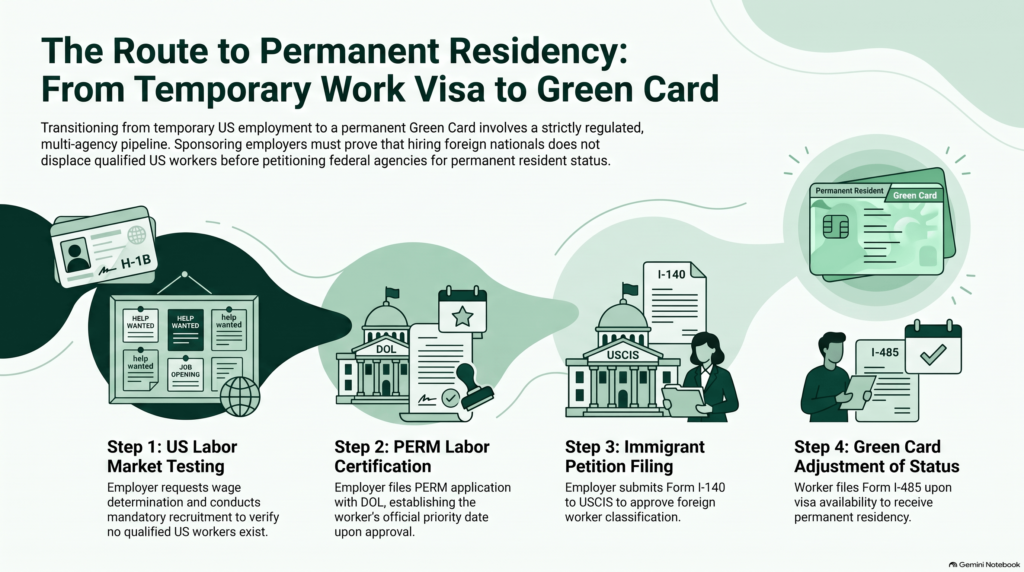
Source: US Department of Labor — Foreign Labor Certification Programmes.
Why is this important for Indian professionals?
Many skilled Indian professionals enter the US workforce on temporary work visas. Over time, an employer may decide to sponsor an eligible employee for permanent residency. PERM is often an essential link in that transition.
A worker may therefore be legally employed in the US for years without having permanent-resident status. If the Green Card process stalls, the employee can face continued uncertainty about their long-term ability to remain in the country, even if their current work authorisation remains valid.
2. What is the H-1B visa, and how is it different from PERM?
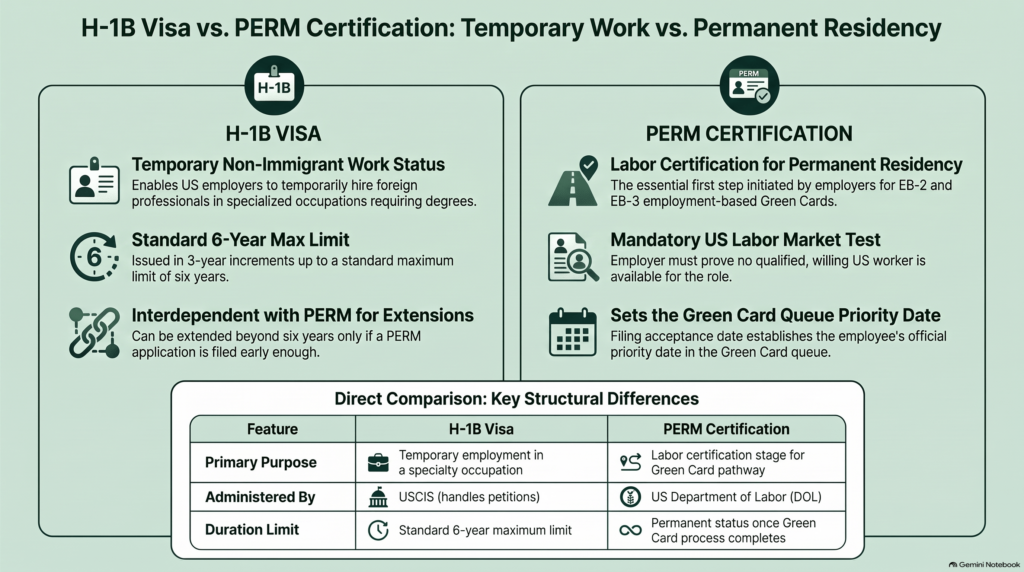
The H-1B is a US temporary work visa category that allows American employers to hire eligible foreign professionals for specialised occupations. These jobs typically require the application of specialised knowledge and, generally, a relevant bachelor’s degree or equivalent qualification.
For Indian IT professionals, H-1B visas can enable employment in areas such as software engineering, cloud computing, cybersecurity, data analytics, enterprise software and IT consulting.
An H-1B worker is not automatically a permanent resident. The visa provides temporary work authorisation under the applicable immigration rules, while a Green Card provides permanent-resident status.
| Feature | H-1B visa | PERM |
| Primary purpose | Temporary employment in a specialised occupation | Labour certification for certain employment-based Green Card cases |
| Administered by | U.S. Citizenship and Immigration Services (USCIS) handles H-1B petitions, with other agencies involved in visa issuance and admission | US Department of Labor |
| Who initiates it? | The employer generally files the petition | The employer files the labour-certification application |
| What does it provide? | Authorised temporary employment, if the relevant requirements are met | Labour certification, not a Green Card by itself |
| Typical relevance to IT workers | Allows eligible professionals to work in the US | Helps eligible employees progress towards permanent residency |
| Effect of the October 2026 suspension | H-1B status is not automatically cancelled by this PERM action | New and pending PERM applications involving the named firms are suspended |
Sources: USCIS — Temporary Workers and US Department of Labor — Foreign Labor Certification.
Why does the distinction matter?
Consider an Indian software engineer employed by an IT services company in the US on an H-1B visa. The engineer can work for the employer in accordance with the approved immigration arrangements, but temporary work authorisation does not itself establish a permanent right to reside in the country.
If the employer subsequently sponsors the engineer for a Green Card, the PERM process may become necessary. A suspension at this stage can disrupt the employee’s longer-term immigration plans, even though the employee’s existing H-1B status has not been automatically cancelled.
3. How do Indian IT companies benefit from H-1B and PERM?
To understand the business significance of these programmes, we first need to understand how the IT services industry operates.
Indian IT companies do not simply develop software in India and sell it to American customers. They also help clients implement enterprise systems, modernise technology infrastructure, migrate workloads to the cloud, manage cybersecurity and maintain complex business applications.
Some of this work can be delivered remotely from India. Other assignments require employees to work at client locations, collaborate with local teams or provide specialised support in the US. The combination of offshore delivery and on-site expertise is an important feature of the global IT services model.
H-1B and PERM serve different purposes within this model.
A. H-1B helps companies deploy specialised talent
Suppose an American bank hires an Indian IT services company to modernise its core banking technology. The project might require engineers who understand the bank’s existing systems, its implementation history and the technology platform being deployed.
The IT services company may have employees in India who already possess this expertise. Where the work requires a US-based presence, and the employee qualifies under the applicable rules, H-1B sponsorship can facilitate that deployment.
This can benefit the company in three ways:
- Access to specialised skills: The company can deploy eligible professionals whose expertise matches a client’s requirements.
- Continuity of delivery: Experienced employees can work alongside client teams during implementation, migration or troubleshooting.
- Coordination between locations: On-site professionals can coordinate with teams in India, where parts of the project are delivered remotely.
This is not the only way to staff US projects. Companies also recruit American professionals, hire employees already authorised to work in the US and deliver work from offshore centres. H-1B is one component of a broader staffing model.
B. PERM supports long-term employee retention
H-1B enables temporary employment, but employees may want greater certainty about their long-term future in the US. Employer-sponsored permanent residency can help address that need.
For an IT company, sponsoring a qualified employee for a Green Card can support retention, particularly when the employee has developed valuable client relationships or accumulated experience in a complex technology environment.
Permanent residency sponsorship can be one element of an employer’s broader retention strategy. It does not guarantee that the employee will remain with the company, but it can make a long-term employment relationship more attractive.
C. The programmes can complement the offshore delivery model
Indian IT services companies often combine relatively large delivery teams in India with smaller groups of employees working at client locations abroad.
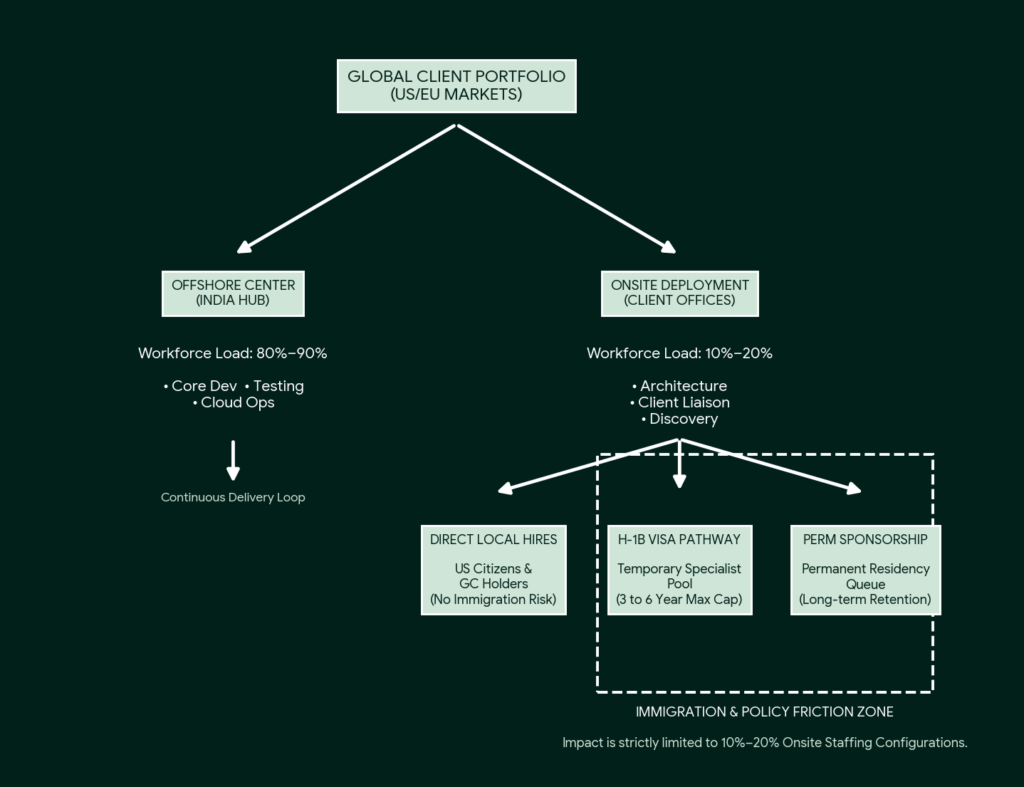
H-1B can help hire eligible US-based roles but only for a temporary basis, while PERM can support permanent-residency sponsorship for qualifying employees. Neither programme is a prerequisite for every element of the offshore delivery model.
This distinction matters because a restriction on one immigration route does not automatically eliminate the underlying demand for IT services. It can, however, make certain staffing arrangements and employee-retention decisions more difficult.
4. What has the US government decided, and why?
On October 8, 2026, the US administration announced that eight companies would be suspended from PERM processing. The affected companies are Tata Consultancy Services (TCS), Infosys, Wipro, HCLTech, Cognizant, Microsoft, Adobe, Capgemini.
The Department of Labor said it would stop accepting new applications involving these companies and halt processing of pending applications. The administration cited allegations of misuse of employment-based immigration programmes, including concerns about the displacement of American workers and the effect on wages.
5. What is the expected adverse impact?
The consequences are likely to differ between individual employees, IT services companies and the wider industry. The immediate effect is on PERM processing; the broader business consequences depend on how long the suspension remains in force and how companies respond.
Indian professionals could face greater uncertainty
The most direct impact falls on employees who rely on an affected employer to sponsor their Green Card.
A worker whose PERM application is pending may be unable to progress through that stage while the suspension remains in place. An employee who has not yet started the process may also face uncertainty about when the employer can initiate it.
Retaining experienced employees could become harder
For companies, the concern extends beyond immigration paperwork.
An employee who is uncertain about permanent residency may reconsider how long they want to remain in the US. Some may explore positions with employers whose PERM applications are not covered by the suspension, provided those employers can lawfully sponsor them and the employees qualify for the relevant immigration pathways. Others may consider returning to India or pursuing opportunities in another country.
If experienced employees leave, the company could incur recruitment and training costs, lose project knowledge and face disruptions to client relationships. These are plausible business risks rather than evidence that a particular company has already experienced a material loss of employees.
Staffing and deployment choices could become more complicated
If the suspension persists, companies may need to rely more heavily on other staffing options, including local US hiring, employees already authorised to work in the country, eligible transfers or assignments, and delivery from India.
Greater reliance on local hiring could raise recruitment costs for some roles. Moving more work offshore may not be feasible where contracts, security requirements, regulations or client preferences require on-site support.
6. What have companies said, and what should investors monitor?
Corporate responses are important because they help distinguish immediate operational disruption from longer-term risks.
According to the report on Economic Times, TCS said the suspension would not significantly affect its workforce strategy or client operations. The company also said it planned to hire an additional 15,000 employees in the US over the next five years, reflecting its emphasis on local hiring. This is the company’s stated position, not independent proof that there will be no future impact.
Industry body NASSCOM has emphasised that relatively few employees now transition from H-1B status to permanent residency through PERM, and highlighted Indian IT companies’ increased local hiring and compliance commitments.
Markets also did not seem perturbed by the development, with the Nifty IT Index closing the day up by ~3%.
For investors, several indicators are worth monitoring over the coming quarters:
- US hiring mix: Whether companies increasingly recruit locally instead of relying on internationally mobile employees for particular roles.
- Employee costs: Whether changes in staffing arrangements affect personnel costs and margins.
- Project execution: Whether companies report difficulties in deploying specialised employees to client locations.
- Employee retention: Whether the restriction creates measurable challenges in retaining experienced US-based professionals.
- Management commentary: Whether annual reports, earnings calls or investor presentations identify immigration restrictions as a material operating risk.
7. Final takeaway
The US suspension of PERM processing for eight technology companies is significant because it disrupts an important pathway for eligible foreign professionals to progress from temporary employment to permanent residency.
For Indian IT companies, H-1B and PERM have different but complementary roles. H-1B can facilitate temporary employment of eligible specialists in the US, while PERM is an important labour-certification stage in certain employer-sponsored Green Card cases.The immediate concern is uncertainty among employees whose permanent residency applications depend on the affected employers. The broader business risk is that prolonged uncertainty could complicate employee retention, staffing, and project deployment.
We are closely tracking developments surrounding the US PERM processing suspension and its evolving impact on the Indian IT sector. As companies adapt their US hiring mix, deployment models, and talent retention strategies, we continue to monitor quarterly management commentary, margin trajectories, and operational disclosures.
Disclaimer: Investment in securities market are subject to market risks. Read all the related documents carefully before investing. Registration granted by SEBI, membership of a SEBI recognized supervisory body (if any) and certification from NISM in no way guarantee performance of the intermediary or provide any assurance of returns to investors.
The content in these posts/articles is for informational and educational purposes only and should not be construed as professional financial advice and nor to be construed as an offer to buy /sell or the solicitation of an offer to buy/sell any security or financial products.Users must make their own investment decisions based on their specific investment objective and financial position and using such independent advisors as they believe necessary.
Windmill Capital Team: Windmill Capital Private Limited is a SEBI registered research analyst (Regn. No. INH200007645) based in Bengaluru at No 51 Le Parc Richmonde, Richmond Road, Shanthala Nagar, Bangalore, Karnataka – 560025 creating Thematic & Quantamental curated stock/ETF portfolios. Data analysis is the heart and soul behind our portfolio construction & with 50+ offerings, we have something for everyone. CIN of the company is U74999KA2020PTC132398. For more information and disclosures, visit our disclosures page here.


You may want to read
 Three Problems Hit Polycab India at Once. Is It a Crisis?
 Decoding Bull Markets: Why are they boring?
 Part III: Gold – Stability in Uncertain Times