

Why APL Apollo’s Growth Doesn’t Cost It a Rupee

How APL Apollo Tubes turned a single plant and a commodity product into a 55% market share, a negative working capital cycle, and a brand that now shows up in IPL broadcasts.
From a Single Plant to the Country’s Largest Steel Tube Maker
There is a product category that holds up metro station roofs, frames the doors of rural homes built under government housing schemes, carries solar panels in field installations across Rajasthan, and forms the scaffolding of airport terminals under construction across India. It does not have a consumer brand the way paint or cement does. Most people who benefit from it never see it. APL Apollo Tubes makes it, structural steel hollow sections, and has spent two decades quietly building a position in this market that is now difficult to contest.
The company started as a single manufacturing unit. The product was a structural steel tube: HRC steel coil fed into a mill, shaped and welded into square, rectangular, or circular hollow sections used wherever fabricated steel structures are needed. The market was fragmented, dominated by small regional mills producing sponge-iron-based “patra” pipe with no brand, no certification, and no distribution depth. APL Apollo chose to build all three.
Today, the company holds 55% of the organised structural steel tube market, operates 11 plants with 5 million metric ton annual capacity, distributes through 800+ distributors serving 50,000 retailers and 200,000 fabricators, and offers 5,000 SKUs, a range that covers applications from furniture frames to airport infrastructure. The journey from commodity supplier to market anchor is instructive, because it happened through a combination of deliberate technology bets, distribution investment, and working capital discipline rather than through acquisition or financial engineering.
The financial proof is in two numbers that rarely move together: EBITDA per tonne and market share. Between FY15 and 9MFY26, sales volumes grew at a 17% CAGR. Over the same period, unit EBITDA expanded from roughly ₹3,150/MT to ₹5,030/MT. Volume and realisation quality moved up simultaneously, which is the operational signature of a business that has genuine pricing power, not just scale.
5,000 SKUs, One Core Thesis
The product portfolio is wider than it appears from the outside. Apollo Structural, HRC-based tubes for residential, commercial, and infrastructure applications, accounts for 64% of sales volumes, with residential buildings and independent homes alone contributing 41%. Apollo Z, a pre-galvanised tube targeted at coastal markets, adds 32%. Apollo Galv, a galvanised product for commercial and agricultural applications, makes up the remaining 4%.
The demand mix by end-use breaks down as 67% building material for housing, 19% building material for commercial, 10% infrastructure, and 4% other industrial and agricultural applications.
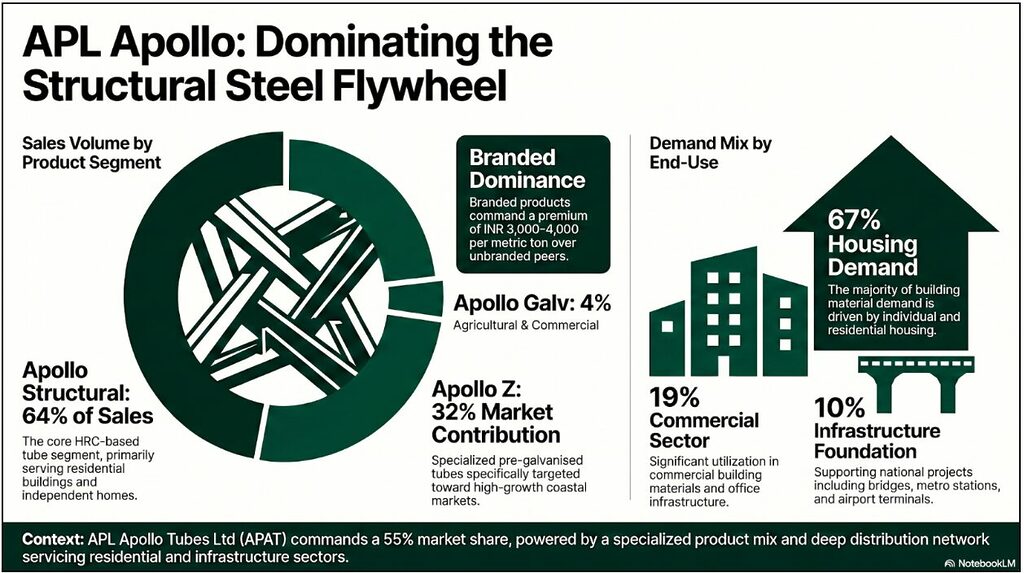
This is not a narrow infrastructure play; it is a broad-based exposure to India’s construction activity, across its residential, commercial, and public segments simultaneously.
The strategic logic of 5,000 SKUs is not product diversification for its own sake. More SKUs mean more applications served, which means a distributor can rely on a single supplier for virtually any structural steel need. That stickiness is commercially valuable: it raises switching costs without requiring any formal exclusivity, and it makes it impractical for a smaller regional mill to displace APL Apollo from a distributor’s primary shelf space. The SKU count has grown from roughly 1,500 a few years ago, with Direct Forming Technology (DFT), a proprietary forming process the company pioneered in India, enabling much of that acceleration.
The brand architecture reinforces the distribution strategy. The flagship APL Apollo brand targets premium segments and commands ₹3,000–4,000/MT above unorganised peers on comparable products. The SG Premium label addresses the value segment, giving the company a credible offering for buyers upgrading from sponge-iron-based patra pipe without cannibalising the premium brand’s positioning. A single price point cannot win the entire market; two complementary ones can.
Four Tailwinds, One Industry
The structural steel tube market does not have a single demand driver; it has several converging ones, each operating on a different timeline. What is notable about the current period is that all four are active simultaneously.
Infrastructure Spending
The Union Budget for FY26–27 allocated ₹1,22,000 crore to capital expenditure. The National Infrastructure Pipeline targets approximately USD 1.4 trillion in aggregate investment through 2030. Bridges, metro stations, airport terminals, and utility towers all use structural steel tubes as a primary input. At the current pace of government infrastructure spending, up 20% year-on-year as of recent estimates, the order book for fabricators and contractors using APL Apollo’s product is not thin.
Housing Programmes
PMAY-Gramin has been extended to FY29, targeting 2 crore additional rural houses. PMAY-Urban 2.0 targets 1 crore urban houses over five years. These programmes require structural tubes for roofing supports, door frames, and plumbing, the kind of specification-driven demand where branded, BIS-certified products have a durable advantage over unorganised competition. APL Apollo’s Chaukhat door-frame product is a direct response to this: a finished, branded component targeting rural housing construction that converts a structural tube into a consumer-facing installation product.
Renewable Energy
India aims for 500 GW of non-fossil fuel capacity by 2030, with roughly 244 GW still to be added from current installed capacity. Solar mounting structures are a significant consumer of pre-galvanised structural tubes, the Apollo Z product family. This segment is margin-accretive: the corrosion resistance requirements of solar installations favour galvanised products, which carries higher unit value. As renewable capacity additions accelerate, this is one of the faster-growing application segments for the company’s existing product range.
GST Formalisation and Quality Orders
Two regulatory developments are compressing the unorganised segment in a way that market competition alone could not. First, the GST Reverse Charge Mechanism on metal scrap has removed a structural cost advantage that sponge-iron-based patra pipe manufacturers relied on. Second, BIS Quality Control Orders now mandate certification for government and PSU project procurement, a requirement that effectively disqualifies uncertified unorganised producers from a large and growing portion of the addressable market. APL Apollo, as a scaled, certified, branded player, is the primary beneficiary of both.
Market Context
The organised structural steel tube market currently accounts for an estimated60% of overall industry volumes. APL Apollo’s 55% share within the organised segment translates to roughly one-third of total industry volume, a concentration that reflects both the scale of the distribution network and the difficulty of displacing a supplier with 5,000 SKUs and 2-day delivery capability from established distributor relationships.
What Makes This Business Structurally Difficult to Displace
Scale and distribution are visible advantages. The less visible ones compound them.
- Procurement Scale as a Cost Advantage: APL Apollo is India’s largest buyer of HRC coil, sourcing over 80% of its steel from Tata Steel and JSW Steel. That volume translates to approximately ₹1,000/MT procurement cost advantage over peers, a structural edge that smaller mills cannot replicate without matching the company’s scale. When raw material is your primary cost and you buy more of it than anyone else in the country, your cost floor is permanently lower.
- Direct Forming Technology: DFT, which APL Apollo pioneered in India, produces square and rectangular hollow sections directly from HRC coil without the intermediate round-tube step used in conventional mills. The result: lower raw material wastage, lower operating costs, and faster SKU expansion capability. All new greenfield plants are being built on DFT lines. This is not a temporary process advantage, it is the production architecture that the company is doubling down on as it scales to 10 million MT.
- Distribution Depth and Delivery Speed: 800+ distributors. 50,000+ retailers. 200,000+ fabricators. ~300 towns and cities. Most orders are fulfilled within approximately 2 days. This is the operational signature that makes the distribution moat real rather than notional: a fabricator in a mid-sized town who needs a specific hollow section for a project running on deadline will not wait two weeks for a regional mill to produce it. The combination of breadth and speed is what turns distribution scale into customer lock-in.
- Captive Cold-Rolling and Green Energy: Captive cold-rolling mills allow APL Apollo to source thinner-gauge steel internally rather than buying more expensive pre-processed material externally, a unit cost saving on a high-volume input. On energy, renewable power consumption is expected to rise from ~31% in FY25 to over 70% in FY26, materially reducing unit energy costs as electricity prices rise. These are not headline competitive advantages, but they widen the cost gap between APL Apollo and the unorganised segment on every tonne sold.
A Negative Working Capital Cycle, and Why That Matters
Most manufacturing businesses require working capital to fund their supply chains: inventory sitting in the warehouse, receivables outstanding from customers, partially offset by credit from suppliers. The larger the business, the larger the working capital requirement. APL Apollo’s business runs differently.
Receivable days have fallen to 3–5 days from 20–30 days historically. The mechanism was a deliberate transition to a cash-and-carry dealer model in FY21, supported by upfront payment discounts and channel financing through the group’s NBFC, SG Finserve. Inventory days have remained stable at roughly 37 days despite a dramatic expansion in SKUs, possibly because the HRC-to-tube production cycle runs at approximately two hours, allowing lean finished goods holdings against a fast replenishment capability. Payable days have risen to approximately 40 days, reflecting improved supplier credit terms, and now exceed inventory days.
The result: a negative cash conversion cycle since FY23. The company does not fund its own supply chain. Working capital is not a use of capital; it is a source of it. This has a direct consequence for the balance sheet: despite cumulative capex of approximately ₹3,000 crore between FY21 and FY25, APL Apollo turned net cash in FY25. The ₹560 crore net cash position at 9MFY26 reflects a manufacturing business that has effectively eliminated the financing cost of its own scale.
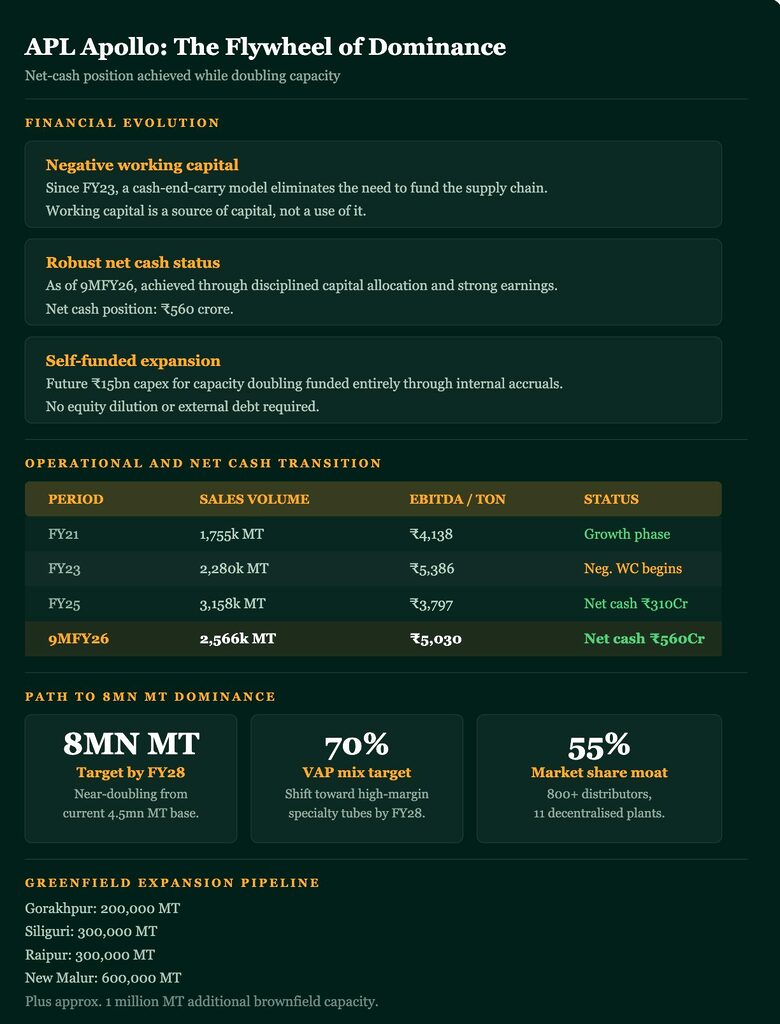
The 9MFY26 numbers extend this pattern. Revenue grew 6.7% year-on-year to ₹16,190 crore despite a 4% decline in net sales realisation, a consequence of weak global steel prices. EBITDA grew 64% to ₹1,291 crore. Net profit reached ₹850 crore, up 83% year-on-year. The divergence between revenue growth and profit growth is explained by unit EBITDA: at ₹5,030/MT in 9MFY26, it is up ₹1,630/MT year-on-year, driven by lower unit operating expenses, higher value-added product mix, procurement advantages, and the green power transition running ahead of schedule. ROCE has risen to 33.3% on an annualised basis, up from 24.5% in FY25.
Doubling Capacity Without Taking On Debt
The expansion plan is consequential in scale. APL Apollo currently operates at approximately 89% capacity utilisation, with annualised volumes running at 4.4 million MT against a 5 million MT installed base as of December 2025. There is limited room to grow volumes without new capacity, and management is acting accordingly.
The target is approximately 8 million MT by FY28, doubling current capacity. The route runs through four greenfield plants, Gorakhpur (200,000 MT), Siliguri (300,000 MT), Bhuj (300,000 MT), and New Malur (600,000 MT), and approximately 1 million MT of additional throughput through debottlenecking and plant modernisation at existing facilities. Total capex budgeted is ₹1,500 crore over FY26–28, funded entirely through internal accruals. No new debt is planned.
The geographic logic is deliberate. Gorakhpur and Siliguri bring manufacturing capacity into the eastern corridor, historically underpenetrated for branded structural steel tubes, reducing freight distances and improving lead times in a region where APL Apollo has been competing from longer distances. Bhuj, positioned for export economics into Africa and the Middle East, is directly connected to the company’s ambition to grow exports. New Malur, in Karnataka, deepens the southern manufacturing base.
Beyond FY28, the stated ambition extends to 10 million MT by 2030. The final 2 million MT is framed explicitly as a mix-upgrade rather than volume play: super-specialty tubes for EV components, aerospace, and petrochemicals, targeting unit EBITDA of ₹10,000–15,000/MT, roughly two to three times the current blended level. That segment does not yet contribute meaningfully to volumes, but it defines the margin architecture management is building toward.
Value-Added Mix Trajectory
Value-added product (VAP) mix reached58% in 9MFY26, up from roughly 40% a decade ago. The stated target is approximately70% by FY28. Each percentage point shift in mix toward higher-specification products carries a disproportionate impact on unit EBITDA, the mechanism by which margin per ton can continue expanding even when steel prices are flat or falling.
Three Risk Factors Worth Watching
The near-term results and the competitive position are broadly constructive. The risks that matter are structural or cyclical, not operational.
- Downstream Entry by Large Steel Producers: APL Apollo commands 55% market share, but the structural steel tube market is not protected by patents or regulation. Large integrated steel producers, who already supply HRC coil to APL Apollo, could, in theory, move downstream into tube manufacturing. While this has not yet materially eroded APL Apollo’s margins or leadership, the possibility represents the clearest structural risk to the company’s medium-term volume growth trajectory and the valuation premium the market assigns to its franchise.
- GCC Region Uncertainty: The UAE plant was positioned to grow its contribution from approximately 5% of volumes to 10–15% over the next one to two years. Geopolitical disruption in the GCC region has already created near-term headwinds; volume growth in the latter part of 9MFY26 was partially affected by these conditions. A prolonged demand weakness or logistical disruption in the Middle East delays what was a meaningful growth vector and an important source of higher-margin export revenue.
- HRC Price Volatility: Steel is the primary raw material and the primary cost. Sharp increases in HRC prices compress EBITDA per tonne when pass-through to customers is delayed or incomplete; the lag between input cost movement and product price adjustment is a recurring feature of this industry. The company has demonstrated pricing power through its brand premium and distributor relationships, including a full absorption of a January 2025 price hike without demand disruption, but a sufficiently sharp and rapid commodity move creates a transient but real earnings risk.
APL Apollo Tubes has spent two decades building what is now the most complete structural steel tube franchise in the country, in terms of product range, distribution reach, manufacturing scale, and cost position.
The financial trajectory through 9MFY26 reflects genuine operational improvement: margins expanding despite falling steel prices, cash generation funding a large capex programme without balance sheet stress, and unit profitability at its highest-ever level.
Whether the next phase, doubling capacity, deepening the eastern corridor, and moving up the speciality tube value chain, delivers the same quality of execution as the last is the question the business now has to answer.
Disclaimer: Investment in securities market are subject to market risks. Read all the related documents carefully before investing. Registration granted by SEBI, membership of a SEBI recognized supervisory body (if any) and certification from NISM in no way guarantee performance of the intermediary or provide any assurance of returns to investors.
The content in these posts/articles is for informational and educational purposes only and should not be construed as professional financial advice and nor to be construed as an offer to buy /sell or the solicitation of an offer to buy/sell any security or financial products.Users must make their own investment decisions based on their specific investment objective and financial position and using such independent advisors as they believe necessary.
Windmill Capital Team: Windmill Capital Private Limited is a SEBI registered research analyst (Regn. No. INH200007645) based in Bengaluru at No 51 Le Parc Richmonde, Richmond Road, Shanthala Nagar, Bangalore, Karnataka – 560025 creating Thematic & Quantamental curated stock/ETF portfolios. Data analysis is the heart and soul behind our portfolio construction & with 50+ offerings, we have something for everyone. CIN of the company is U74999KA2020PTC132398. For more information and disclosures, visit our disclosures page here.


You may want to read
 Is India’s Deep Sea Oil Exploration Move an Economic Gamechanger?
 Strategic Analysis: The Persistent-Nagarro $2.9 Billion AI Consolidation
 Why India’s Retail Investors Are Embracing Quant Investing