

Every Car Has More Uno Minda Than You Think
What Uno Minda actually is
Every car that rolls off a Maruti Suzuki line in Manesar, every two-wheeler that TVS ships from Hosur, and every Hyundai that leaves the Chennai plant carries components made by Uno Minda. Switches, lighting assemblies, horns, alloy wheels, seating systems, die-castings: across 28 product lines and 78 manufacturing facilities spanning India, Indonesia, Vietnam, Germany, Spain and Mexico, Uno Minda has built something that is genuinely difficult to replicate quickly.
The company has been in this business since 1958. That history matters less as a story and more as a structural fact: six decades of relationships with OEMs have produced deep integration at the product design stage, not merely the supply stage. When Uno Minda wins a switch programme with a Korean carmaker or a lighting contract with a Japanese two-wheeler OEM, it does not compete on price alone. It competes on co-development capability and that creates switching costs that show up in the revenue mix: roughly 93% of sales come from OEMs, the most demanding and demanding customers in the industry.
The stock is down roughly 21% in 2026, a correction that has brought valuations to approximately 30× FY28 earnings on par with peers like Sona BLW and Bharat Forge. The trigger has been a combination of geopolitical noise and OEM export headwinds. Neither is trivial. But neither touches the underlying engine of the Uno Minda story, which is content per vehicle: as cars get safer, smarter, more connected, and electrified, the number of components Uno Minda can supply per vehicle expands and that expansion is where the multi-year earnings trajectory lives.
Revenue architecture: 6 segments and one direction
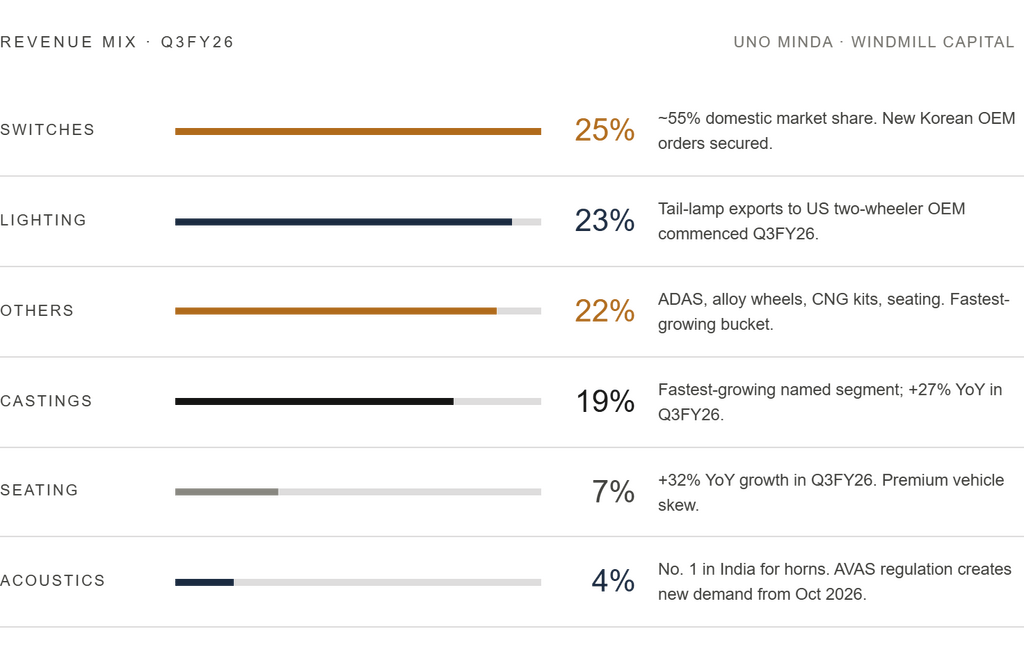
The revenue structure is more balanced than any single product company in the auto ancillary space. No segment exceeds 25% of consolidated revenue, which means no single product cycle, whether a regulatory change, a technology shift, or an OEM volume swing, can materially dislocate the company’s overall earnings.
The vehicle segment split mirrors the Indian auto market’s own structure: approximately 48% from four-wheelers and 42% from two-wheelers in Q3FY26, with the balance in commercial vehicles and off-road equipment. This broad coverage means Uno Minda does not need to bet on any single segment doing well — it needs the Indian auto industry to produce vehicles, and that has been a fairly reliable outcome over any three-to-five-year horizon.
Geography tells a similar story. India accounts for 90% of revenue, with international operations at 10%. The international number has been trending upward, management has guided for continued traction, but the business remains fundamentally a domestic Indian story, which insulates it from the kind of geopolitical disruptions currently weighing on sentiment.
The “Others” segment deserves special attention. At 22% of revenue and growing at roughly 19% year-on-year, it contains the most interesting optionality in the portfolio: alloy wheels (where the company has just approved a 1.8-million-unit-per-year greenfield facility at ₹764 crore), CNG kits (through a 76% stake in Minda Westport, a JV with Italy’s EMER Spa), high-voltage EV powertrain components (through a greenfield facility being developed jointly with Inovance), sunroof systems (through a technology licensing agreement with Japan’s Aisin Corporation), and acoustic vehicle alerting systems for EVs. These are not low-margin commodity lines; they are the new content that the company is adding per vehicle as the industry modernises.
The EV question – When your Customers change their engines, you don’t lose your seat
The standard anxiety for auto component companies in an EV transition is that they are selling parts for an engine that is going away. Uno Minda is largely immune to this concern, and the immunity is structural, not accidental.
More than 95% of the company’s product portfolio is powertrain agnostic. Switches and HVAC controls work in an EV. Lighting systems work in an EV. Steering wheels, seat belts, body sealing, speakers, horns, braking systems, alloy wheels, ADAS sensors — they all work in an EV. The company does not make exhaust systems, fuel injectors, or combustion engine components in any meaningful way. It makes the parts of a vehicle that move, inform, alert, comfort, and protect the occupant, and none of those functions goes away when the drivetrain changes.
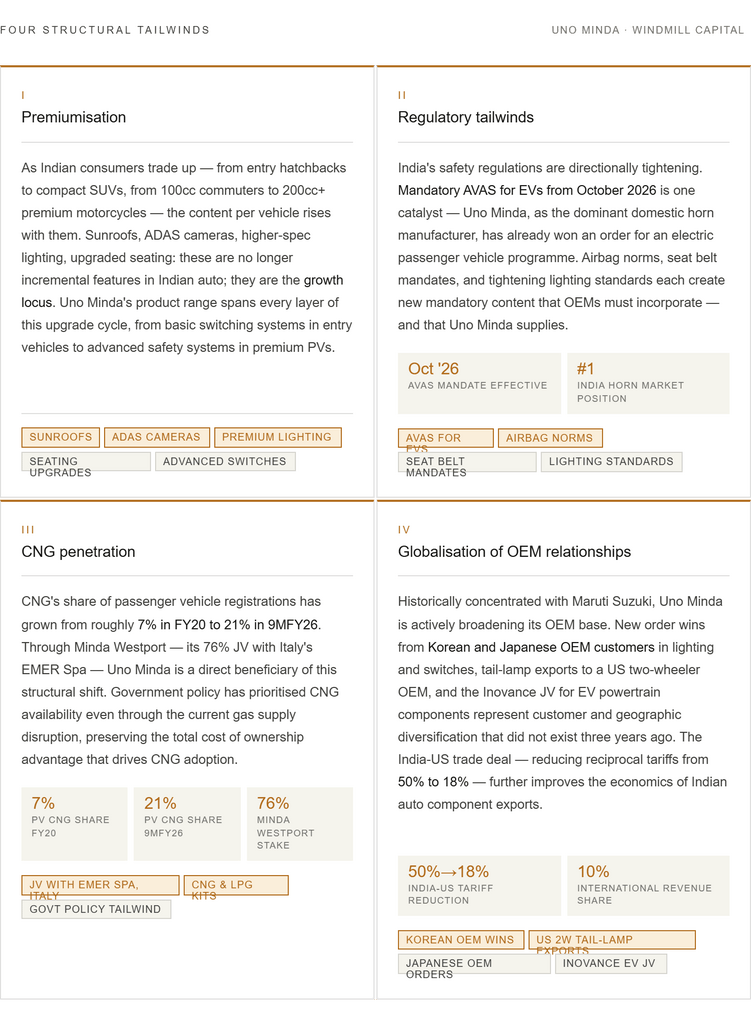
More than that, the EV transition is actively expanding Uno Minda’s addressable opportunity. A two-wheeler transitioning from ICE to EV is an opportunity for the company to grow its kit value from roughly one unit to seven or eight units, as the complexity of the vehicle’s electronic and safety systems increases. Mandatory acoustic vehicle alerting systems for EVs, effective from October 2026, create an entirely new demand category in the acoustics segment, where Uno Minda holds the domestic leadership position. And the push into high-voltage EV powertrain components represents a deliberate move into the one area of the transition where the company had no prior presence.
The pace question is where some caution is warranted. The company’s CNG kit business benefits from the other side of the energy transition, the continued strong adoption of CNG in passenger vehicles, where penetration has risen from roughly 7% in FY20 to approximately 21% of registrations in the first nine months of FY26. CNG and EV are not mutually exclusive in the Indian market; both are growing simultaneously, and Uno Minda captures revenue from both.
Quarterly numbers: what’s cooking?
Q3FY26 was operationally clean. Revenue grew 20% year-on-year to ₹5,018 crore, with all six segments posting double-digit growth: Castings at 26%, Seating at 32%, Switches at 19%, and Acoustics recovering to 14% after several quarters of contraction. EBITDA grew 21% to ₹554 crore, with margins at 11.0%, up 11 basis points year-on-year.
Q4FY26 results are not yet in the public domain. The quarter carried into a more difficult operating environment: OEM export headwinds, gas supply disruption across the auto manufacturing ecosystem, and aluminium cost pressure arriving with a pass-through lag. How these played out in Uno Minda’s numbers and whether the new capacity additions began contributing meaningfully to volumes will be the key read when results are declared. More clarity will emerge then.
Near term risk – What Is Actually Weighing on the Stock
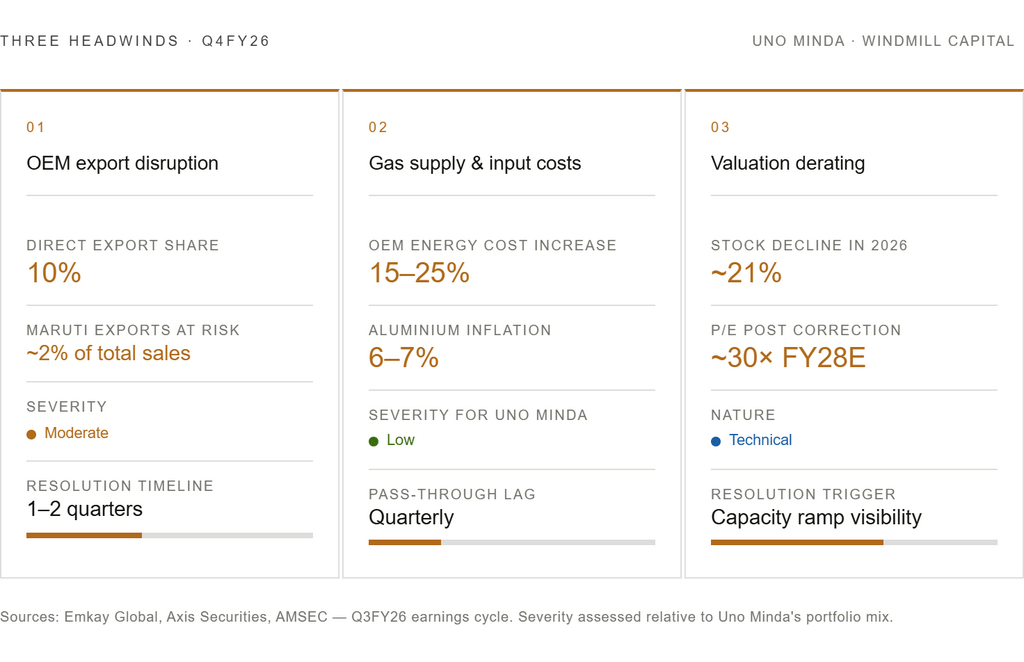
Three headwinds have converged on the Uno Minda narrative in early 2026, and disentangling them matters for assessing how much of the stock’s correction is fundamental versus temporary.
- OEM Export Exposure: Uno Minda’s direct export share is about 10% of revenues, not large enough to move the needle materially on its own. The indirect exposure is more significant: OEM customers, including Maruti Suzuki (whose exports form roughly 18% of its total volume), are pulling back shipments to West Asia and North Africa as shipping routes through the Strait of Hormuz become costlier and riskier. West Asia accounts for roughly 12.5% of Maruti’s exports, which translates to only about 2% of total Maruti sales. For Uno Minda, the impact on volumes is real but bounded, and the company’s broad OEM coverage across domestic-focused customers like TVS, Honda, and Hyundai India provides a natural buffer.
- Gas Supply Disruptions at OEMs: Geopolitical tensions have tightened industrial gas supply in India, affecting automotive paint shops and forging operations that rely on gas-based heating processes. Several OEMs are shifting from piped natural gas to spot LNG or alternative fuels, driving manufacturing costs up by an estimated 15–25%. In Uno Minda’s specific case, the impact is assessed as “low” by sector analysts; the portfolio skews toward lighting, electronics, switches, and alloy wheels, which are less gas-intensive than forging or casting operations at peers like Sansera Engineering or CIE Automotive. Aluminium price inflation, roughly 6-7%, is the more direct headwind, and that is largely passed through to OEMs with a quarterly to half-yearly lag.
- Valuation Derating: The third headwind is technical rather than operational. Uno Minda had been trading at a meaningful premium to the auto ancillary peer group; the market was pricing in both the content-per-vehicle growth story and the EV optionality simultaneously. At roughly 30× FY28 earnings post correction, that premium has compressed significantly. Whether this represents a fair re-rating or an overshoot depends on how quickly the near-term disruptions resolve and whether the medium-term capacity investments begin contributing to revenue.
Uno Minda’s underlying demand drivers, premiumisation, safety regulation, electrification, and content expansion have not changed. The company’s net debt-to-equity of approximately 0.33× is manageable given the capex pipeline. The OEM relationships that anchor 93% of revenue are not at risk from a geopolitical shipping disruption. The capex programme of ₹3,120 crore across 11 active projects is progressing on schedule, with multiple facilities expected to begin contributing through FY27.
What drives the long cycle – 4 forces that are not going away
Uno Minda’s business model has been constructed around a simple but durable idea: if you supply the parts that make a vehicle safe, comfortable, and functional, and you supply them across enough product lines, segments, and vehicle types, the automotive cycle becomes less important than the automotive content cycle.
The near-term headwinds, OEM export disruption, energy cost pressure, and valuation reset are real, and Q4FY26 is likely to reflect them. But none of them alters the mechanism by which Uno Minda grows: more vehicles, more content per vehicle, more regulatory mandates creating new content.
The company’s capacity additions, order book, and product expansion into alloy wheels, sunroofs, EV powertrain, and AVAS represent the next phase of that mechanism being built. We will continue to track developments as they unfold.
Disclaimer: Investment in securities market are subject to market risks. Read all the related documents carefully before investing. Registration granted by SEBI, membership of a SEBI recognized supervisory body (if any) and certification from NISM in no way guarantee performance of the intermediary or provide any assurance of returns to investors.
The content in these posts/articles is for informational and educational purposes only and should not be construed as professional financial advice and nor to be construed as an offer to buy /sell or the solicitation of an offer to buy/sell any security or financial products.Users must make their own investment decisions based on their specific investment objective and financial position and using such independent advisors as they believe necessary.
Windmill Capital Team: Windmill Capital Private Limited is a SEBI registered research analyst (Regn. No. INH200007645) based in Bengaluru at No 51 Le Parc Richmonde, Richmond Road, Shanthala Nagar, Bangalore, Karnataka – 560025 creating Thematic & Quantamental curated stock/ETF portfolios. Data analysis is the heart and soul behind our portfolio construction & with 50+ offerings, we have something for everyone. CIN of the company is U74999KA2020PTC132398. For more information and disclosures, visit our disclosures page here.


You may want to read
 Decoding Bull Markets: Why are they boring?
 Investing in India’s Real Estate Renaissance with Realty Tracker smallcase
 The Case for a Separate Global Equity Bucket