

Inflation, Interest Rates, and Your Money: Inside the RBI’s October 2026 Policy Pivot
Interest rates often look like numbers meant strictly for economists and financial markets. In reality, they quietly recalibrate every balance sheet in the economy, influencing whether you buy a home, take a loan, keep money in a fixed deposit, or allocate capital to bonds and equities.
That is why the Reserve Bank of India’s (RBI) latest monetary policy decision matters beyond the headline repo rate.
The Core Idea
On October 7, 2026, the RBI raised the policy repo rate by 25 basis points, from 5.25% to 5.50%, marking the first rate increase since February 2023. More importantly, the Monetary Policy Committee (MPC) shifted its official stance to “calibrated tightening,” signaling that controlling inflation has once again become its primary objective. Simultaneously, the RBI raised its FY2026-27 CPI inflation forecast to 5.2%, while upwardly revising its real GDP growth forecast to 7.1%.
1. What is Inflation and How is India Tracking It?
Inflation simply represents a sustained increase in the general price level of goods and services. If a basket of goods costing ₹100 today costs ₹105 a year later, the price level has increased by 5%. Your money hasn’t vanished, but its purchasing power has contracted; the same ₹100 buys fewer goods and services.
India primarily tracks consumer inflation through the Consumer Price Index (CPI), which reflects the true cost of living for urban and rural households. The latest official data prior to the October RBI meeting showed headline CPI inflation at 4.82% in August 2026 (up from 4.45% in July).
Inflation is rarely uniform across an economy:
- Food Inflation: Stood significantly higher at 5.95% from 5.52%.
- Rural vs. Urban: Rural CPI reached 5.23% from 4.84% in July, compared to 4.31% from 3.96% in July in urban areas
- Category Breakdown: Paan, tobacco & intoxicants recorded 7.34%, transport printed at 4.43%, clothing at 3.93%, while housing inflation remained subdued at 2.27%
Because inflation is non-uniform, central banks cannot react to a single volatile commodity price. Instead, they must evaluate whether price pressures are becoming broad-based and persistent across the broader macro basket.
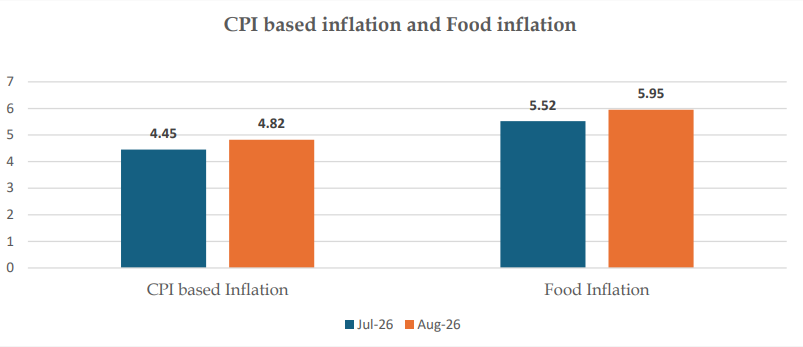
Source: All India General (Rural, Urban and Combined) group-wise indices and inflation for August, 2026
2. How Interest Rates Dampen Inflationary Demand
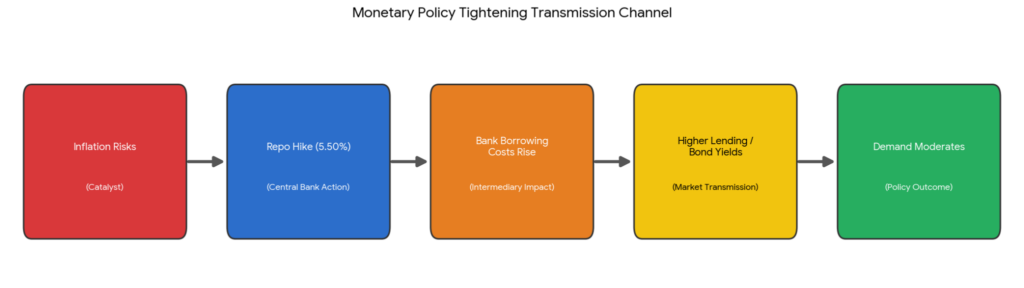
The RBI controls the policy repo rate, the rate at which it lends short-term funds to commercial banks against eligible securities. The repo rate dictates the overall cost of money in the financial ecosystem.
When the RBI hikes the repo rate, borrowing costs rise across the board:
- Households: Experience higher loan EMIs reduced disposable income lower aggregate consumption.
- Corporates: Face elevated borrowing costs deferred marginal Capex cooling aggregate demand.
- Financial Markets: Higher yields make fixed-income instruments more attractive relative to risk assets.
Monetary Policy is like the brakes to an overheating engine. While interest rates cannot fix external supply-side shocks, such as poor monsoons, agricultural disruptions, or global crude spikes, this kind of tightening stops short-term supply spikes from disrupting broader demand and increasing inflation expectations.
The RBI’s October decision came against a backdrop of elevated global oil prices, weather-related agricultural risks, and geopolitical uncertainties. However, economic growth remains strong, giving the central bank greater leeway to raise the cost of borrowing for consumers and businesses.
3. Why the RBI Became More Cautious
Monetary policy is inherently forward-looking. Rather than reacting solely to August’s 4.82% CPI reading, the MPC adjusted its policy settings to address where inflation is heading over the coming quarters.
| Parameter | Previous Projection | Revised October 2026 Decision |
| Policy Repo Rate | 5.25% | 5.50% (+25 bps) |
| Policy Stance | Accommodative / Neutral | Calibrated Tightening |
| FY27 CPI Inflation Forecast | 5.0% | 5.2% (Peaking ~6% in Q3) |
| FY27 Real GDP Growth Forecast | 6.7% | 7.1% (Q1 printed at 7.8%) |
Because real GDP growth remains resilient, the RBI found itself in a favorable policy window: it can front-load tightening to rein in persistent inflation risks without triggering an immediate growth collapse.
4. Impact on Borrowers and Savers
Borrowers & Homeowners
Lending rates tied to external benchmarks (EBLR) recalibrate quickly. Historical transmission data from the May 2022 to September 2024 tightening cycle showed that a 250 bps repo hike in 2022 drove a 170 bps increase in weighted average lending rates on fresh rupee loans and 118 bps on outstanding loans.
Case Study: The ₹50 Lakh Home Loan (20-Year Tenure)
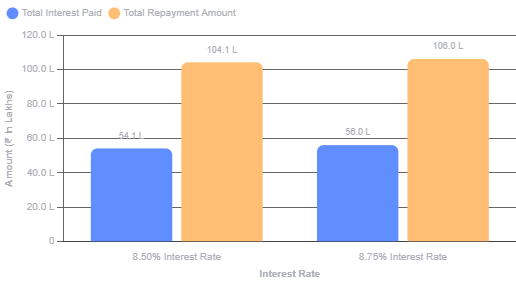
| Loan Parameter | Scenario A: Existing Rate | Scenario B: Revised Rate | Impact of 25 bps Hike |
| Loan Principal | ₹50,00,000 | ₹50,00,000 | Unchanged |
| Interest Rate (p.a.) | 8.50% | 8.75% | +0.25% (+25 bps) |
| Tenure | 20 Years (240 months) | 20 Years (240 months) | Unchanged |
| Monthly EMI | ₹43,391 | ₹44,186 | +₹795 / month |
| Total Interest Paid | ₹54,13,879 | ₹56,04,539 | +₹1,90,660 (~₹1.91 Lakh) |
| Total Repayment | ₹1,04,13,879 | ₹1,06,04,539 | +₹1,90,660 |
Savers & Fixed Income
While existing Fixed Deposits (FDs) remain locked at their contracted rates, new and renewing FDs benefit directly as banks compete for liquidity. Between May 2022 and September 2024, weighted average domestic term-deposit rates on fresh deposits rose by 251 bps (and 192 bps on outstanding deposits).
However, the impact on your money depends entirely on whether your cash is already locked in or ready to deploy:
Fresh vs. Outstanding Deposits
- Existing Fixed Deposits: Rates remain locked at contracted levels. A policy hike does not retroactively increase yields on active FDs until maturity.
- Fresh & Renewing Deposits: Receive the direct benefit. Historical transmission shows banks pass on nearly 100% of policy rate hikes to fresh term deposits over time.
5. Portfolio Strategy Across Asset Classes
A shift toward calibrated tightening fundamentally alters asset allocation dynamics:
- Bonds: Rising market yields depress existing bond prices (especially long-duration paper). However, newly deployed capital can lock in higher yields in short-to-medium duration instruments.
- Equities: Valuations face pressure from higher discount rates (due to higher Weighted Average Cost of Capital). Highly leveraged companies face rising interest costs, whereas debt-free companies with strong pricing power remain resilient.
- Banks & Financials: Profitability hinges on how quickly lending yields reprice compared to cost of funds. Historically, both lending and term deposit rates moved up significantly, benefiting institutions with strong low-cost CASA bases.
- Gold: High real interest rates increase the opportunity cost of holding non-yielding gold, creating short-term headwinds unless offset by geopolitical risk or safe-haven demand.
Final takeaway
The most important message from the RBI’s October 2026 policy is not that interest rates have risen by 25 basis points. It is that the balance of risks has changed.
India is no longer dealing with an environment where the central bank can comfortably assume that inflation will continue moving lower. August CPI inflation was already 4.82%, food inflation was 5.95%, and the RBI has now raised its FY27 inflation forecast to 5.2%. At the same time, economic growth remains strong, with the central bank projecting 7.1% growth for FY27.
That combination gives the RBI room to prioritise inflation without having to sacrifice a weak economy.
For households, the message is straightforward: borrowers should prepare for the possibility of higher financing costs, while savers may gradually find better returns on new deposits and short-duration fixed income.
For investors, however, the lesson is more nuanced.
Higher rates do not make one asset class good and another bad. They change the relative attractiveness of different cash flows.
Disclaimer: Investment in securities market are subject to market risks. Read all the related documents carefully before investing. Registration granted by SEBI, membership of a SEBI recognized supervisory body (if any) and certification from NISM in no way guarantee performance of the intermediary or provide any assurance of returns to investors.
The content in these posts/articles is for informational and educational purposes only and should not be construed as professional financial advice and nor to be construed as an offer to buy /sell or the solicitation of an offer to buy/sell any security or financial products.Users must make their own investment decisions based on their specific investment objective and financial position and using such independent advisors as they believe necessary.
Windmill Capital Team: Windmill Capital Private Limited is a SEBI registered research analyst (Regn. No. INH200007645) based in Bengaluru at No 51 Le Parc Richmonde, Richmond Road, Shanthala Nagar, Bangalore, Karnataka – 560025 creating Thematic & Quantamental curated stock/ETF portfolios. Data analysis is the heart and soul behind our portfolio construction & with 50+ offerings, we have something for everyone. CIN of the company is U74999KA2020PTC132398. For more information and disclosures, visit our disclosures page here.


You may want to read
 US Suspends PERM Processing for 8 Tech Firms: Impact on Indian IT
 Inside HNI Prime Growth at a Fair Price Asset Allocation smallcase
 4 interesting questions asked during our Bengaluru Meetup