

The Case for a Separate Global Equity Bucket
Many investors believe they are diversified if they own twenty or thirty stocks. However, if all those stocks are Indian companies, that only addresses part of the issue.
Two kinds of risk, only one of which more stocks can fix
Each stock comes with two types of risk. The first is specific to the company, like poor management, a failed product, or a factory fire. If you own enough different companies, this risk tends to even out, since one company’s problems usually don’t affect the others.
The second type of risk affects the entire market you invest in, such as a recession, an interest rate increase, or a policy change. Adding more domestic stocks won’t solve this, because it’s not about individual companies. It’s about the whole market moving together.
In 1974, Bruno Solnik published a paper that measured this effect. He studied eight countries and found that adding more domestic stocks only reduced risk up to a point, levelling off at about a quarter to a third of the risk of a single stock. However, spreading investments across different countries lowered that risk floor to around ~12%. Since recessions, interest rate cycles, and inflation do not happen at the same time everywhere, some risks that can’t be avoided in one market become manageable when you invest internationally. This is why international equity deserves a dedicated place in your portfolio, not just as an afterthought.
Why international equity deserves its own bucket
This is where many investors make a mistake: they treat all “equity” as one category and stop there. But domestic and international equity are not just the same thing with different names. They are different in at least three important ways:
Country- and economic-cycle dynamics: India, the US, and Europe do not experience recessions or recoveries simultaneously. When one economy is slowing down, another might be picking up speed.
Sector mix: India’s stock market is focused on financial and consumer companies. Developed markets offer greater exposure to technology, healthcare innovation, and industrial sectors, which are less prominent in India.
Monetary regime: The US Federal Reserve, the European Central Bank, and the RBI change interest rates at different times and for different reasons. This means foreign stocks have a different kind of interest rate risk.
Since these factors move independently from what happens in India, international equity acts differently from domestic equity. It makes sense to treat it as a separate part of your portfolio rather than combining everything under “equity,” as if a single market represents them all.
What the numbers actually show (2005–2026)
We tested this idea using daily data for MSCI India, MSCI World, and Gold from 3 January 2005 to 25 August 2026. This period covers about 21.6 years, including the 2008 crisis, the 2013 taper tantrum, COVID, and more. We looked at four simple portfolios, each bought once and held without rebalancing:
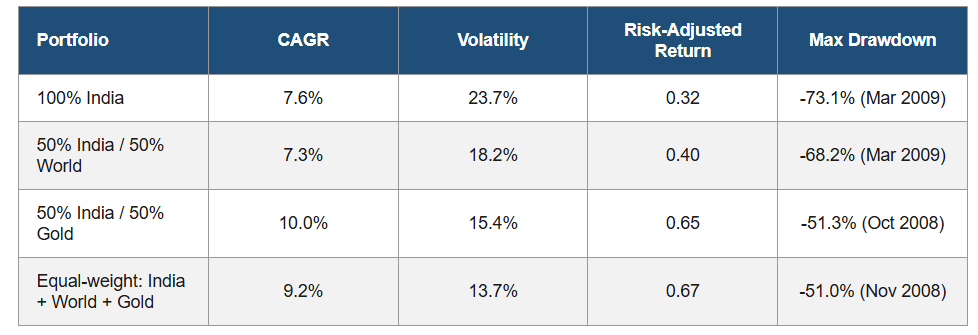
A few key points stand out in the results. When you add international equity (India + World), volatility drops from 23.7% to 18.2%, and the risk-adjusted return goes up from 0.32 to 0.40. That’s a real improvement. But the drawdown barely changes, moving from -73.1% to -68.2%. This happens because, in a true global crisis like 2008, stock markets everywhere tend to fall at the same time. International equity helps spread out economic risks, but it can’t fully protect you from a worldwide downturn.
If you swap international equity for gold (India + Gold), the results improve further. Volatility drops, the risk-adjusted return rises, and the maximum drawdown improves. Gold doesn’t follow the same cycles as stocks, whether in India or globally, so it usually holds up when stock markets are falling everywhere.
When you combine all three—India, World, and Gold—in equal parts, you get more than just an average. This mix has the highest risk-adjusted return of the four portfolios (0.67) and the smallest maximum drawdown (-51.0%), which is even better than the India + Gold blend. No two-way combination can match this result. To get the best risk-adjusted outcome and the smallest losses during tough times, you need both a separate international equity portion and a separate non-equity portion.
This isn’t just because we picked a specific 21-year window to measure.
If you run the same comparison on rolling 1-year, 3-year, and 5-year periods, the equal-weight India + World + Gold portfolio still has the highest risk-adjusted return every time.
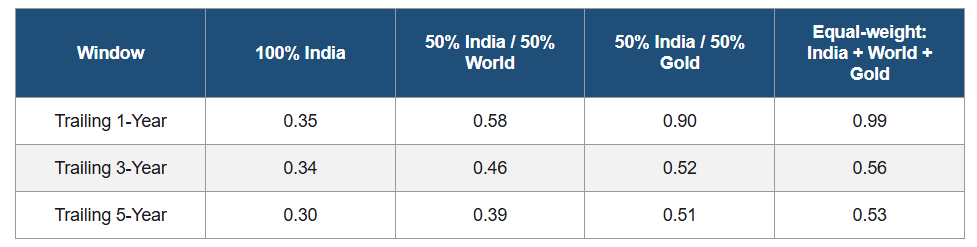
The equal-weight India + World + Gold portfolio has the highest risk-adjusted return among the four in every window, while standalone India has the lowest. The ranking holds however you slice the timeframe, not just when you measure it start to finish.
The takeaway
Think of your portfolio as at least three separate buckets: domestic equity, international equity, and a true non-equity diversifier, such as gold. Each one serves a different purpose. Domestic equity captures your home market’s growth. International equity spreads your investments across countries, currencies, sectors, and interest rate cycles that don’t always move with your home market. Gold protects you from the risk that no amount of equity diversification, whether domestic or global, can fully remove: the risk of all stock markets falling at the same time.
The data makes it clear: over more than twenty years, the portfolio that combined all three had a higher CAGR than India alone, with about half the volatility and a smaller worst-case drawdown. That’s not just a small improvement. It’s the difference between a portfolio dropping 51% in a crisis and one dropping 73%.
Disclaimer: Investment in securities market are subject to market risks. Read all the related documents carefully before investing. Registration granted by SEBI, membership of a SEBI recognized supervisory body (if any) and certification from NISM in no way guarantee performance of the intermediary or provide any assurance of returns to investors.
The content in these posts/articles is for informational and educational purposes only and should not be construed as professional financial advice and nor to be construed as an offer to buy /sell or the solicitation of an offer to buy/sell any security or financial products.Users must make their own investment decisions based on their specific investment objective and financial position and using such independent advisors as they believe necessary.
Windmill Capital Team: Windmill Capital Private Limited is a SEBI registered research analyst (Regn. No. INH200007645) based in Bengaluru at No 51 Le Parc Richmonde, Richmond Road, Shanthala Nagar, Bangalore, Karnataka – 560025 creating Thematic & Quantamental curated stock/ETF portfolios. Data analysis is the heart and soul behind our portfolio construction & with 50+ offerings, we have something for everyone. CIN of the company is U74999KA2020PTC132398. For more information and disclosures, visit our disclosures page here.


You may want to read
 US Tariffs Rattle Global Markets, Strain Economies
 The Rise and Promise of Affordable Housing Finance in India
 Strategic Analysis: The Persistent-Nagarro $2.9 Billion AI Consolidation