

Reading RIL’s FY26 Report Card & Why it Matters to You

Reliance Industries Limited (RIL) closed FY26 with record revenue and profit, yet its March quarter (Q4) showed clear stress in the oil and gas businesses. Disruptions linked to the Strait of Hormuz exposed how quickly external shocks can hit the largest conglomerate in India by market m-cap (₹19.87 lakh crore).
And that’s why the focus is on one company. Because RIL is more than a stock ticker. Its segment-by-segment performance moves the index earnings and sets the tone for sentiment across sectors.
Let’s get into it.
The Big Picture: Strong Year, Soft Quarter
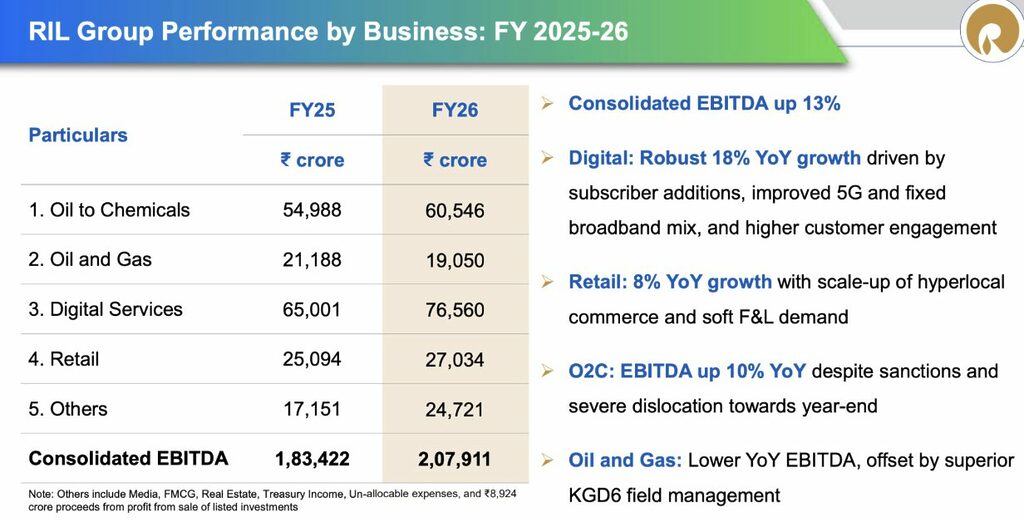
For FY26 as a whole, RIL’s consolidated revenue climbed about 9.8% year-on-year to roughly ₹11.76 lakh crore, with profit after tax rising around 18% to about ₹95,600 crore. Operating profit (EBITDA) for the year grew 13.4% to nearly ₹2.08 lakh crore, powered mainly by Digital Services (Jio) and Retail. RIL also became the first Indian company to cross the $10 billion annual profit mark.
Source: RIL Investor Deck
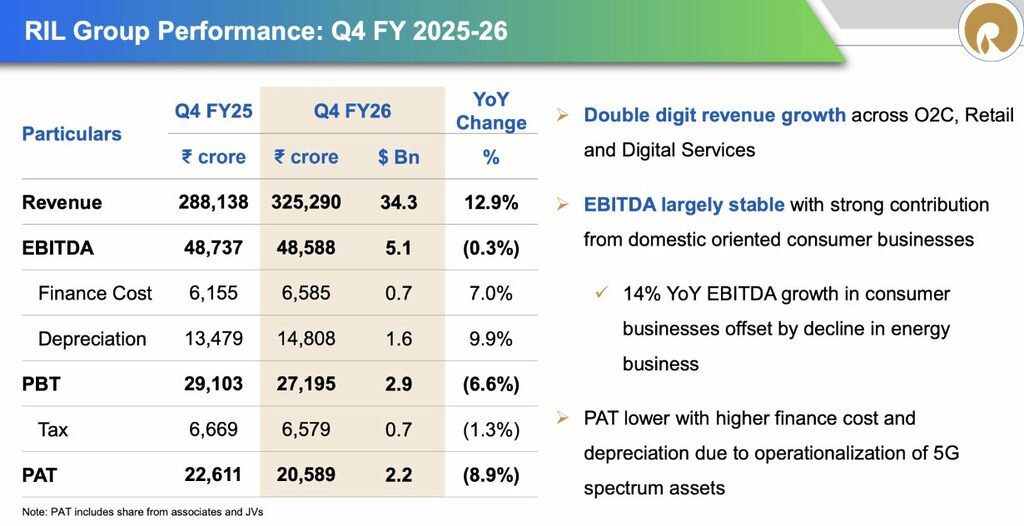
The Q4 print read differently. Gross revenue rose 12.9% year-on-year to ₹3,25,290 crore, and revenue from operations grew 13% to ₹2,98,621 crore. EBITDA was nearly flat at ₹48,588 crore, against ₹48,737 crore in the same quarter last year. Net profit declined 12.55% year-on-year to ₹16,971 crore, and was 8.97% lower sequentially. EBITDA margin compressed to 14.9% from 16.9% a year ago, a 200-basis-point reduction.
Source: RIL Investor Deck
How the Earnings Pie is Split
RIL now earns from several large verticals: Oil-to-Chemicals (O2C), Oil & Gas (upstream), Digital Services (Jio), Retail and a small contribution from other businesses. The FY26 segment numbers give a good sense of where profits actually come from.
Segment-wise Snapshot
Source: RIL Investor Deck
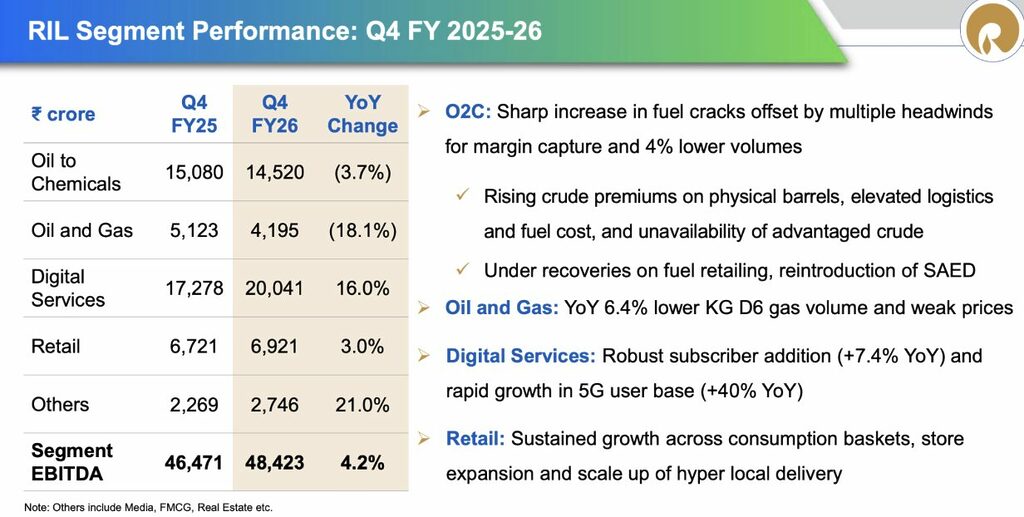
Taken together, Jio and Retail now contribute more than half of RIL’s EBITDA, which gives the group a more consumer- and digital-heavy earnings profile than a pure oil major. O2C still dominates revenue, yet the profit engine is more balanced across segments than it was a decade ago.
The O2C Scenario
The oil-to-chemicals business sits at the heart of RIL’s traditional franchise. In FY26, O2C delivered record revenue of about ₹6.62 lakh crore and EBITDA of over ₹60,500 crore, supported by strong global demand for transport fuels and refining spreads.
In Q4 FY26, O2C revenue rose 12.4% year-on-year to roughly ₹1.85 lakh crore. EBITDA for the quarter, however, slipped 3.7% to about ₹14,520 crore, and the margin narrowed to 7.9%.
Several forces drove this:
- Crude oil prices jumped as the Middle East conflict intensified and supply routes through the Strait of Hormuz faced disruption.
- Physical crude premiums, freight and insurance costs went up, raising the landing cost of feedstock.
- The government reintroduced export duties on diesel and aviation turbine fuel, which limited the benefit from strong global fuel cracks.
RIL diverted some streams towards liquefied petroleum gas (LPG) and domestic fuel supplies, which supported Indian energy security but limited export-led profit. It also cut output of alkylates and diverted feedstock to ramp up production of LPG as India battles shortages of the cooking fuel due to the global situation.
In simple terms, the quarter saw high demand for fuels and strong benchmark refining margins, yet costs and policy headwinds reduced what RIL could retain as profit.
Oil & Gas: Still Profitable, Now Under Pressure
RIL’s upstream Oil & Gas segment is much smaller than O2C, yet it has historically delivered high margins thanks to the KG-D6 gas field (its major offshore natural gas field in the Bay of Bengal) and coal bed methane assets. For FY26, this segment recorded revenue of around ₹23,861 crore and EBITDA of about ₹19,050 crore, both lower than the previous year.
In Q4 FY26, Oil & Gas revenue declined 8.9% year-on-year to about ₹5,867 crore, while EBITDA fell 18.1%. The main issues were lower gas production volumes and weaker realised prices in some contracts. This segment still earns healthy margins on an absolute basis, although it no longer acts as a growth engine in the way Jio and Retail do.
Jio: Digital Cash Flows at Scale
Digital Services, led by Jio, continued to deliver double-digit growth.
In Q4 FY26 alone, operating revenue grew 12.6% year-on-year to ₹38,259 crore, and EBITDA climbed 17.9% to ₹20,060 crore. Average revenue per user (ARPU) reached roughly ₹214, helped by 5G adoption, broadband growth and richer data usage. The subscriber base crossed 520 million, with a large and rising portion on 5G.
For investors, Jio’s role is important because it brings recurring, subscription-like cash flows into what was once an energy-heavy group. This helps smooth out some of the volatility from the oil business.
Retail: Building a Consumer Flywheel
Retail, much like Jio, broadens RIL’s earnings. It ties the group to India’s consumption story, a sought-after investment theme.
This segment is now one of India’s largest consumer platforms, spanning supermarkets, fashion, electronics, e-commerce and quick commerce.
In Q4 FY26, Retail reported gross revenue of around ₹98,232 crore, a growth of about 11% year-on-year, while EBITDA increased 3.1% to ₹6,921 crore. Margins were slightly softer as the company invested in hyperlocal and omni-channel formats, but customer metrics stayed strong – store count crossed 20,000 and registered customers stood near 387 million.
How Management Sees the Road Ahead
Management commentary at the analyst meeting indicated that FY27 capital expenditure is expected to land between ₹1.5 lakh crore and ₹1.6 lakh crore. The spend is directed at O2C, new energy projects including solar module and cell manufacturing, battery manufacturing, renewable capacity at Kutch, and data centres.
The Jio IPO, described in the earnings call as “fairly imminent,” is now expected to be filed in the second half of FY27, with the timeline pushed back due to the West Asia conflict. Early reports suggest a 2.5% to 3% stake sale that could raise close to ₹37,500 crore, with a valuation between $120 billion and $170 billion for the digital business.
RIL used its high-complexity refineries and diversified crude sourcing to keep utilisation high. The company also ramped up LPG and prioritised domestic fuel supply through its Jio-bp outlets, aligning with India’s energy security goals.
How Does All This Matter to You?
Reliance commands a 9.81% weight in the Nifty 50, the highest of any constituent. Thus, a 1% move in the Reliance share price translates into roughly 10 basis points of movement on the Nifty 50 on its own.
| Metric | Value |
| Weight in Nifty 50 | 9.81% |
| Weight in Nifty Oil & Gas Index | 31% |
| Weight in Nifty Energy Index | 8.73% |
| Weight in Nifty Manufacturing Index | 4.66% |
Source: NSE Index Factsheet
Because the company operates in energy, telecom, retail and now renewables, its commentary offers clues on:
- Global oil price trends and refining margins
- Domestic data usage and telecom pricing
- Organised retail demand in urban and semi-urban markets
- Corporate capex appetite and funding conditions
To Wrap Up
RIL’s FY26 results offer a broader lesson about how Indian companies navigate a world where geopolitics rules earnings inputs.
For investors thinking about portfolio construction, the FY26 reading offers a structural takeaway:
- Concentration in a single sector can expose portfolios to sharp shocks, especially from supply chain disruptions and commodity price swings.
- Diversification across themes—energy, consumption, technology, financials, manufacturing—helps balance such risks.
- A mix of sectors ensures that weakness in one pocket doesn’t drag down the entire portfolio.
Looking to Diversify Across Themes?
The Reliance FY26 chapter is one company’s experience of a single financial year. The reading lens applies more broadly across the Indian market.
Platforms like smallcase offer expert-curated portfolios spanning sectors, themes, and strategies. Click here to explore smallcase.
Disclaimer: This analysis is for educational purposes and does not constitute investment advice. Market conditions can change, and past performance is not indicative of future results. Investors should conduct their own research and/or consult a certified financial advisor before making investment decisions.


You may want to read
 Launching Windmill Capital’s Global smallcases
 Tips Music Is Turning Yesterday’s Hits Into Today’s Profits
 How Phoenix Mills Built a ₹16,500 Crore Mall Business by Letting the Rent Lag Behind the Sales